
Join Our JEE Preparation Group
Prep with like-minded aspirants; Get access to free daily tests and study material.
Sign in
Please select an account to continue using cracku.in
↓ →
Join Our JEE Preparation Group
Prep with like-minded aspirants; Get access to free daily tests and study material.
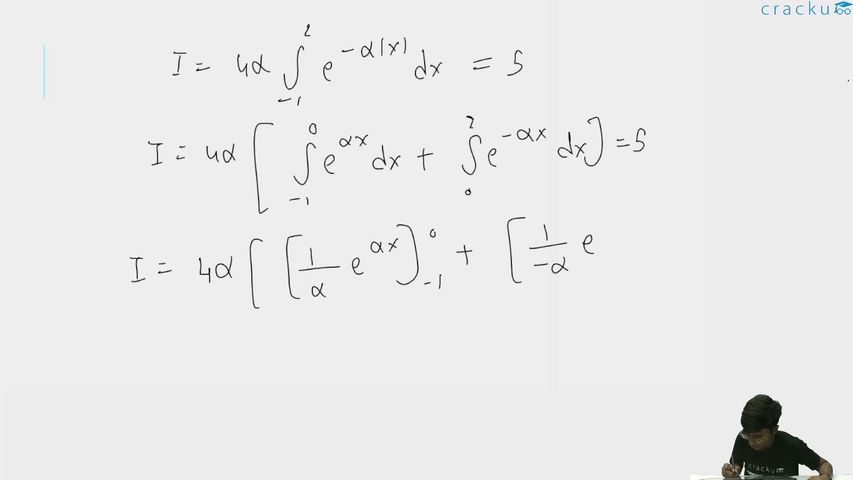
The value of $$\alpha$$ for which $$4\alpha \int_{-1}^{2} e^{-\alpha|x|}dx = 5$$, is
We start from the given condition
$$4\alpha \int_{-1}^{2} e^{-\alpha|x|}\,dx \;=\;5.$$
To evaluate the integral we must remove the absolute‐value sign. For $$x<0$$ we have $$|x|=-x$$, whereas for $$x\ge 0$$ we have $$|x|=x$$. Therefore we split the integral at the point $$x=0$$:
$$\int_{-1}^{2} e^{-\alpha|x|}\,dx =\int_{-1}^{0} e^{-\alpha(-x)}\,dx+\int_{0}^{2} e^{-\alpha x}\,dx =\int_{-1}^{0} e^{\alpha x}\,dx+\int_{0}^{2} e^{-\alpha x}\,dx.$$
We now compute each part in turn.
First part:
Using the fact that $$\int e^{kx}\,dx=\dfrac{1}{k}e^{kx},$$ with $$k=\alpha,$$ we get
$$\int_{-1}^{0} e^{\alpha x}\,dx =\left.\frac{1}{\alpha}e^{\alpha x}\right|_{x=-1}^{x=0} =\frac{1}{\alpha}\left(e^{0}-e^{-\alpha}\right) =\frac{1}{\alpha}(1-e^{-\alpha}).$$
Second part:
Again applying $$\int e^{kx}\,dx=\dfrac{1}{k}e^{kx},$$ but now with $$k=-\alpha,$$ we have
$$\int_{0}^{2} e^{-\alpha x}\,dx =\left.-\frac{1}{\alpha}e^{-\alpha x}\right|_{x=0}^{x=2} =-\frac{1}{\alpha}\left(e^{-2\alpha}-e^{0}\right) =\frac{1}{\alpha}(1-e^{-2\alpha}).$$
Adding both parts, the complete integral becomes
$$\int_{-1}^{2} e^{-\alpha|x|}\,dx =\frac{1}{\alpha}(1-e^{-\alpha})+\frac{1}{\alpha}(1-e^{-2\alpha}) =\frac{1}{\alpha}\left[2-e^{-\alpha}-e^{-2\alpha}\right].$$
Substituting this result into the original equation gives
$$4\alpha\;\times\;\frac{1}{\alpha}\left[2-e^{-\alpha}-e^{-2\alpha}\right]=5,$$ so that $$4\left[2-e^{-\alpha}-e^{-2\alpha}\right]=5.$$
Expanding the left side:
$$8-4e^{-\alpha}-4e^{-2\alpha}=5.$$ Now we isolate the exponential terms:
$$8-5=4e^{-\alpha}+4e^{-2\alpha},$$ so $$3=4\left(e^{-\alpha}+e^{-2\alpha}\right).$$
Dividing both sides by $$4$$, we obtain
$$\frac{3}{4}=e^{-\alpha}+e^{-2\alpha}.$$
For convenience let $$y=e^{-\alpha}.$$ Since an exponential is always positive, $$y>0$$. Rewriting the equation in terms of $$y$$ we get
$$y+y^{2}=\frac{3}{4}.$$
Bringing all terms to one side gives a quadratic equation:
$$y^{2}+y-\frac{3}{4}=0.$$
Multiplying by $$4$$ to clear the fraction,
$$4y^{2}+4y-3=0.$$
We solve this quadratic using the quadratic formula $$y=\dfrac{-b\pm\sqrt{b^{2}-4ac}}{2a}$$ with $$a=4,\;b=4,\;c=-3.$$ Thus
$$y=\frac{-4\pm\sqrt{16+48}}{8} =\frac{-4\pm\sqrt{64}}{8} =\frac{-4\pm8}{8}.$$
This yields two values:
$$y=\frac{-4+8}{8}=\frac{4}{8}=\frac12,\quad\text{or}\quad y=\frac{-4-8}{8}=\frac{-12}{8}=-\frac32.$$
Because $$y=e^{-\alpha}>0,$$ the negative root is inadmissible, leaving
$$y=\frac12.$$
Hence
$$e^{-\alpha}=\frac12.$$
Taking the natural logarithm on both sides and using $$\ln e^{k}=k,$$ we get
$$-\alpha=\ln\left(\frac12\right)=-\ln 2,$$ so
$$\alpha=\ln 2.$$
Therefore the value of $$\alpha$$ is $$\log_e 2$$, which corresponds to Option A.
Hence, the correct answer is Option A.
Was this solution helpful?
Click on the Email ☝️ to Watch the Video Solution
Create a FREE account and get:
_1.webp)

Educational materials for JEE preparation

Ask our AI anything

AI can make mistakes. Please verify important information.
AI can make mistakes. Please verify important information.
