
Join Our JEE Preparation Group
Prep with like-minded aspirants; Get access to free daily tests and study material.
Sign in
Please select an account to continue using cracku.in
↓ →
Join Our JEE Preparation Group
Prep with like-minded aspirants; Get access to free daily tests and study material.
The value of $$c$$, in the Lagrange's mean value theorem for the function $$f(x) = x^3 - 4x^2 + 8x + 11$$, when $$x \in [0, 1]$$, is
For applying Lagrange’s Mean Value Theorem we start with its statement: for a function which is continuous on a closed interval $$[a,b]$$ and differentiable on the open interval $$(a,b)$$, there exists at least one point $$c \in (a,b)$$ such that
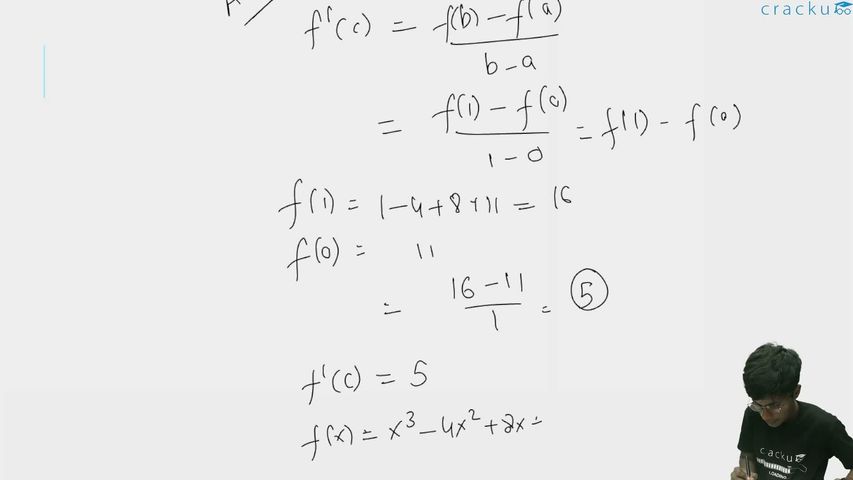
$$f'(c)=\dfrac{f(b)-f(a)}{b-a}.$$
Here we have $$f(x)=x^{3}-4x^{2}+8x+11$$ defined on $$[0,1]$$, so we take $$a=0$$ and $$b=1$$. The given polynomial is continuous and differentiable everywhere, hence all the conditions are satisfied.
First we compute the values of the function at the endpoints:
$$\begin{aligned} f(1) &= 1^{3}-4(1)^{2}+8(1)+11 \\ &= 1-4+8+11 \\ &= 16, \\ f(0) &= 0^{3}-4(0)^{2}+8(0)+11 \\ &= 11. \end{aligned}$$
Now the average rate of change (the slope of the chord) on $$[0,1]$$ is
$$\dfrac{f(1)-f(0)}{1-0}=\dfrac{16-11}{1}=5.$$
Next we find the derivative of the function:
$$\begin{aligned} f(x)&=x^{3}-4x^{2}+8x+11,\\ f'(x)&=3x^{2}-8x+8. \end{aligned}$$
By the theorem, at the required point $$c$$ we must have
$$f'(c)=5.$$
So we set
$$3c^{2}-8c+8=5.$$
Bringing all terms to one side gives
$$3c^{2}-8c+8-5=0,$$
which simplifies to
$$3c^{2}-8c+3=0.$$
We solve this quadratic equation. The quadratic formula states that for $$Ax^{2}+Bx+C=0$$ the roots are
$$x=\dfrac{-B\pm\sqrt{B^{2}-4AC}}{2A}.$$
Here $$A=3,\;B=-8,\;C=3$$, so
$$\begin{aligned} c &=\dfrac{-(-8)\pm\sqrt{(-8)^{2}-4\cdot3\cdot3}}{2\cdot3}\\ &=\dfrac{8\pm\sqrt{64-36}}{6}\\ &=\dfrac{8\pm\sqrt{28}}{6}. \end{aligned}$$
Because $$\sqrt{28}=2\sqrt{7}$$, this becomes
$$c=\dfrac{8\pm2\sqrt{7}}{6}=\dfrac{4\pm\sqrt{7}}{3}.$$
Thus we obtain two possible values:
$$c_{1}=\dfrac{4+\sqrt{7}}{3},\qquad c_{2}=\dfrac{4-\sqrt{7}}{3}.$$
We now check which of these lies inside the open interval $$(0,1)$$:
$$\begin{aligned} c_{1}&=\dfrac{4+\sqrt{7}}{3}\approx\dfrac{4+2.6458}{3}\approx2.215\; >1,\\ c_{2}&=\dfrac{4-\sqrt{7}}{3}\approx\dfrac{4-2.6458}{3}\approx0.451\; \in(0,1). \end{aligned}$$
Only $$c=\dfrac{4-\sqrt{7}}{3}$$ satisfies $$0<c<1$$, so this is the required point ensured by Lagrange’s Mean Value Theorem.
Hence, the correct answer is Option B.
Was this solution helpful?
Click on the Email ☝️ to Watch the Video Solution
Create a FREE account and get:
_1.webp)

Educational materials for JEE preparation

Ask our AI anything

AI can make mistakes. Please verify important information.
AI can make mistakes. Please verify important information.
