
Join Our JEE Preparation Group
Prep with like-minded aspirants; Get access to free daily tests and study material.
Sign in
Please select an account to continue using cracku.in
↓ →
Join Our JEE Preparation Group
Prep with like-minded aspirants; Get access to free daily tests and study material.
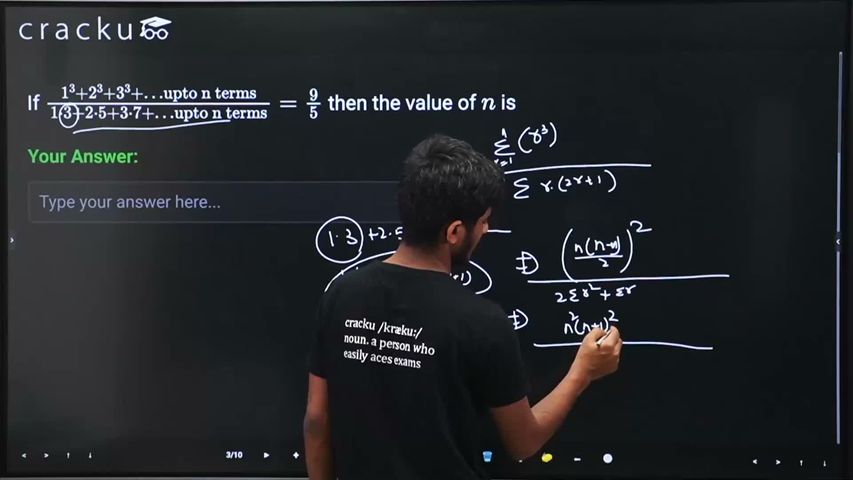
If $$\frac{1^3 + 2^3 + 3^3 + \ldots \text{upto n terms}}{1 \cdot 3 + 2 \cdot 5 + 3 \cdot 7 + \ldots \text{upto n terms}} = \frac{9}{5}$$ then the value of $$n$$ is
Correct Answer: 5
We start with the equation $$\frac{1^3 + 2^3 + 3^3 + \cdots + n^3}{1 \cdot 3 + 2 \cdot 5 + 3 \cdot 7 + \cdots \text{ (n terms)}} = \frac{9}{5}$$.
Using the well-known formula for the sum of cubes, one finds that
$$1^3 + 2^3 + \cdots + n^3 = \left[\frac{n(n+1)}{2}\right]^2$$.
On the other hand, the general term of the denominator is $$k(2k+1)$$ for $$k = 1,2,\ldots,n$$, so
$$\sum_{k=1}^{n} k(2k+1) = 2\sum_{k=1}^{n}k^2 + \sum_{k=1}^{n}k$$
which becomes
$$2\cdot\frac{n(n+1)(2n+1)}{6} + \frac{n(n+1)}{2} = \frac{n(n+1)(2n+1)}{3} + \frac{n(n+1)}{2}$$
and hence
$$\frac{n(n+1)}{6}\bigl[2(2n+1)+3\bigr] = \frac{n(n+1)(4n+5)}{6}$$.
Substituting these results into the original equation gives
$$\frac{\left[\frac{n(n+1)}{2}\right]^2}{\frac{n(n+1)(4n+5)}{6}} = \frac{9}{5}$$
which simplifies to
$$\frac{n^2(n+1)^2}{4}\times\frac{6}{n(n+1)(4n+5)} = \frac{9}{5} \quad\Longrightarrow\quad \frac{3n(n+1)}{2(4n+5)} = \frac{9}{5}$$.
Cross-multiplying leads to
$$15n(n+1) = 18(4n+5)$$
or equivalently
$$15n^2 + 15n = 72n + 90 \quad\Longrightarrow\quad 15n^2 - 57n - 90 = 0$$.
Dividing by 3 simplifies this to
$$5n^2 - 19n - 30 = 0$$
and application of the quadratic formula gives
$$n = \frac{19 \pm \sqrt{361+600}}{10} = \frac{19 \pm \sqrt{961}}{10} = \frac{19 \pm 31}{10}$$.
Since $$n$$ must be a positive integer, one obtains
$$n = \frac{19 + 31}{10} = \frac{50}{10} = 5$$.
Therefore, the correct answer is 5.
Was this solution helpful?
Click on the Email ☝️ to Watch the Video Solution
Create a FREE account and get:
_1.webp)

Educational materials for JEE preparation

Ask our AI anything

AI can make mistakes. Please verify important information.
AI can make mistakes. Please verify important information.
