
Join Our JEE Preparation Group
Prep with like-minded aspirants; Get access to free daily tests and study material.
Sign in
Please select an account to continue using cracku.in
↓ →
Join Our JEE Preparation Group
Prep with like-minded aspirants; Get access to free daily tests and study material.
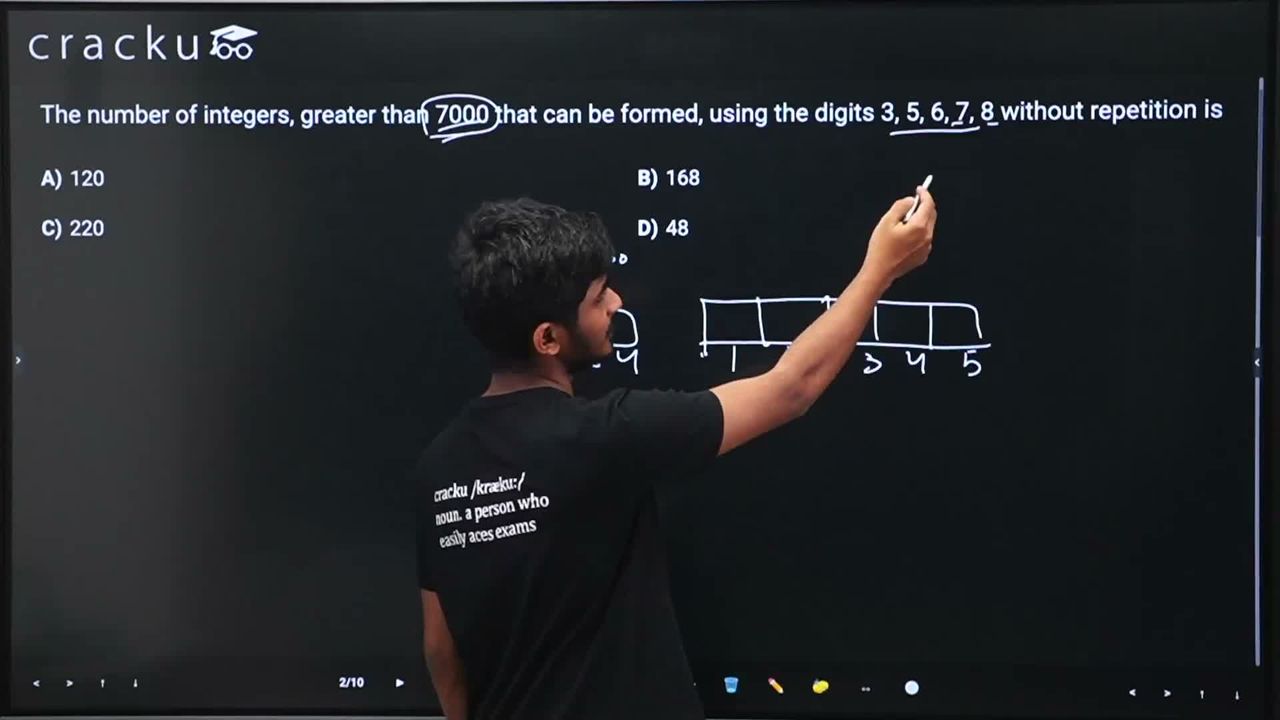
The number of integers, greater than 7000 that can be formed, using the digits 3, 5, 6, 7, 8 without repetition is
We need integers greater than 7000 using digits 3, 5, 6, 7, 8 without repetition.
These can be 4-digit numbers (> 7000) or 5-digit numbers.
5-digit numbers: All 5-digit numbers formed using 3, 5, 6, 7, 8 without repetition are greater than 7000.
Count = $$5! = 120$$
4-digit numbers greater than 7000:
The first digit must be 7 or 8 (to make the number ≥ 7000).
First digit = 7: Remaining 3 digits chosen from {3, 5, 6, 8} in $$4 \times 3 \times 2 = 24$$ ways. But we need numbers > 7000, and any 4-digit number starting with 7 is ≥ 7000. Since 7000 itself can't be formed (no 0), all such numbers are > 7000.
Count = $$P(4,3) = 24$$
First digit = 8: Remaining 3 digits chosen from {3, 5, 6, 7} in $$4 \times 3 \times 2 = 24$$ ways.
Count = $$P(4,3) = 24$$
Total 4-digit numbers = $$24 + 24 = 48$$
Total = 120 + 48 = 168
The correct answer is Option 2: 168.
Click on the Email ☝️ to Watch the Video Solution
Create a FREE account and get:
_1.webp)

Educational materials for JEE preparation

Ask our AI anything

AI can make mistakes. Please verify important information.
AI can make mistakes. Please verify important information.


