
Join Our JEE Preparation Group
Prep with like-minded aspirants; Get access to free daily tests and study material.
Sign in
Please select an account to continue using cracku.in
↓ →
Join Our JEE Preparation Group
Prep with like-minded aspirants; Get access to free daily tests and study material.
The set of all real values of $$\lambda$$ for which the function $$f(x) = (1 - \cos^2 x) \cdot (\lambda + \sin x)$$, $$x \in \left(-\frac{\pi}{2}, \frac{\pi}{2}\right)$$, has exactly one maxima and exactly one minima, is:
We have the function
$$f(x)=\bigl(1-\cos^2x\bigr)\,(\lambda+\sin x),\qquad x\in\left(-\dfrac{\pi}{2},\dfrac{\pi}{2}\right),\qquad\lambda\in\mathbb R.$$
Because the Pythagorean identity says $$\sin^2x+\cos^2x=1,$$ we may write
$$1-\cos^2x=\sin^2x.$$
Substituting this into the definition of $$f(x)$$ gives
$$f(x)=\sin^2x\;(\lambda+\sin x).$$
To locate local maxima and minima we set the first derivative equal to zero. First we differentiate. Write
$$g(x)=\sin^2x,\qquad h(x)=\lambda+\sin x,$$
so that $$f(x)=g(x)\,h(x).$$ Using the product rule $$\bigl(g\,h\bigr)'=g'h+gh',$$ and the facts
$$g'(x)=2\sin x\cos x=\sin 2x,\qquad h'(x)=\cos x,$$
we obtain
$$f'(x)=\sin 2x\;(\lambda+\sin x)+\sin^2x\;\cos x.$$
Replacing $$\sin 2x$$ by $$2\sin x\cos x$$ simplifies the expression:
$$f'(x)=2\sin x\cos x\;(\lambda+\sin x)+\sin^2x\cos x.$$
Both terms contain the factor $$\sin x\cos x,$$ so we factor it out:
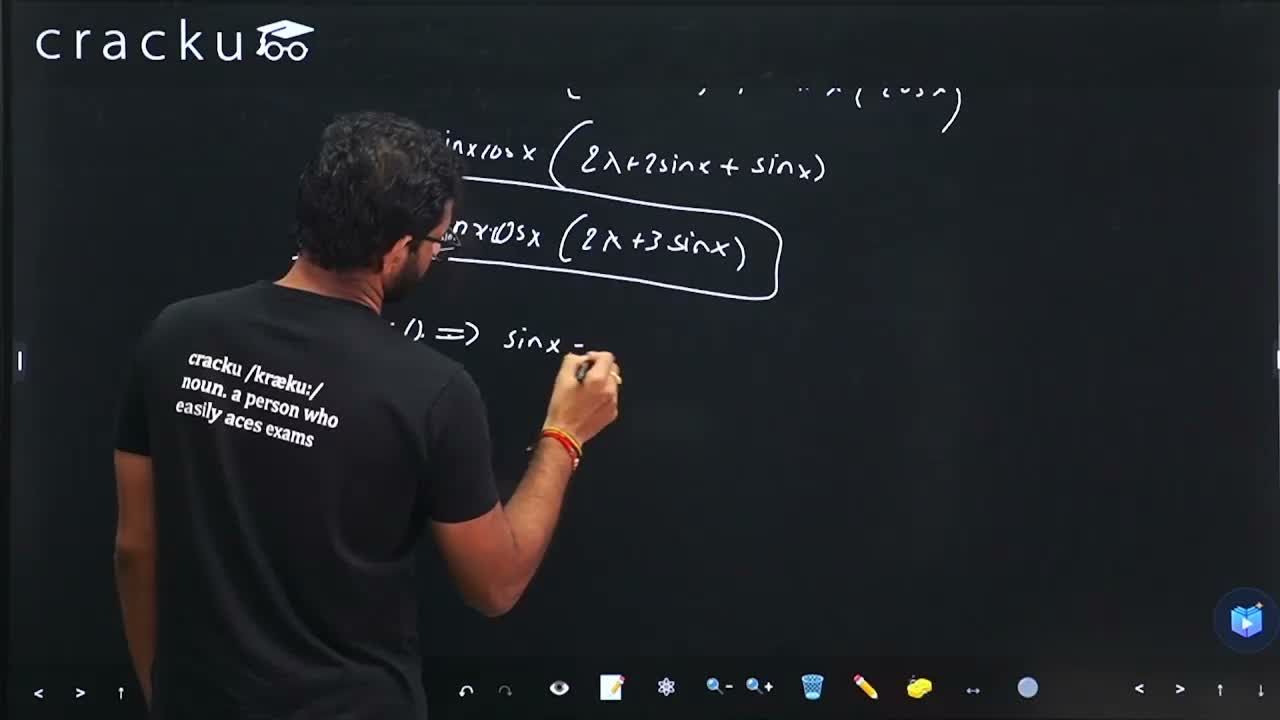
$$f'(x)=\sin x\cos x\;\bigl[\,2(\lambda+\sin x)+\sin x\,\bigr].$$
Simplifying the bracket further,
$$2(\lambda+\sin x)+\sin x=2\lambda+2\sin x+\sin x=2\lambda+3\sin x.$$
Hence
$$f'(x)=\sin x\cos x\;\bigl(2\lambda+3\sin x\bigr).$$
Critical points arise when $$f'(x)=0,$$ i.e.
$$\sin x=0\quad\text{or}\quad\cos x=0\quad\text{or}\quad2\lambda+3\sin x=0.$$
Inside the open interval $$\left(-\dfrac{\pi}{2},\dfrac{\pi}{2}\right)$$ we note
• $$\cos x=0$$ only at $$x=\pm\dfrac{\pi}{2},$$ which are not in the domain, so they are discarded.
• $$\sin x=0$$ gives the critical point $$x_0=0.$$
• $$2\lambda+3\sin x=0$$ yields
$$\sin x=-\dfrac{2\lambda}{3}.$$
This equation has a real solution in the given interval precisely when
$$-1<-\dfrac{2\lambda}{3}<1.$$
Multiplying throughout by $$-\dfrac{3}{2}$$ (remembering to reverse the inequalities) gives
$$-\,\dfrac{3}{2}<\lambda<\dfrac{3}{2}.$$
If $$\lambda=0,$$ the value $$-\dfrac{2\lambda}{3}=0$$ coincides with the already found root $$x_0=0,$$ so we would have only one critical point. To obtain exactly two distinct critical points we therefore require
$$\lambda\in\left(-\dfrac{3}{2},\dfrac{3}{2}\right)\setminus\{0\}.$$
Let $$x_1$$ denote the additional root satisfying $$\sin x_1=-\dfrac{2\lambda}{3}\neq0.$$ The two critical points are thus
$$x_1\quad\text{and}\quad x_0=0.$$
We now examine the nature (maxima or minima) of these points by studying the sign of $$f'(x).$$ The factorisation
$$f'(x)=\bigl(\sin x\bigr)\bigl(\cos x\bigr)\bigl(2\lambda+3\sin x\bigr)$$
makes the sign analysis straightforward because $$\cos x>0$$ throughout the interval. Only the signs of $$\sin x$$ and $$2\lambda+3\sin x$$ matter.
Case 1: $$\lambda>0.$$
Then $$-\dfrac{2\lambda}{3}<0,$$ so $$x_1<0.$$ Moving from left to right along the interval we have
The derivative changes from positive to negative at $$x_1,$$ giving a local maximum there, and from negative to positive at $$x_0=0,$$ giving a local minimum. Thus we obtain exactly one maxima and one minima.
Case 2: $$\lambda<0.$$
Now $$-\dfrac{2\lambda}{3}>0,$$ so $$x_1>0.$$ The sign table becomes
Here the derivative switches from positive to negative at $$x_0=0,$$ producing a local maximum, and from negative to positive at $$x_1,$$ producing a local minimum. Again there is exactly one maxima and one minima.
Consequently, every $$\lambda$$ satisfying
$$\boxed{\,-\dfrac{3}{2}<\lambda<\dfrac{3}{2},\;\lambda\neq0\,}$$
gives exactly two distinct critical points, one a maximum and the other a minimum. No other value of $$\lambda$$ works:
• If $$\lambda=\pm\dfrac{3}{2},$$ the second root would correspond to $$\sin x=\mp1,$$ i.e. to $$x=\pm\dfrac{\pi}{2},$$ outside the open interval, leaving only a single critical point.
• If $$\lambda=0,$$ both conditions $$\sin x=0$$ and $$2\lambda+3\sin x=0$$ coincide, again giving only one critical point.
The required set is therefore
$$\left(-\dfrac{3}{2},\dfrac{3}{2}\right)\setminus\{0\}.$$
Hence, the correct answer is Option D.
Was this solution helpful?
Click on the Email ☝️ to Watch the Video Solution
Create a FREE account and get:
_1.webp)

Educational materials for JEE preparation

Ask our AI anything

AI can make mistakes. Please verify important information.
AI can make mistakes. Please verify important information.


