
Join Our JEE Preparation Group
Prep with like-minded aspirants; Get access to free daily tests and study material.
Sign in
Please select an account to continue using cracku.in
↓ →
Join Our JEE Preparation Group
Prep with like-minded aspirants; Get access to free daily tests and study material.
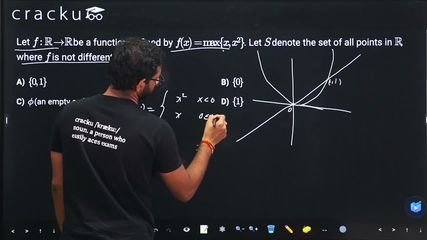
Let $$f : \mathbb{R} \to \mathbb{R}$$ be a function defined by $$f(x) = \max\{x, x^2\}$$. Let $$S$$ denote the set of all points in $$\mathbb{R}$$, where $$f$$ is not differentiable. Then:
We are given the real-valued function $$f:\mathbb R\to\mathbb R$$ defined by $$f(x)=\max\{x,\;x^2\}\,.$$
To analyse differentiability we first express $$f$$ as a piece-wise function, because at each real number we must decide which of the two expressions, $$x$$ or $$x^2$$, is larger.
We compare $$x^2$$ with $$x$$:
$$x^2\ge x\;\Longleftrightarrow\;x^2-x\ge0\;\Longleftrightarrow\;x(x-1)\ge0.$$
The inequality $$x(x-1)\ge0$$ holds when $$x\le0$$ or $$x\ge1$$, and it fails when $$0<x<1$$. Hence
$$ f(x)= \begin{cases} x^2,& x\le0,\\[4pt] x, & 0\lt x\lt 1,\\[4pt] x^2,& x\ge1. \end{cases} $$
Now we differentiate each branch separately.
For $$x<0$$ we have $$f(x)=x^2,$$ so using the standard rule $$\dfrac{d}{dx}(x^n)=nx^{n-1}$$ we get
$$f'(x)=2x\qquad(x<0).$$
For $$0<x<1$$ we have $$f(x)=x,$$ and the derivative of $$x$$ is
$$f'(x)=1\qquad(0<x<1).$$
For $$x>1$$ we have again $$f(x)=x^2,$$ giving
$$f'(x)=2x\qquad(x>1).$$
Thus $$f'$$ is well defined everywhere except possibly at the junction points $$x=0$$ and $$x=1$$. We must examine these two points separately by comparing the left-hand and right-hand derivatives.
Point $$x=0$$.
The left-hand derivative is the limit of $$2x$$ as $$x\to0^-$$:
$$\lim_{x\to0^-}2x=0.$$
The right-hand derivative is the limit of $$1$$ as $$x\to0^+$$:
$$\lim_{x\to0^+}1=1.$$
Because $$0\ne1$$, the two one-sided derivatives are unequal, so $$f$$ is not differentiable at $$x=0$$.
Point $$x=1$$.
The left-hand derivative is the limit of $$1$$ as $$x\to1^-$$:
$$\lim_{x\to1^-}1=1.$$
The right-hand derivative is the limit of $$2x$$ as $$x\to1^+$$:
$$\lim_{x\to1^+}2x=2.$$
Since $$1\ne2$$, the one-sided derivatives differ, so $$f$$ is not differentiable at $$x=1$$.
For every other real number the function matches just one smooth branch, and the derivative we calculated is finite and continuous, hence $$f$$ is differentiable everywhere except at $$0$$ and $$1$$.
Therefore the set $$S$$ of non-differentiability points is
$$S=\{0,1\}.$$
Among the given options, this set corresponds to Option A.
Hence, the correct answer is Option A.
Was this solution helpful?
Click on the Email ☝️ to Watch the Video Solution
Create a FREE account and get:
_1.webp)

Educational materials for JEE preparation

Ask our AI anything

AI can make mistakes. Please verify important information.
AI can make mistakes. Please verify important information.


