
Join Our JEE Preparation Group
Prep with like-minded aspirants; Get access to free daily tests and study material.
Sign in
Please select an account to continue using cracku.in
↓ →
Join Our JEE Preparation Group
Prep with like-minded aspirants; Get access to free daily tests and study material.
Let $$A(a, 0)$$, $$B(b, 2b+1)$$ and $$C(0, b)$$, $$b \neq 0$$, $$|b| \neq 1$$, be points such that the area of triangle $$ABC$$ is 1 sq. unit, then the sum of all possible values of $$a$$ is:
We have the three vertices $$A(a,0)$$, $$B(b,2b+1)$$ and $$C(0,b)$$.
The area of a triangle with vertices $$\bigl(x_1$$, $$y_1\bigr)$$, $$\;(x_2$$, $$y_2)$$, $$\;(x_3$$, $$y_3)$$ is given by the determinant formula
Area $$\;=\;\frac12\,\Bigl|\,x_1(y_2-y_3)+x_2(y_3-y_1)+x_3(y_1-y_2)\Bigr|.$$
Substituting $$x_1=a$$, $$\;y_1=0$$, $$\;x_2=b$$, $$\;y_2=2b+1$$, $$\;x_3=0$$, $$\;y_3=b$$ we obtain
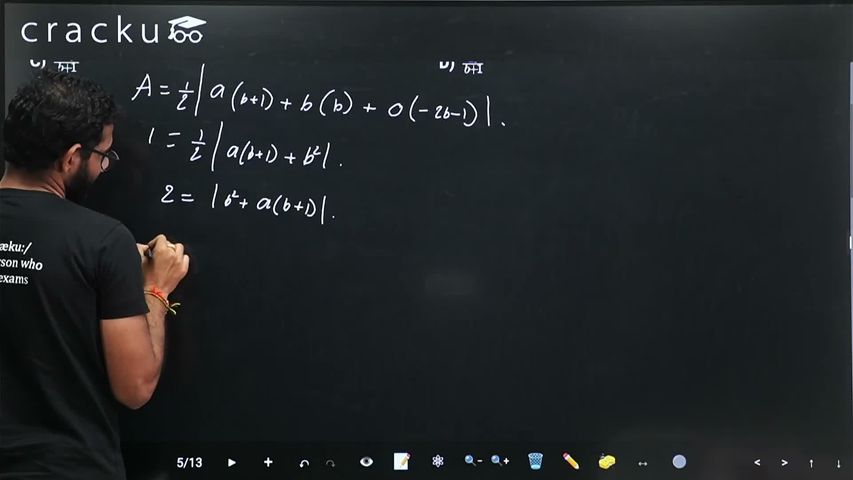
$$\begin{aligned} \text{Area}&=\frac12\Bigl|\,a\bigl((2b+1)-b\bigr)+b\bigl(b-0\bigr)+0\bigl(0-(2b+1)\bigr)\Bigr| \\[4pt] &=\frac12\Bigl|\,a(b+1)+b^2\Bigr|. \end{aligned}$$
We are told that the area equals $$1$$ square unit, so
$$\frac12\Bigl|\,a(b+1)+b^2\Bigr|=1.$$
Multiplying by $$2$$, this becomes
$$\Bigl|\,a(b+1)+b^2\Bigr|=2.$$
Removing the absolute value gives the two possible linear equations
$$\begin{cases} a(b+1)+b^2=2,\\ a(b+1)+b^2=-2. \end{cases}$$
Because $$b\neq -1$$ (since $$|b|\neq 1$$), we can safely divide by $$(b+1)$$ in each equation.
From the first equation:
$$a(b+1)=2-b^2\quad\Longrightarrow\quad a=\dfrac{2-b^2}{b+1}.$$
From the second equation:
$$a(b+1)=-(b^2+2)\quad\Longrightarrow\quad a=-\dfrac{b^2+2}{b+1}.$$
The problem asks for the sum of all possible values of $$a$$, so we add the two expressions:
$$\begin{aligned} a_{\text{sum}}&=\frac{2-b^2}{b+1}+\left(-\frac{b^2+2}{b+1}\right)\\[4pt] &=\frac{\,2-b^2-(b^2+2)\,}{b+1}\\[4pt] &=\frac{-2b^2}{b+1}. \end{aligned}$$
This value matches Option C.
Hence, the correct answer is Option C.
Click on the Email ☝️ to Watch the Video Solution
Create a FREE account and get:
_1.webp)

Educational materials for JEE preparation

Ask our AI anything

AI can make mistakes. Please verify important information.
AI can make mistakes. Please verify important information.


