
Join Our JEE Preparation Group
Prep with like-minded aspirants; Get access to free daily tests and study material.
Sign in
Please select an account to continue using cracku.in
↓ →
Join Our JEE Preparation Group
Prep with like-minded aspirants; Get access to free daily tests and study material.
The sum of all those terms which are rational numbers in the expansion of $$\left(2^{\frac{1}{3}} + 3^{\frac{1}{4}}\right)^{12}$$ is:
1. Write the general term of the expansion
The general term $$T_{r+1}$$ in the binomial expansion of $$(a + b)^n$$ is given by the formula:
$$T_{r+1} = \binom{n}{r} a^{n-r} b^r$$
Substituting $$a = 2^{\frac{1}{3}}$$, $$b = 3^{\frac{1}{4}}$$, and $$n = 12$$, we get:
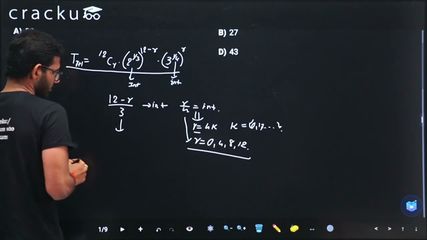
$$T_{r+1} = \binom{12}{r} \left(2^{\frac{1}{3}}\right)^{12-r} \left(3^{\frac{1}{4}}\right)^r$$
$$T_{r+1} = \binom{12}{r} 2^{\frac{12-r}{3}} 3^{\frac{r}{4}}$$
Here, the variable $$r$$ can take any integer value from $$0$$ to $$12$$.
2. Determine the condition for rational terms
For a term to be a rational number, the exponents of both base prime numbers $$2$$ and $$3$$ must be integers. This gives us two conditions:
The fraction $$\frac{12-r}{3}$$ must be an integer, which implies that $$12-r$$ is a multiple of $$3$$. Consequently, $$r$$ must be a multiple of $$3$$.
The fraction $$\frac{r}{4}$$ must be an integer, which implies that $$r$$ must be a multiple of $$4$$.
To satisfy both conditions simultaneously, $$r$$ must be a common multiple of both $$3$$ and $$4$$. The least common multiple is:
$$\text{LCM}(3, 4) = 12$$
3. Find the valid values of r
Since the range of $$r$$ is restricted to $$0 \leq r \leq 12$$, the only possible integer values for $$r$$ that are multiples of $$12$$ are:
$$r = 0$$
$$r = 12$$
4. Calculate the rational terms
Now, evaluate the value of the general term at these two specific values of $$r$$:
When $$r = 0$$:
$$T_1 = \binom{12}{0} 2^{\frac{12-0}{3}} 3^{\frac{0}{4}}$$
$$T_1 = 1 \times 2^4 \times 3^0$$
$$T_1 = 1 \times 16 \times 1 = 16$$
When $$r = 12$$:
$$T_{13} = \binom{12}{12} 2^{\frac{12-12}{3}} 3^{\frac{12}{4}}$$
$$T_{13} = 1 \times 2^0 \times 3^3$$
$$T_{13} = 1 \times 1 \times 27 = 27$$
5. Compute the sum of the rational terms
Add the two rational terms together to find the total sum:
$$\text{Sum} = T_1 + T_{13}$$
Was this solution helpful?
Click on the Email ☝️ to Watch the Video Solution
Create a FREE account and get:
_1.webp)

Educational materials for JEE preparation

Ask our AI anything

AI can make mistakes. Please verify important information.
AI can make mistakes. Please verify important information.
