
Join Our JEE Preparation Group
Prep with like-minded aspirants; Get access to free daily tests and study material.
Sign in
Please select an account to continue using cracku.in
↓ →
Join Our JEE Preparation Group
Prep with like-minded aspirants; Get access to free daily tests and study material.
If the greatest value of the term independent of $$x$$ in the expansion of $$\left(x \sin \alpha + a\frac{\cos \alpha}{x}\right)^{10}$$ is $$\frac{10!}{(5!)^2}$$, then the value of $$a$$ is equal to:
We are asked to look at the expansion of $$\left(x\sin\alpha + a\dfrac{\cos\alpha}{x}\right)^{10}$$ and pick out that term in which the power of $$x$$ is zero, that is, the term independent of $$x$$.
First we recall the binomial-theorem formula $$\left(u+v\right)^{n}=\sum_{r=0}^{n}\binom{n}{r}u^{\,n-r}v^{\,r},$$ where the general term is $$T_{r+1}=\binom{n}{r}u^{\,n-r}v^{\,r}.$$
In the present question we have $$u=x\sin\alpha,\qquad v=a\dfrac{\cos\alpha}{x},\qquad n=10.$$ So the general term is
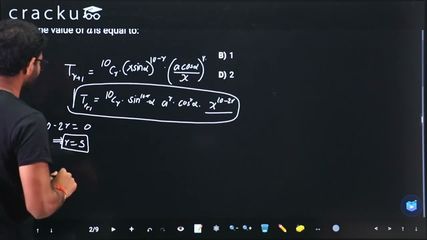
$$T_{r+1}= \binom{10}{r}\bigl(x\sin\alpha\bigr)^{10-r}\left(a\dfrac{\cos\alpha}{x}\right)^{r}.$$
We simplify this power by power:
$$\bigl(x\sin\alpha\bigr)^{10-r}=x^{\,10-r}(\sin\alpha)^{10-r},$$ $$\left(a\dfrac{\cos\alpha}{x}\right)^{r}=a^{\,r}(\cos\alpha)^{r}x^{-\,r}.$$
Multiplying the two parts gives
$$T_{r+1}=\binom{10}{r}a^{\,r}(\sin\alpha)^{10-r}(\cos\alpha)^{r}\;x^{(10-r)-r} =\binom{10}{r}a^{\,r}(\sin\alpha)^{10-r}(\cos\alpha)^{r}\;x^{10-2r}.$$
For independence of $$x$$ we need the exponent of $$x$$ to be zero, so we set $$10-2r=0\quad\Longrightarrow\quad r=5.$$
Substituting $$r=5$$ back into the expression, the constant term becomes
$$T_{\text{indep}}=\binom{10}{5}a^{5}(\sin\alpha)^{5}(\cos\alpha)^{5}.$$
We know that $$\binom{10}{5}=\dfrac{10!}{5!\,5!},$$ so numerically the term is
$$T_{\text{indep}}=\dfrac{10!}{(5!)^{2}}\;a^{5}(\sin\alpha\cos\alpha)^{5}.$$
The problem says that the greatest value (maximum possible value) of this constant term is exactly $$\dfrac{10!}{(5!)^{2}}.$$ Hence we must have
$$\dfrac{10!}{(5!)^{2}}\;|a|^{5}\;|\sin\alpha\cos\alpha|^{5}= \dfrac{10!}{(5!)^{2}}.$$
Dividing both sides by the common factor $$\dfrac{10!}{(5!)^{2}}$$ we arrive at
$$|a|^{5}\;|\sin\alpha\cos\alpha|^{5}=1.$$
Now we recall the standard trigonometric result $$\sin\alpha\cos\alpha=\dfrac{\sin2\alpha}{2},$$ whose maximum absolute value is $$\dfrac{1}{2}.$$ Therefore the greatest possible value of $$|\sin\alpha\cos\alpha|^{5}$$ is $$\left(\dfrac12\right)^{5}=\dfrac{1}{32}.$$
Putting this maximum into our equation gives
$$|a|^{5}\;\dfrac{1}{32}=1 \quad\Longrightarrow\quad |a|^{5}=32 \quad\Longrightarrow\quad |a|=2.$$
So $$a$$ can be either $$2$$ or $$-2$$, but among the listed choices only the positive value $$2$$ is present.
Hence, the correct answer is Option D.
Was this solution helpful?
Click on the Email ☝️ to Watch the Video Solution
Create a FREE account and get:
_1.webp)

Educational materials for JEE preparation

Ask our AI anything

AI can make mistakes. Please verify important information.
AI can make mistakes. Please verify important information.
