
Join Our JEE Preparation Group
Prep with like-minded aspirants; Get access to free daily tests and study material.
Sign in
Please select an account to continue using cracku.in
↓ →
Join Our JEE Preparation Group
Prep with like-minded aspirants; Get access to free daily tests and study material.
The given equation is:
x² − |x| − 12 = 0
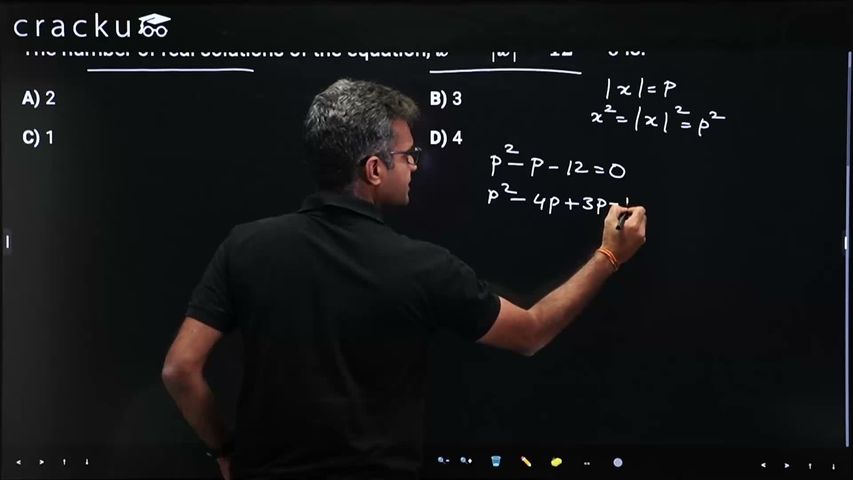
We know that the square of a real number is the same as the square of its absolute value. Therefore, we can rewrite x² as |x|².
|x|² − |x| − 12 = 0
Let us assume p = |x|. Since p represents an absolute value, it must be greater than or equal to zero, so p ≥ 0.
Substituting p into our equation, we get:
p² − p − 12 = 0
Factoring the quadratic equation:
(p − 4)(p + 3) = 0
This gives two possible values for p:
p = 4 or p = −3
Since we already established that p ≥ 0, we must reject p = −3.
Thus, the only valid value is p = 4.
Substituting back p = |x|:
|x| = 4
This implies:
x = 4 or x = −4
Therefore, the equation has exactly two real solutions.
Was this solution helpful?
Click on the Email ☝️ to Watch the Video Solution
Create a FREE account and get:
_1.webp)

Educational materials for JEE preparation

Ask our AI anything

AI can make mistakes. Please verify important information.
AI can make mistakes. Please verify important information.
