
Join Our JEE Preparation Group
Prep with like-minded aspirants; Get access to free daily tests and study material.
Sign in
Please select an account to continue using cracku.in
↓ →
Join Our JEE Preparation Group
Prep with like-minded aspirants; Get access to free daily tests and study material.
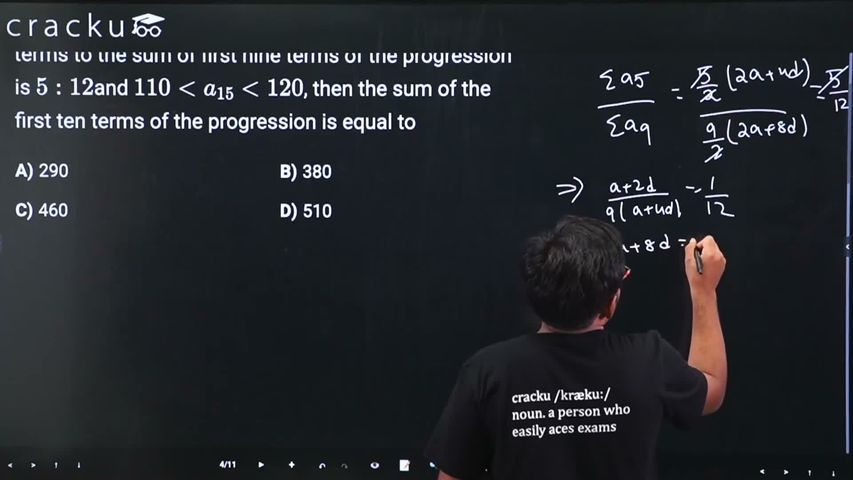
Suppose $$a_1, a_2, \ldots, a_n$$ be an arithmetic progression of natural numbers. If the ratio of the sum of the first five terms to the sum of first nine terms of the progression is $$5:12$$ and $$110 < a_{15} < 120$$, then the sum of the first ten terms of the progression is equal to
Solution :
Let the arithmetic progression be :
$$a,\ a+d,\ a+2d,\ldots$$
Sum of first $$n$$ terms of an AP :
$$S_n = \frac{n}{2}[2a+(n-1)d]$$
Given :
$$\frac{S_5}{S_9} = \frac{5}{12}$$
Now,
$$S_5 = \frac{5}{2}[2a+4d]$$
$$= 5(a+2d)$$
and,
$$S_9 = \frac{9}{2}[2a+8d]$$
$$= 9(a+4d)$$
Therefore,
$$\frac{5(a+2d)}{9(a+4d)}=\frac{5}{12}$$
Cancelling 5 :
$$\frac{a+2d}{9(a+4d)}=\frac{1}{12}$$
$$12(a+2d)=9(a+4d)$$
$$12a+24d=9a+36d$$
$$3a=12d$$
$$a=4d$$
Now,
$$a_{15}=a+14d$$
$$=4d+14d$$
$$=18d$$
Given :
$$110<a_{15}<120$$
$$110<18d<120$$
$$\frac{110}{18}<d<\frac{120}{18}$$
$$6.11<d<6.67$$
Since $$d$$ is a natural number,
$$d=6$$
Hence,
$$a=4d=24$$
Now sum of first 10 terms :
$$S_{10}=\frac{10}{2}[2a+9d]$$
$$=5[2(24)+9(6)]$$
$$=5[48+54]$$
$$=5(102)$$
$$=510$$
Final Answer :
$$510$$
Was this solution helpful?
Click on the Email ☝️ to Watch the Video Solution
Create a FREE account and get:
_1.webp)

Educational materials for JEE preparation

Ask our AI anything

AI can make mistakes. Please verify important information.
AI can make mistakes. Please verify important information.
