Join Our JEE Preparation Group
Prep with like-minded aspirants; Get access to free daily tests and study material.
Sign in
Please select an account to continue using cracku.in
↓ →
Join Our JEE Preparation Group
Prep with like-minded aspirants; Get access to free daily tests and study material.
According to Werner’s theory,
• the oxidation state of the central metal atom / ion gives the number of primary valencies (ionisable).
• the total number of donor atoms directly linked with the metal gives the secondary valencies (coordination number).
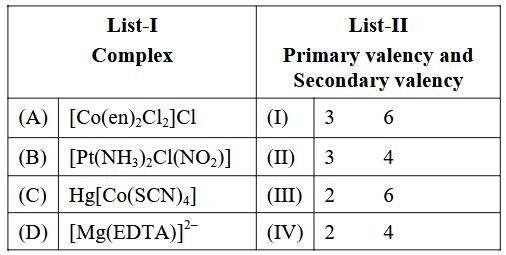
Complex : $$[Co(en)_2Cl_2]Cl$$
Step-1 Oxidation state of Co (inside the square bracket):
Let it be $$x$$.
$$x + 2(0) + 2(-1) = +1\;$$ (because one $$Cl^-$$ is outside the bracket)
$$x - 2 = +1 \Rightarrow x = +3$$
Primary valencies = $$3$$.
Step-2 Coordination number:
$$en$$ is bidentate → $$2 \; en$$ supplies $$2 \times 2 = 4$$ donor atoms.
$$2 \; Cl^-$$ supplies $$2$$ donor atoms.
Total $$= 4 + 2 = 6$$.
Secondary valencies = $$6$$.
Hence (A) ⟶ (I) (primary 3, secondary 6).
Case B:Complex : $$[Pt(NH_3)_2Cl(NO_2)]$$
Step-1 Oxidation state of Pt:
Let it be $$x$$.
$$x + 2(0) + (-1) + (-1) = 0$$
$$x - 2 = 0 \Rightarrow x = +2$$
Primary valencies = $$2$$.
Step-2 Coordination number:
All the four ligands ($$NH_3, NH_3, Cl^- , NO_2^-$$) are monodentate → $$4$$ donor atoms.
Secondary valencies = $$4$$.
Hence (B) ⟶ (IV) (primary 2, secondary 4).
Case C:Complex : $$Hg[Co(SCN)_4]$$
Step-1 Find the charge on the complex anion.
Hg is present as $$Hg^+$$ (monovalent mercurous ion).
For electrical neutrality, the anion must carry $$-1$$ charge.
Step-2 Oxidation state of Co:
Let it be $$x$$.
$$x + 4(-1) = -1$$
$$x - 4 = -1 \Rightarrow x = +3$$
Primary valencies = $$3$$.
Step-3 Coordination number:
Each $$SCN^-$$ is monodentate → $$4$$ donor atoms.
Secondary valencies = $$4$$.
Hence (C) ⟶ (II) (primary 3, secondary 4).
Case D:Complex : $$[Mg(EDTA)]^{2-}$$
Step-1 Oxidation state of Mg:
Let it be $$x$$.
Charge on $$EDTA$$ ligand $$= -4$$.
Total charge on complex $$= -2$$.
$$x + (-4) = -2 \Rightarrow x = +2$$
Primary valencies = $$2$$.
Step-2 Coordination number:
$$EDTA^{4-}$$ is hexadentate → $$6$$ donor atoms.
Secondary valencies = $$6$$.
Hence (D) ⟶ (III) (primary 2, secondary 6).
Putting the four results together:
$$(A)-(I),\;(B)-(IV),\;(C)-(II),\;(D)-(III)$$
Therefore the correct choice is Option B.
Was this solution helpful?
Create a FREE account and get:
_1.webp)

Educational materials for JEE preparation

Ask our AI anything

AI can make mistakes. Please verify important information.
AI can make mistakes. Please verify important information.