
Join Our JEE Preparation Group
Prep with like-minded aspirants; Get access to free daily tests and study material.
Sign in
Please select an account to continue using cracku.in
↓ →
Join Our JEE Preparation Group
Prep with like-minded aspirants; Get access to free daily tests and study material.
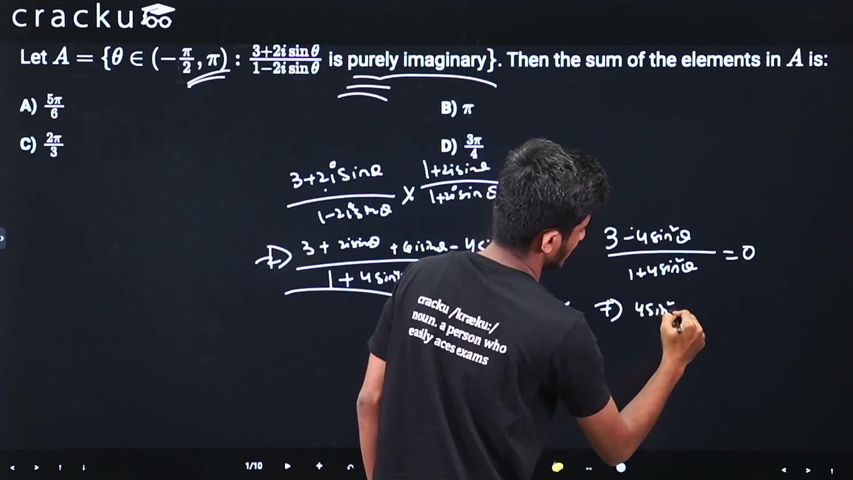
Let $$A = \{\theta \in (-\frac{\pi}{2}, \pi): \frac{3 + 2i\sin\theta}{1 - 2i\sin\theta}$$ is purely imaginary$$\}$$. Then the sum of the elements in $$A$$ is:
First of all, recall that a complex number $$z = x + iy$$ is said to be purely imaginary when its real part vanishes, that is, when $$x = 0$$.
We are given the expression
$$z(\theta)=\dfrac{3 + 2i\sin\theta}{1 - 2i\sin\theta},$$
and we must locate all $$\theta \in \left(-\dfrac{\pi}{2},\;\pi\right)$$ for which $$z(\theta)$$ is purely imaginary. Hence we need to make the real part of $$z(\theta)$$ equal to zero.
To separate the real and imaginary parts we multiply the numerator and the denominator by the complex conjugate of the denominator. The conjugate of $$1 - 2i\sin\theta$$ is $$1 + 2i\sin\theta$$, and multiplying by this conjugate is permissible because we are effectively multiplying by $$1$$:
$$z(\theta)=\dfrac{3 + 2i\sin\theta}{1 - 2i\sin\theta}\,\cdot\,\dfrac{1 + 2i\sin\theta}{1 + 2i\sin\theta}.$$
We now evaluate the denominator. Using the identity $$(a - ib)(a + ib)=a^{2}+b^{2},$$ we obtain
$$\bigl(1 - 2i\sin\theta\bigr)\bigl(1 + 2i\sin\theta\bigr)=1^{2}+\bigl(2\sin\theta\bigr)^{2}=1+4\sin^{2}\theta.$$
Next we expand the numerator term by term:
$$\bigl(3 + 2i\sin\theta\bigr)\bigl(1 + 2i\sin\theta\bigr) = 3\cdot1 + 3\cdot(2i\sin\theta) + (2i\sin\theta)\cdot1 + (2i\sin\theta)\cdot(2i\sin\theta).$$
Carrying out each multiplication gives
$$= 3 + 6i\sin\theta + 2i\sin\theta + 4i^{2}\sin^{2}\theta.$$
Because $$i^{2}=-1,$$ the last term becomes $$4(-1)\sin^{2}\theta=-4\sin^{2}\theta.$$ Collecting the real and the imaginary parts separately we get
$$\bigl(3 + 2i\sin\theta\bigr)\bigl(1 + 2i\sin\theta\bigr) = \bigl(3 - 4\sin^{2}\theta\bigr) + 8i\sin\theta.$$
Placing this over the already‐found denominator yields
$$z(\theta)=\dfrac{\bigl(3 - 4\sin^{2}\theta\bigr) + 8i\sin\theta}{1 + 4\sin^{2}\theta}.$$
From this fraction the real part is immediately
$$\operatorname{Re}\bigl[z(\theta)\bigr]=\dfrac{3 - 4\sin^{2}\theta}{1 + 4\sin^{2}\theta}.$$
For $$z(\theta)$$ to be purely imaginary we impose
$$\dfrac{3 - 4\sin^{2}\theta}{1 + 4\sin^{2}\theta}=0.$$
The denominator $$1 + 4\sin^{2}\theta$$ is always positive, so the fraction can vanish only when the numerator vanishes:
$$3 - 4\sin^{2}\theta = 0.$$ $$\Longrightarrow\;4\sin^{2}\theta = 3.$$ $$\Longrightarrow\;\sin^{2}\theta = \dfrac{3}{4}.$$ $$\Longrightarrow\;\sin\theta = \pm\dfrac{\sqrt{3}}{2}.$$
Now we look for all angles in the interval $$\left(-\dfrac{\pi}{2},\;\pi\right)$$ that satisfy either $$\sin\theta=\dfrac{\sqrt{3}}{2}$$ or $$\sin\theta=-\dfrac{\sqrt{3}}{2}.$$
1. For $$\sin\theta=\dfrac{\sqrt{3}}{2}:$$ The standard angles are $$\theta=\dfrac{\pi}{3}$$ and $$\theta=\dfrac{2\pi}{3}.$$ Both lie in the required interval.
2. For $$\sin\theta=-\dfrac{\sqrt{3}}{2}:$$ The principal solution is $$\theta=-\dfrac{\pi}{3},$$ which also lies inside $$\left(-\dfrac{\pi}{2},\;\pi\right).$$ The other usual solution $$\theta=\dfrac{4\pi}{3}$$ exceeds $$\pi$$ and hence is excluded.
Therefore, the complete set is
$$A=\left\{-\dfrac{\pi}{3},\;\dfrac{\pi}{3},\;\dfrac{2\pi}{3}\right\}.$$
The required sum equals
$$-\dfrac{\pi}{3}+\dfrac{\pi}{3}+\dfrac{2\pi}{3} =\dfrac{2\pi}{3}.$$
Hence, the correct answer is Option C.
Was this solution helpful?
Click on the Email ☝️ to Watch the Video Solution
Create a FREE account and get:
_1.webp)

Educational materials for JEE preparation

Ask our AI anything

AI can make mistakes. Please verify important information.
AI can make mistakes. Please verify important information.
