
Join Our JEE Preparation Group
Prep with like-minded aspirants; Get access to free daily tests and study material.
Sign in
Please select an account to continue using cracku.in
↓ →
Join Our JEE Preparation Group
Prep with like-minded aspirants; Get access to free daily tests and study material.
The set of all values of $$k \gt -1$$, for which the equation $$(3x^2+4x+3)^2 - (k+1)(3x^2+4x+3)(3x^2+4x+2) + k(3x^2+4x+2)^2 = 0$$ has real roots, is:
We start with the given equation
$$ (3x^2+4x+3)^2-(k+1)(3x^2+4x+3)(3x^2+4x+2)+k(3x^2+4x+2)^2=0,\qquad k\gt -1. $$
Notice that the two quadratic expressions which appear repeatedly differ by exactly $$1$$:
$$ 3x^2+4x+3=(3x^2+4x+2)+1. $$
So we introduce the substitution
$$ A=3x^2+4x+2, \qquad \text{hence } 3x^2+4x+3=A+1. $$
Re-writing every occurrence in terms of $$A$$ gives
$$ (A+1)^2-(k+1)(A+1)A+kA^2=0. $$
Now we expand every product:
$$ (A+1)^2=A^2+2A+1, $$
$$ (A+1)A=A^2+A. $$
Substituting these expansions, the whole equation becomes
$$ (A^2+2A+1)-(k+1)(A^2+A)+kA^2=0. $$
We now collect like terms. First the $$A^2$$ terms:
$$ A^2 - (k+1)A^2 + kA^2 \;=\; \bigl[1-(k+1)+k\bigr]A^2 \;=\; (1-k-1+k)A^2 \;=\; 0\cdot A^2 \;=\;0. $$
Thus the entire $$A^2$$ part cancels out completely.
Next the $$A$$ terms:
$$ 2A-(k+1)A \;=\; (2-k-1)A \;=\; (1-k)A. $$
Finally, the constant term is simply $$+1$$.
So the original rather complicated equation has reduced to the linear equation in $$A$$
$$ (1-k)A+1=0. $$
If $$k\neq1$$, we can solve for $$A$$ straight away:
$$ A=\frac{-1}{1-k}=\frac{1}{k-1}. $$
However, if $$k=1$$ the coefficient in front of $$A$$ becomes zero and we are left with the contradictory statement $$1=0$$. Therefore
$$ k=1 \quad\text{gives no root at all and must be excluded}. $$
For every other value of $$k$$ (still keeping $$k\gt -1$$ in mind) the problem now boils down to asking when the quadratic in $$x$$
$$ 3x^2+4x+2=\frac{1}{k-1} $$
has real solutions. Rearranging this gives a standard quadratic equation:
$$ 3x^2+4x+\Bigl(2-\frac{1}{k-1}\Bigr)=0. $$
For such a quadratic $$ax^2+bx+c=0$$ to have real roots, its discriminant must satisfy $$\Delta=b^2-4ac\ge 0.$$ Here
$$ a=3,\qquad b=4,\qquad c=2-\frac{1}{k-1}. $$
Therefore
$$ \Delta =4^2-4\cdot3\Bigl(2-\frac{1}{k-1}\Bigr) =16-12\Bigl(2-\frac{1}{k-1}\Bigr). $$
Expanding the right-hand side, we get
$$ \Delta =16-24+12\cdot\frac{1}{k-1} =-8+\frac{12}{k-1}. $$
Requiring $$\Delta\ge0$$ gives
$$ -8+\frac{12}{k-1}\ge0 \;\;\Longrightarrow\;\; \frac{12}{k-1}\ge8 \;\;\Longrightarrow\;\; \frac{1}{k-1}\ge\frac{2}{3}. $$
Now we solve the inequality $$\dfrac{1}{k-1}\ge\dfrac{2}{3}$$ carefully, taking into account the sign of the denominator.
Case I: $$k-1\gt 0$$ (that is, $$k\gt 1$$).
Multiplying by the positive quantity $$(k-1)$$ preserves the inequality:
$$ 1\;\ge\;\frac{2}{3}(k-1) \;\;\Longrightarrow\;\; k-1\;\le\;\frac{3}{2} \;\;\Longrightarrow\;\; k\;\le\;\frac{5}{2}. $$
Together with $$k\gt 1$$, this yields the interval
$$ 1\lt k\le\frac{5}{2}. $$
Case II: $$k-1\lt 0$$ (that is, $$k\lt 1$$).
Here the denominator is negative, so multiplying reverses the inequality:
$$ 1\;\le\;\frac{2}{3}(k-1). $$
The right side is negative because $$(k-1)\lt 0$$, while the left side is positive, which is impossible. Thus no solutions arise from this case.
Combining everything, remembering also that $$k=1$$ is excluded and the original condition was $$k\gt -1$$, we obtain the final set of all permissible values of $$k$$:
$$ \,1\lt k\le\frac{5}{2}\,. $$
Looking at the options, this interval is exactly Option B.
Hence, the correct answer is Option B.
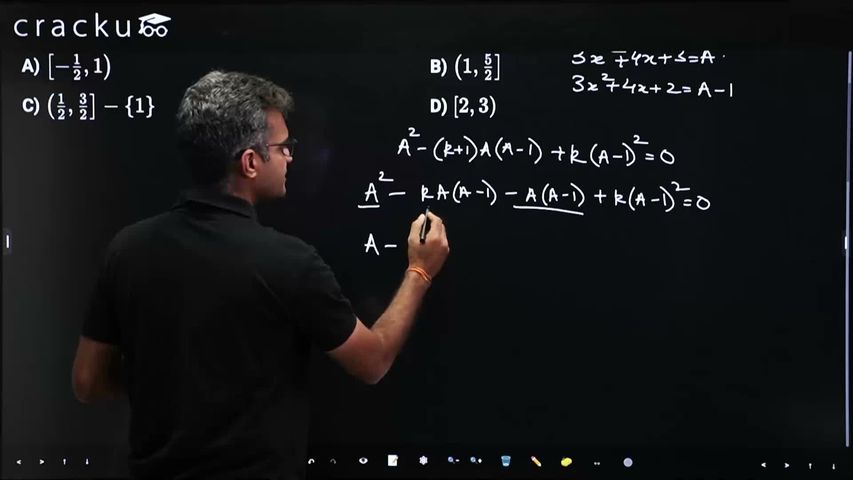
Click on the Email ☝️ to Watch the Video Solution
Create a FREE account and get:
_1.webp)

Educational materials for JEE preparation

Ask our AI anything

AI can make mistakes. Please verify important information.
AI can make mistakes. Please verify important information.


