
Join Our JEE Preparation Group
Prep with like-minded aspirants; Get access to free daily tests and study material.
Sign in
Please select an account to continue using cracku.in
↓ →
Join Our JEE Preparation Group
Prep with like-minded aspirants; Get access to free daily tests and study material.
Let $$\alpha, \beta$$ be two roots of the equation $$x^2 + (20)^{1/4}x + (5)^{1/2} = 0$$. Then $$\alpha^8 + \beta^8$$ is equal to:
We start with the quadratic equation $$x^{2} + (20)^{1/4}\,x + (5)^{1/2}=0$$ whose two roots are denoted by $$\alpha$$ and $$\beta$$.
For any quadratic $$x^{2}+px+q=0$$ with roots $$\alpha,\,\beta$$ we always have the Vieta relations
$$\alpha+\beta=-p,\qquad \alpha\beta=q.$$
Matching the given equation with the standard form we identify
$$p=(20)^{1/4},\qquad q=(5)^{1/2}.$$
Hence
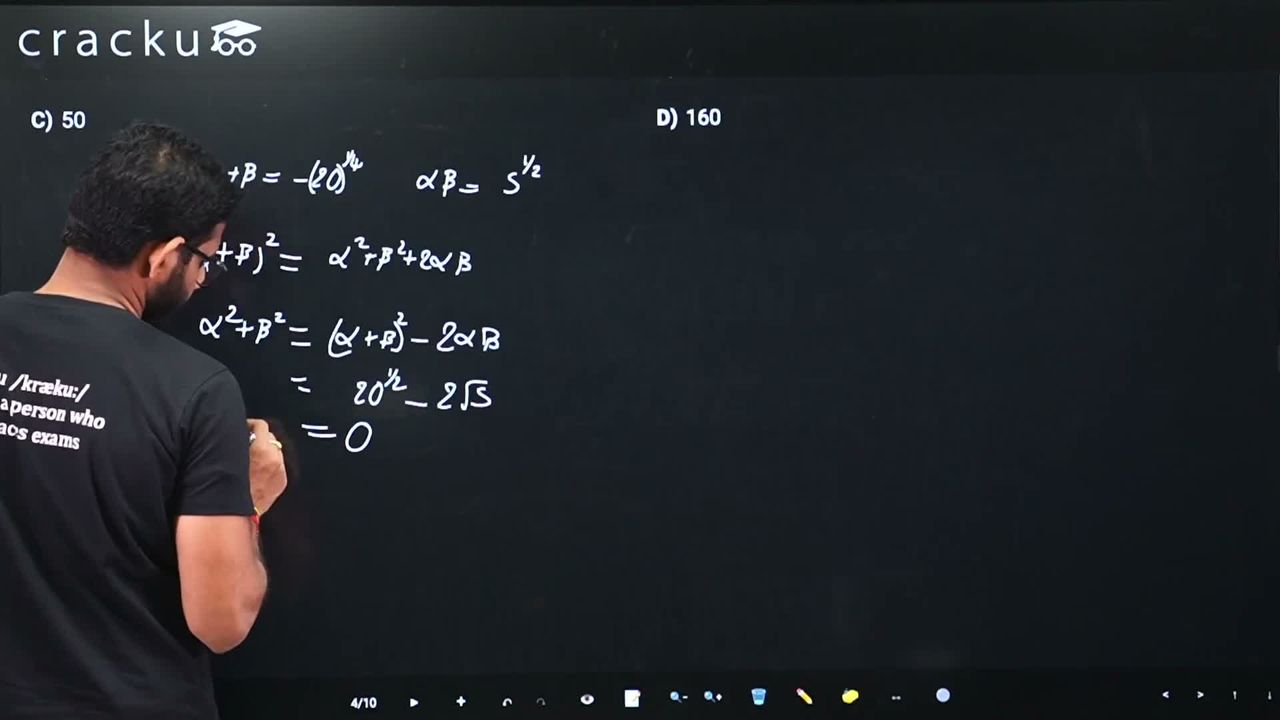
$$\alpha+\beta=-\,(20)^{1/4},\qquad \alpha\beta=(5)^{1/2}.$$
We wish to evaluate $$\alpha^{8}+\beta^{8}.$$ To avoid expanding high powers directly, we use the fact that every power of a root can be reduced with the help of the quadratic itself. Because each root satisfies $$x^{2}+px+q=0,$$ we can write
$$x^{2}=-px-q.$$
If we set $$R_{k}=\alpha^{k}+\beta^{k}$$ then, multiplying the above identity by $$x^{k-2}$$ and adding for $$x=\alpha$$ and $$x=\beta,$$ we obtain the recurrence relation
$$R_{k}=-p\,R_{k-1}-q\,R_{k-2}\qquad(k\ge 2).$$
First we list the initial values:
$$R_{0}=\alpha^{0}+\beta^{0}=1+1=2,$$
$$R_{1}=\alpha+\beta=-p=-(20)^{1/4}.$$
For convenience let us denote $$r=(20)^{1/4}$$ so that $$p=r$$ and $$q=\sqrt5.$$ It will be useful to note
$$r^{2}=(20)^{1/2}=\sqrt{20}=2\sqrt5.$$
Now we compute successive $$R_k$$ using the recurrence.
Second power
$$R_{2}=-p\,R_{1}-q\,R_{0}=-(r)(-r)-(\sqrt5)(2)=r^{2}-2\sqrt5.$$
Substituting $$r^{2}=2\sqrt5$$ gives
$$R_{2}=2\sqrt5-2\sqrt5=0.$$
Third power
$$R_{3}=-p\,R_{2}-q\,R_{1}=-(r)(0)-(\sqrt5)(-r)=\sqrt5\,r.$$
Fourth power
$$R_{4}=-p\,R_{3}-q\,R_{2}=-(r)(\sqrt5\,r)-(\sqrt5)(0)=-\sqrt5\,r^{2}.$$
Because $$r^{2}=2\sqrt5,$$ we obtain
$$R_{4}=-\sqrt5\,(2\sqrt5)=-2\cdot5=-10.$$
Fifth power
$$R_{5}=-p\,R_{4}-q\,R_{3}=-(r)(-10)-(\sqrt5)(\sqrt5\,r)=10r-5r=5r.$$
Sixth power
$$R_{6}=-p\,R_{5}-q\,R_{4}=-(r)(5r)-(\sqrt5)(-10)=-5r^{2}+10\sqrt5.$$
Again inserting $$r^{2}=2\sqrt5$$ yields
$$R_{6}=-5(2\sqrt5)+10\sqrt5=-10\sqrt5+10\sqrt5=0.$$
Seventh power
$$R_{7}=-p\,R_{6}-q\,R_{5}=-(r)(0)-(\sqrt5)(5r)=-5\sqrt5\,r.$$
Eighth power (desired term)
$$R_{8}=-p\,R_{7}-q\,R_{6}=-(r)(-5\sqrt5\,r)-(\sqrt5)(0)=5\sqrt5\,r^{2}.$$
Using $$r^{2}=2\sqrt5$$ one final time gives
$$R_{8}=5\sqrt5\,(2\sqrt5)=5\cdot2\cdot5=50.$$
Therefore we have found
$$\alpha^{8}+\beta^{8}=50.$$
Hence, the correct answer is Option C.
Was this solution helpful?
Click on the Email ☝️ to Watch the Video Solution
Create a FREE account and get:
_1.webp)

Educational materials for JEE preparation

Ask our AI anything

AI can make mistakes. Please verify important information.
AI can make mistakes. Please verify important information.
