
Join Our JEE Preparation Group
Prep with like-minded aspirants; Get access to free daily tests and study material.
Sign in
Please select an account to continue using cracku.in
↓ →
Join Our JEE Preparation Group
Prep with like-minded aspirants; Get access to free daily tests and study material.
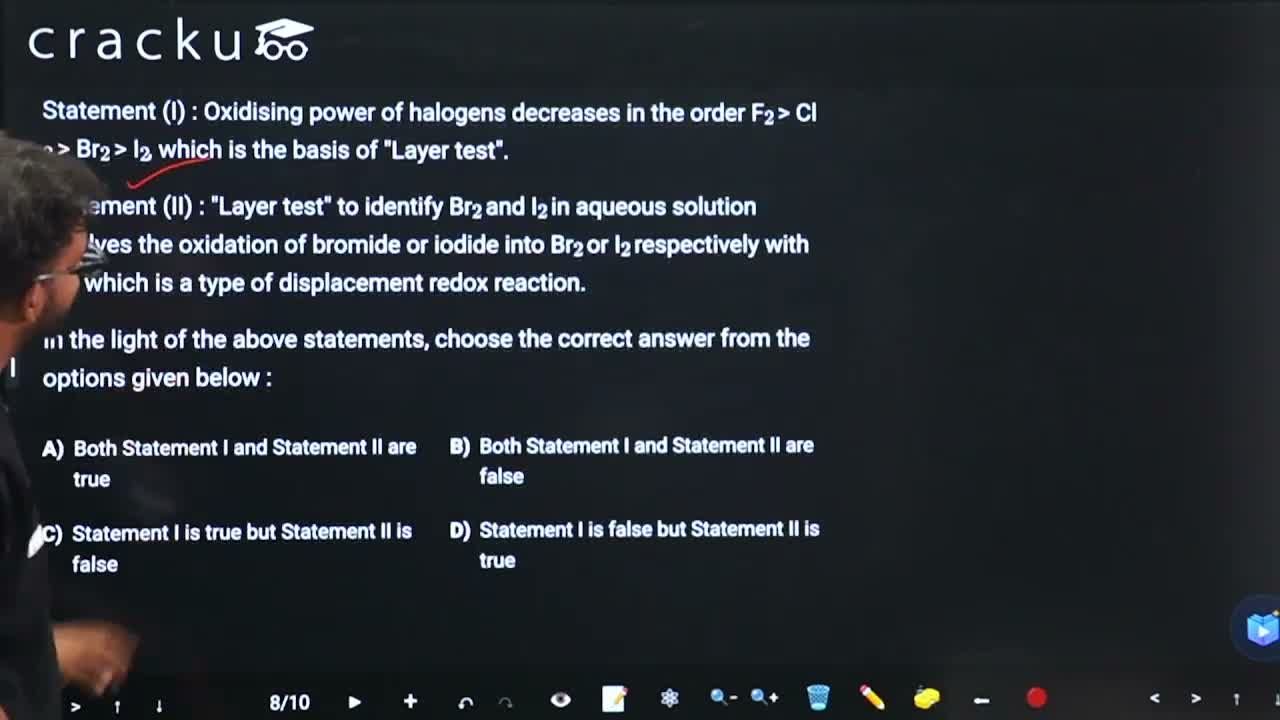
Given below are two statements :
Statement (I) : Oxidising power of halogens decreases in the order F$$_2$$ > Cl$$_2$$ > Br$$_2$$ > I$$_2$$, which is the basis of "Layer test".
Statement (II) : "Layer test" to identify Br$$_2$$ and I$$_2$$ in aqueous solution involves the oxidation of bromide or iodide into Br$$_2$$ or I$$_2$$ respectively with Cl$$_2$$, which is a type of displacement redox reaction.
In the light of the above statements, choose the correct answer from the options given below :
The oxidising power of a substance is decided by its standard reduction potential $$E^\circ\,(X_2 + 2e^- \rightarrow 2X^-)$$.
Higher $$E^\circ$$ means the molecule gains electrons more readily and is therefore a stronger oxidising agent.
For the halogens the standard values are:
$$E^\circ_{F_2/F^-}=+2.87\ \text{V},$$
$$E^\circ_{Cl_2/Cl^-}=+1.36\ \text{V},$$
$$E^\circ_{Br_2/Br^-}=+1.07\ \text{V},$$
$$E^\circ_{I_2/I^-}=+0.54\ \text{V}.$$
Because $$E^\circ_{F_2}\gt E^\circ_{Cl_2}\gt E^\circ_{Br_2}\gt E^\circ_{I_2}$$, the oxidising power decreases in the same order: $$F_2 \gt Cl_2 \gt Br_2 \gt I_2$$.
Hence Statement (I) is correct.
The “Layer test” for bromide and iodide ions is based on this difference in oxidising power. Chlorine water (or $$Cl_2$$ gas bubbled through the solution) oxidises $$Br^-$$ or $$I^-$$ because $$Cl_2$$ is a stronger oxidising agent than either $$Br_2$$ or $$I_2$$:
$$2Br^- + Cl_2 \rightarrow 2Cl^- + Br_2$$
$$2I^- + Cl_2 \rightarrow 2Cl^- + I_2$$
These are displacement redox reactions. The liberated $$Br_2$$ (orange-brown) or $$I_2$$ (violet) is then extracted into an organic solvent layer, giving the characteristic colour that identifies the ion present—hence the name “Layer test.”
Therefore Statement (II) is also correct.
Since both statements are true, the correct choice is:
Option A $$\longrightarrow\ $$ Both Statement I and Statement II are true.
Was this solution helpful?
Click on the Email ☝️ to Watch the Video Solution
Create a FREE account and get:
_1.webp)

Educational materials for JEE preparation

Ask our AI anything

AI can make mistakes. Please verify important information.
AI can make mistakes. Please verify important information.
