
Join Our JEE Preparation Group
Prep with like-minded aspirants; Get access to free daily tests and study material.
Sign in
Please select an account to continue using cracku.in
↓ →
Join Our JEE Preparation Group
Prep with like-minded aspirants; Get access to free daily tests and study material.
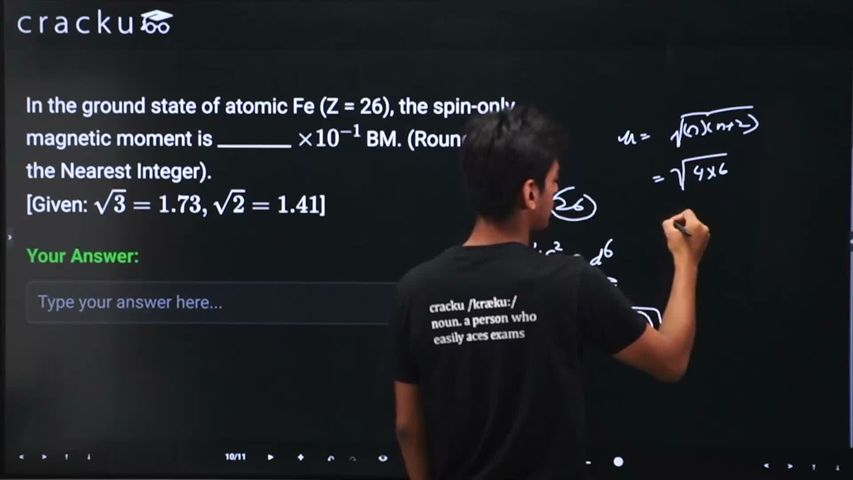
In the ground state of atomic Fe (Z = 26), the spin-only magnetic moment is ________ $$\times 10^{-1}$$ BM. (Round off to the Nearest Integer).
[Given: $$\sqrt{3} = 1.73, \sqrt{2} = 1.41$$]
Correct Answer: 49
Iron has atomic number $$Z = 26$$, and its ground state electronic configuration is $$[\text{Ar}]\, 3d^6\, 4s^2$$.
To find the number of unpaired electrons, we look at the $$3d$$ subshell which has 6 electrons distributed among 5 orbitals. By Hund's rule, the electrons fill singly first: the first five electrons go into the five $$3d$$ orbitals (one each), and the sixth electron pairs up with one of them. This gives 4 unpaired electrons.
The spin-only magnetic moment formula is $$\mu = \sqrt{n(n+2)}$$ BM, where $$n$$ is the number of unpaired electrons. Substituting $$n = 4$$:
$$\mu = \sqrt{4(4+2)} = \sqrt{4 \times 6} = \sqrt{24} = \sqrt{4 \times 6} = 2\sqrt{6}$$
Computing the value: $$\sqrt{6} = \sqrt{2} \times \sqrt{3} = 1.41 \times 1.73 = 2.4393$$
$$\mu = 2 \times 2.4393 = 4.8786 \text{ BM}$$
Expressing this as $$\_\_ \times 10^{-1}$$ BM: $$\mu = 48.786 \times 10^{-1}$$ BM. Rounding to the nearest integer gives $$49 \times 10^{-1}$$ BM.
The answer is 49.
Was this solution helpful?
Click on the Email ☝️ to Watch the Video Solution
Create a FREE account and get:
_1.webp)

Educational materials for JEE preparation

Ask our AI anything

AI can make mistakes. Please verify important information.
AI can make mistakes. Please verify important information.


