
Join Our JEE Preparation Group
Prep with like-minded aspirants; Get access to free daily tests and study material.
Sign in
Please select an account to continue using cracku.in
↓ →
Join Our JEE Preparation Group
Prep with like-minded aspirants; Get access to free daily tests and study material.
Catalyst A reduces the activation energy for a reaction by $$10$$ kJ mol$$^{-1}$$ at $$300$$ K. The ratio of rate constants, $$\frac{k_T \text{ Catalysed}}{k_T \text{ Uncatalysed}}$$ is $$e^x$$. The value of $$x$$ is ______ [nearest integer] [Assume that the pre-exponential factor is same in both the cases. Given $$R = 8.31$$ J K$$^{-1}$$ mol$$^{-1}$$]
Correct Answer: 4
We need to find the ratio of rate constants when a catalyst reduces the activation energy by 10 kJ mol⁻¹.
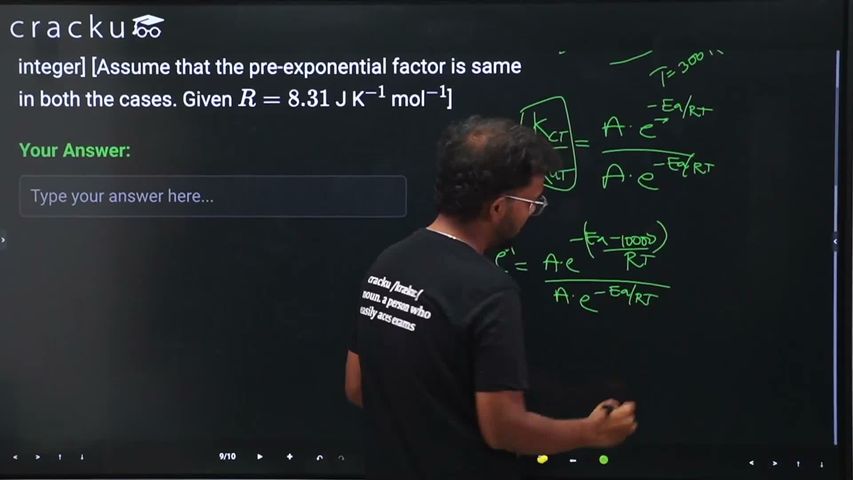
According to the Arrhenius equation, the rate constant with catalyst is given by $$k_{cat} = A \cdot e^{-(E_a - 10000)/(RT)}$$ and the rate constant without catalyst is $$k_{uncat} = A \cdot e^{-E_a/(RT)}$$. The pre-exponential factor $$A$$ is the same in both cases.
Taking the ratio of these expressions yields $$\frac{k_{cat}}{k_{uncat}} = \frac{e^{-(E_a - 10000)/(RT)}}{e^{-E_a/(RT)}} = e^{10000/(RT)}$$.
Substituting the gas constant and temperature gives $$x = \frac{10000}{RT} = \frac{10000}{8.31 \times 300} = \frac{10000}{2493} = 4.011$$.
Rounding to the nearest integer, we obtain $$x \approx 4$$, so the value of $$x$$ is 4.
Was this solution helpful?
Click on the Email ☝️ to Watch the Video Solution
Create a FREE account and get:
_1.webp)

Educational materials for JEE preparation

Ask our AI anything

AI can make mistakes. Please verify important information.
AI can make mistakes. Please verify important information.
