
Join Our JEE Preparation Group
Prep with like-minded aspirants; Get access to free daily tests and study material.
Sign in
Please select an account to continue using cracku.in
↓ →
Join Our JEE Preparation Group
Prep with like-minded aspirants; Get access to free daily tests and study material.
$$Cu(s) + Sn^{2+}(0.001M) \to Cu^{2+}(0.01M) + Sn(s)$$
The Gibbs free energy change for the above reaction at $$298$$ K is $$x \times 10^{-1}$$ kJ mol$$^{-1}$$. The value of $$x$$ is ______ [nearest integer]
[Given : $$E^\circ_{Cu^{2+}/Cu} = 0.34$$ V; $$E^\circ_{Sn^{2+}/Sn} = -0.14$$ V; $$F = 96500$$ C mol$$^{-1}$$]
Correct Answer: 983
We need to find the Gibbs free energy change for the reaction:
$$Cu(s) + Sn^{2+}(0.001\text{ M}) \to Cu^{2+}(0.01\text{ M}) + Sn(s)$$
In this reaction, Cu is oxidized at the anode and Sn2+ is reduced at the cathode.
The standard cell potential is given by
$$E^\circ_{cell} = E^\circ_{cathode} - E^\circ_{anode} = E^\circ_{Sn^{2+}/Sn} - E^\circ_{Cu^{2+}/Cu}$$
Substituting the standard potentials yields
$$E^\circ_{cell} = -0.14 - 0.34 = -0.48 \text{ V}$$
The number of electrons transferred in the reaction is $$n = 2$$.
The reaction quotient is
$$Q = \frac{[Cu^{2+}]}{[Sn^{2+}]} = \frac{0.01}{0.001} = 10$$
Applying the Nernst equation gives
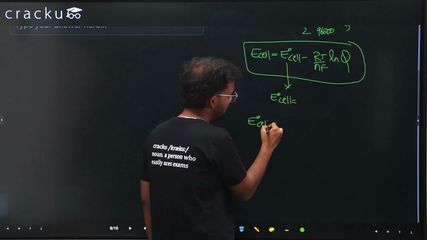
$$E_{cell} = E^\circ_{cell} - \frac{RT}{nF}\ln Q = -0.48 - \frac{8.314 \times 298}{2 \times 96500}\ln(10)$$
Evaluating the numerical values yields
$$E_{cell} = -0.48 - \frac{2477.6}{193000} \times 2.3026 = -0.48 - 0.01284 \times 2.3026$$
$$E_{cell} = -0.48 - 0.02958 = -0.50958 \text{ V}$$
The Gibbs free energy change is related to the cell potential by
$$\Delta G = -nFE_{cell} = -2 \times 96500 \times (-0.50958)$$
Hence
$$\Delta G = 98348.54 \text{ J mol}^{-1} = 98.349 \text{ kJ mol}^{-1}$$
Given that $$\Delta G = x \times 10^{-1}$$ kJ mol−1, it follows that
$$x \times 10^{-1} = 98.349$$
Solving for x gives
$$x = 983.49 \approx 983$$
The value of $$x$$ is 983.
Was this solution helpful?
Click on the Email ☝️ to Watch the Video Solution
Create a FREE account and get:
_1.webp)

Educational materials for JEE preparation

Ask our AI anything

AI can make mistakes. Please verify important information.
AI can make mistakes. Please verify important information.
