
Join Our JEE Preparation Group
Prep with like-minded aspirants; Get access to free daily tests and study material.
Sign in
Please select an account to continue using cracku.in
↓ →
Join Our JEE Preparation Group
Prep with like-minded aspirants; Get access to free daily tests and study material.
Reaction of $$[Co(H_2O)_6]^{2+}$$ with excess ammonia and in the presence of oxygen results into a diamagnetic product. Number of electrons present in $$t_{2g}$$-orbitals of the product is ______
Correct Answer: 6
We need to find the number of electrons in the $$t_{2g}$$ orbitals of the product formed when $$[Co(H_2O)_6]^{2+}$$ reacts with excess ammonia in the presence of oxygen.
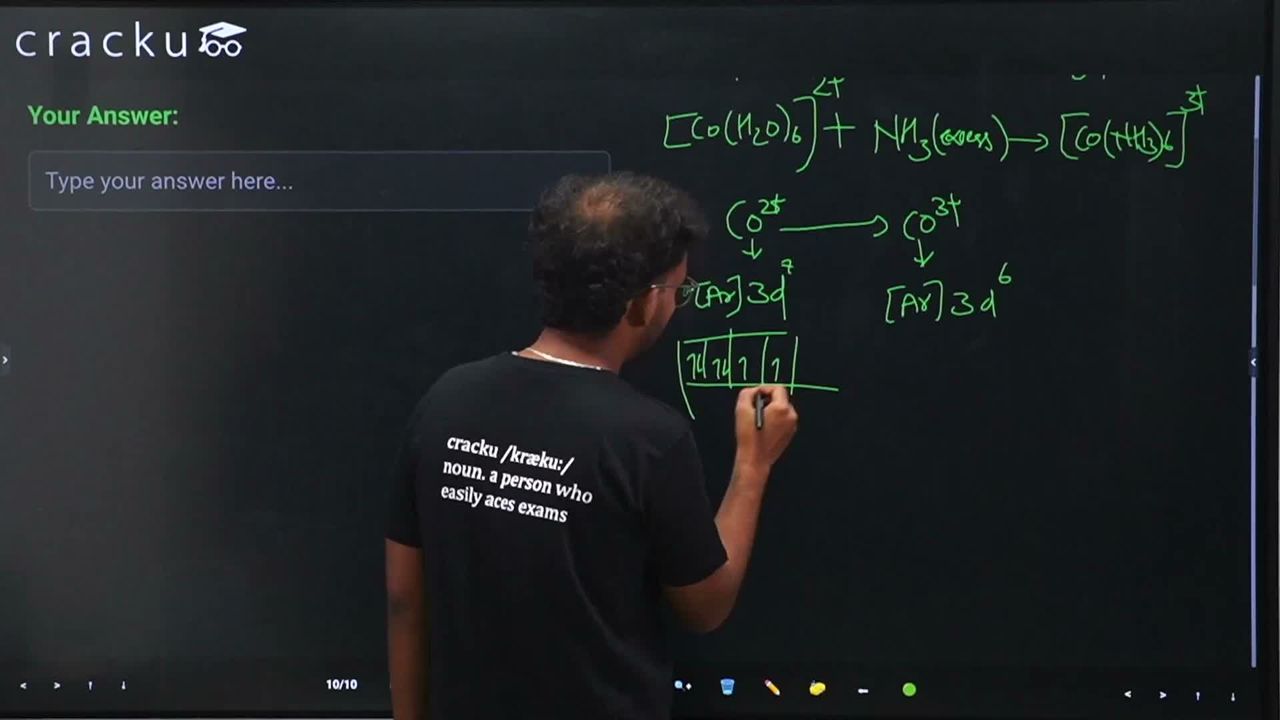
$$[Co(H_2O)_6]^{2+}$$ contains $$Co^{2+}$$ (d⁷). In the presence of excess ammonia and oxygen, $$Co^{2+}$$ is oxidized to $$Co^{3+}$$ and the water ligands are replaced by ammonia.
The product formed is $$[Co(NH_3)_6]^{3+}$$.
$$Co^{3+}$$ has the electronic configuration $$[Ar]\,3d^6$$, giving 6 d-electrons.
$$NH_3$$ is a strong field ligand, resulting in a low spin complex, which is confirmed by its diamagnetic behavior.
In a low spin octahedral $$d^6$$ complex, the electrons occupy the $$t_{2g}^6\,e_g^0$$ configuration.
All 6 electrons are therefore paired in the $$t_{2g}$$ orbitals (three orbitals with two electrons each).
The number of electrons in the $$t_{2g}$$ orbitals is 6.
Was this solution helpful?
Click on the Email ☝️ to Watch the Video Solution
Create a FREE account and get:
_1.webp)

Educational materials for JEE preparation

Ask our AI anything

AI can make mistakes. Please verify important information.
AI can make mistakes. Please verify important information.
