
Join Our JEE Preparation Group
Prep with like-minded aspirants; Get access to free daily tests and study material.
Sign in
Please select an account to continue using cracku.in
↓ →
Join Our JEE Preparation Group
Prep with like-minded aspirants; Get access to free daily tests and study material.
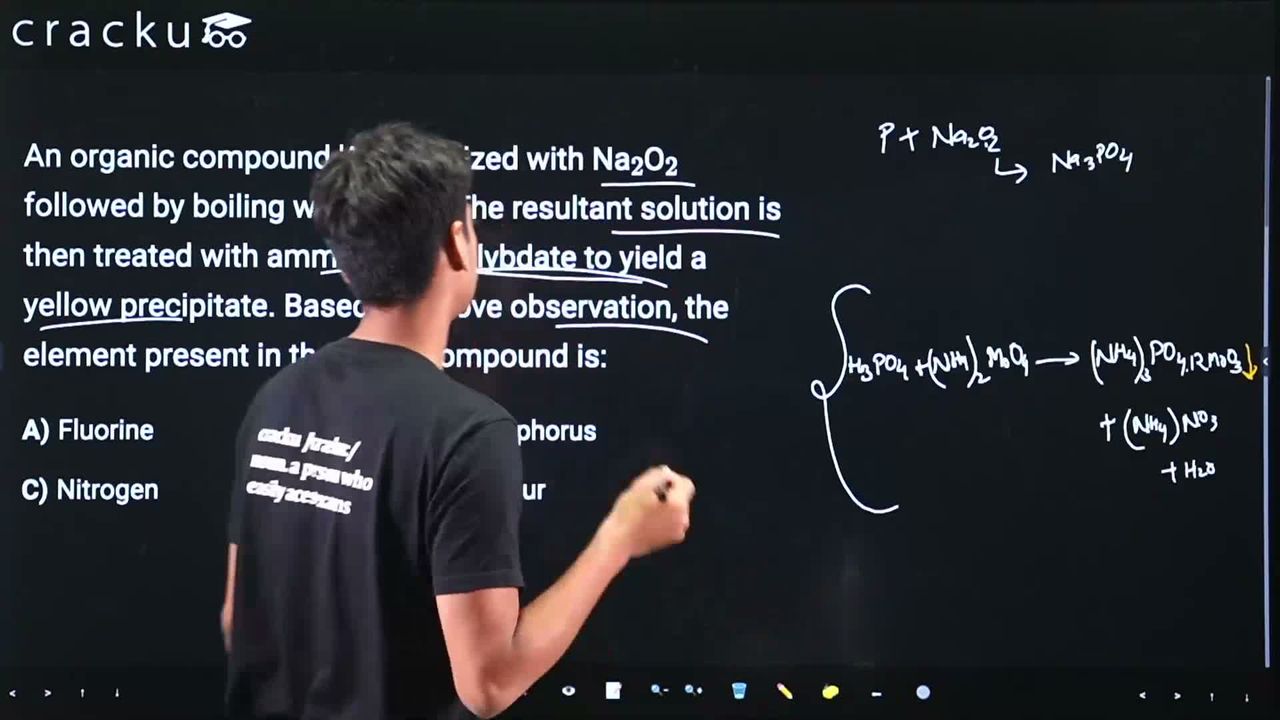
An organic compound 'A' is oxidized with Na$$_2$$O$$_2$$ followed by boiling with HNO$$_3$$. The resultant solution is then treated with ammonium molybdate to yield a yellow precipitate. Based on above observation, the element present in the given compound is:
We start by recalling a well-known qualitative test that analysts employ for detecting the presence of the element phosphorus in an organic compound. The sequence of reagents is distinctive: first the compound is fused or oxidised with an oxidising agent such as sodium peroxide, $$\text{Na}_2\text{O}_2$$, in order to convert any phosphorus present into the water-soluble phosphate ion $$\text{PO}_4^{3-}$$.
So, when the unknown organic compound “A” is treated with $$\text{Na}_2\text{O}_2$$, the following transformation takes place:
$$\text{(Phosphorus in A)} \; \overset{\text{Na}_2\text{O}_2}{\underset{\text{fusion}}{\rightarrow}} \; \text{Na}_3\text{PO}_4$$
Next, according to the stated procedure, the fusion mass is boiled with concentrated nitric acid, $$\text{HNO}_3$$. The purpose of this step is twofold: (i) to dissolve the sodium phosphate formed, producing orthophosphoric acid $$\text{H}_3\text{PO}_4$$ (or its nitrate solution), and (ii) to destroy any excess peroxide or other interfering species.
Symbolically we may write:
$$\text{Na}_3\text{PO}_4 + 3 \,\text{HNO}_3 \;\longrightarrow\; \text{H}_3\text{PO}_4 + 3 \,\text{NaNO}_3$$
Now we come to the characteristic identification step. The clear nitric-acid solution containing phosphate ions is treated with ammonium molybdate, $$(\text{NH}_4)_2\text{MoO}_4$$, in the presence of excess $$\text{HNO}_3$$ (the medium must be acidic). If phosphate ions are indeed present, a canary-yellow precipitate of ammonium phosphomolybdate is produced.
The balanced form of this precipitation reaction is generally represented as:
$$\text{H}_3\text{PO}_4 + 12 \,(\text{NH}_4)_2\text{MoO}_4 + 21 \,\text{HNO}_3 \;\longrightarrow\; (\text{NH}_4)_3\text{PO}_4 \cdot 12 \,\text{MoO}_3 \; \downarrow \; + 21 \,\text{NH}_4\text{NO}_3 + 12 \,\text{H}_2\text{O}$$
The appearance of the yellow precipitate is therefore an unmistakable confirmation test for phosphorus.
In the question, we are told exactly this sequence: oxidation with $$\text{Na}_2\text{O}_2$$, boiling with $$\text{HNO}_3$$, and finally the formation of a yellow precipitate upon addition of ammonium molybdate. Since this matches the classic test for phosphorus, we deduce that the element present in compound “A” must be phosphorus.
Fluorine, nitrogen and sulphur do not give such a yellow molybdate precipitate under these conditions; their identification relies on entirely different qualitative tests (e.g., the Lassaigne test for nitrogen and sulphur, or the precipitation of $$\text{BaSO}_4$$ for sulphate, etc.).
Hence, the correct answer is Option B.
Was this solution helpful?
Click on the Email ☝️ to Watch the Video Solution
Create a FREE account and get:
_1.webp)

Educational materials for JEE preparation

Ask our AI anything

AI can make mistakes. Please verify important information.
AI can make mistakes. Please verify important information.
