
Join Our JEE Preparation Group
Prep with like-minded aspirants; Get access to free daily tests and study material.
Sign in
Please select an account to continue using cracku.in
↓ →
Join Our JEE Preparation Group
Prep with like-minded aspirants; Get access to free daily tests and study material.
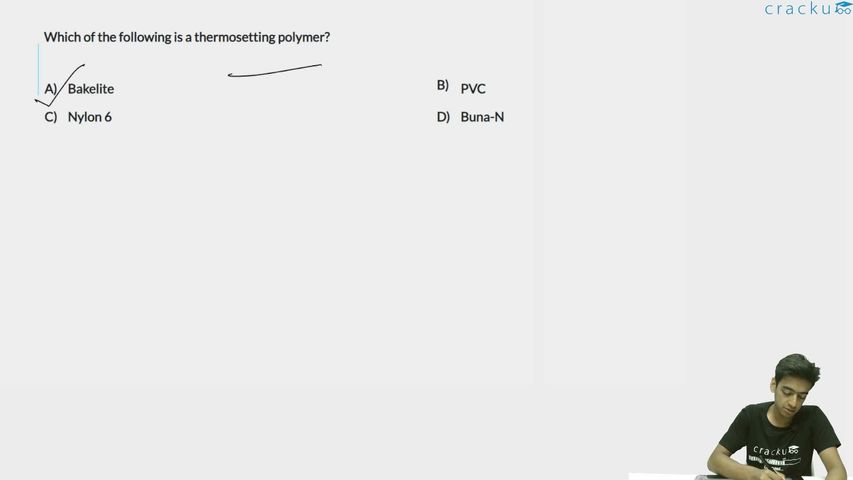
First, we recall the basic definition of a thermosetting polymer. A thermosetting polymer is a polymer that, once molded or set by heating, becomes infusible and insoluble. This irreversible hardening occurs because extensive cross-linking forms a three-dimensional network. After this curing, reheating cannot soften or melt the material; instead, it simply chars or decomposes.
Now, we consider each option one by one and decide whether it exhibits such cross-linked, permanently hard characteristics.
We have Option A, Bakelite. Bakelite is the trade name for phenol-formaldehyde resin. During its synthesis, phenol reacts with formaldehyde through a condensation reaction, initially producing a linear Novolac. Upon heating in the presence of a curing agent such as hexamethylenetetramine, Novolac undergoes further condensation to create extensive $$−CH_{2}−$$ cross-links connecting the aromatic rings. This yields a rigid, three-dimensional network. Because of these cross-links, Bakelite cannot be remelted; it is a classic thermosetting polymer used for electrical switches, handles of utensils, and radio and television casings.
Next, we look at Option B, PVC, or polyvinyl chloride. PVC is obtained by addition polymerisation of vinyl chloride $$\left(CH_{2}=CHCl\right)$$. The structure is essentially linear with slight branching; there is no extensive cross-linking. When we heat PVC, it can soften and then be moulded, and upon cooling it solidifies again. This reversibility identifies PVC as a typical thermoplastic, not a thermoset.
Then, Option C is Nylon 6. Nylon 6 is a polyamide formed by ring-opening polymerisation of caprolactam $$\left((CH_{2})5C(O)NH\right)$$. The polymer chain contains repeating $$−NH−(CH_{2})5−CO−$$ units. Although hydrogen bonding imparts high tensile strength and crystallinity, the polymer chains are still essentially linear. Heating Nylon 6 allows it to melt and be reshaped, which is the hallmark of a thermoplastic, not a thermosetting polymer.
Finally, Option D is Buna-N, also called NBR (nitrile-butadiene rubber). It is a copolymer of acrylonitrile and butadiene obtained through free-radical addition polymerisation. Buna-N is an elastomer, meaning it exhibits elasticity; it can be vulcanised to introduce some sulphur cross-links, but even vulcanised rubber does not possess the infusible, insoluble three-dimensional network characteristic of true thermosets like Bakelite.
So, comparing all four substances, only Bakelite meets the strict criterion of a thermosetting polymer with irreversible cross-linking formed upon curing.
Hence, the correct answer is Option A.
Was this solution helpful?
Click on the Email ☝️ to Watch the Video Solution
Create a FREE account and get:
_1.webp)

Educational materials for JEE preparation

Ask our AI anything

AI can make mistakes. Please verify important information.
AI can make mistakes. Please verify important information.
