
Join Our JEE Preparation Group
Prep with like-minded aspirants; Get access to free daily tests and study material.
Sign in
Please select an account to continue using cracku.in
↓ →
Join Our JEE Preparation Group
Prep with like-minded aspirants; Get access to free daily tests and study material.
The molar conductivity at infinite dilution of barium chloride, sulphuric acid and hydrochloric acid are 280, 860, 426 Scm$$^2$$mol$$^{-1}$$ respectively. The molar conductivity at infinite dilution of barium sulphate is ___ Scm$$^2$$ mol$$^{-1}$$ (Round off to the Nearest Integer).
Correct Answer: 288
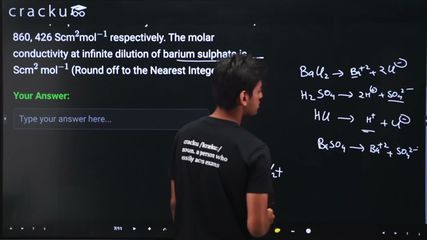
We use Kohlrausch's law of independent migration of ions: $$\Lambda_m^\infty(\text{BaSO}_4) = \Lambda_m^\infty(\text{BaCl}_2) + \Lambda_m^\infty(\text{H}_2\text{SO}_4) - 2\Lambda_m^\infty(\text{HCl})$$.
This works because $$\Lambda_m^\infty(\text{BaCl}_2) = \lambda^\infty_{\text{Ba}^{2+}} + 2\lambda^\infty_{\text{Cl}^-}$$, $$\Lambda_m^\infty(\text{H}_2\text{SO}_4) = 2\lambda^\infty_{\text{H}^+} + \lambda^\infty_{\text{SO}_4^{2-}}$$, and $$2\Lambda_m^\infty(\text{HCl}) = 2\lambda^\infty_{\text{H}^+} + 2\lambda^\infty_{\text{Cl}^-}$$. Adding the first two and subtracting the third gives $$\lambda^\infty_{\text{Ba}^{2+}} + \lambda^\infty_{\text{SO}_4^{2-}} = \Lambda_m^\infty(\text{BaSO}_4)$$.
Substituting the given values: $$\Lambda_m^\infty(\text{BaSO}_4) = 280 + 860 - 2(426) = 280 + 860 - 852 = 288 \text{ S cm}^2 \text{mol}^{-1}$$.
The answer is $$288$$ S cm$$^2$$ mol$$^{-1}$$.
Was this solution helpful?
Click on the Email ☝️ to Watch the Video Solution
Create a FREE account and get:
_1.webp)

Educational materials for JEE preparation

Ask our AI anything

AI can make mistakes. Please verify important information.
AI can make mistakes. Please verify important information.
