
Join Our JEE Preparation Group
Prep with like-minded aspirants; Get access to free daily tests and study material.
Sign in
Please select an account to continue using cracku.in
↓ →
Join Our JEE Preparation Group
Prep with like-minded aspirants; Get access to free daily tests and study material.
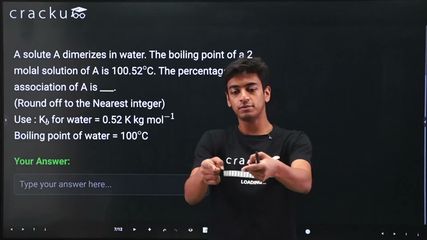
A solute A dimerizes in water. The boiling point of a 2 molal solution of A is 100.52$$^\circ$$C. The percentage association of A is ___.
(Round off to the Nearest integer)
Use : K$$_b$$ for water = 0.52 K kg mol$$^{-1}$$
Boiling point of water = 100$$^\circ$$C
Correct Answer: 100
The boiling point elevation is $$\Delta T_b = 100.52 - 100 = 0.52^\circ\text{C}$$. For a 2 molal solution with no association, $$\Delta T_b = K_b \times m = 0.52 \times 2 = 1.04^\circ\text{C}$$. The observed elevation is only 0.52°C, so the van 't Hoff factor is $$i = \frac{\Delta T_{b,\text{obs}}}{\Delta T_{b,\text{calc}}} = \frac{0.52}{1.04} = 0.5$$.
For a solute that dimerizes: $$2A \rightleftharpoons A_2$$. If $$\alpha$$ is the degree of association, then starting with 1 mole of A, after association we have $$(1 - \alpha)$$ moles of free A and $$\frac{\alpha}{2}$$ moles of $$A_2$$, for a total of $$1 - \alpha + \frac{\alpha}{2} = 1 - \frac{\alpha}{2}$$ moles.
The van 't Hoff factor is $$i = 1 - \frac{\alpha}{2}$$. Setting this equal to 0.5: $$1 - \frac{\alpha}{2} = 0.5$$, which gives $$\frac{\alpha}{2} = 0.5$$, so $$\alpha = 1.0$$. The percentage association is $$\alpha \times 100 = 100\%$$.
Was this solution helpful?
Click on the Email ☝️ to Watch the Video Solution
Create a FREE account and get:
_1.webp)

Educational materials for JEE preparation

Ask our AI anything

AI can make mistakes. Please verify important information.
AI can make mistakes. Please verify important information.
