
Join Our JEE Preparation Group
Prep with like-minded aspirants; Get access to free daily tests and study material.
Sign in
Please select an account to continue using cracku.in
↓ →
Join Our JEE Preparation Group
Prep with like-minded aspirants; Get access to free daily tests and study material.
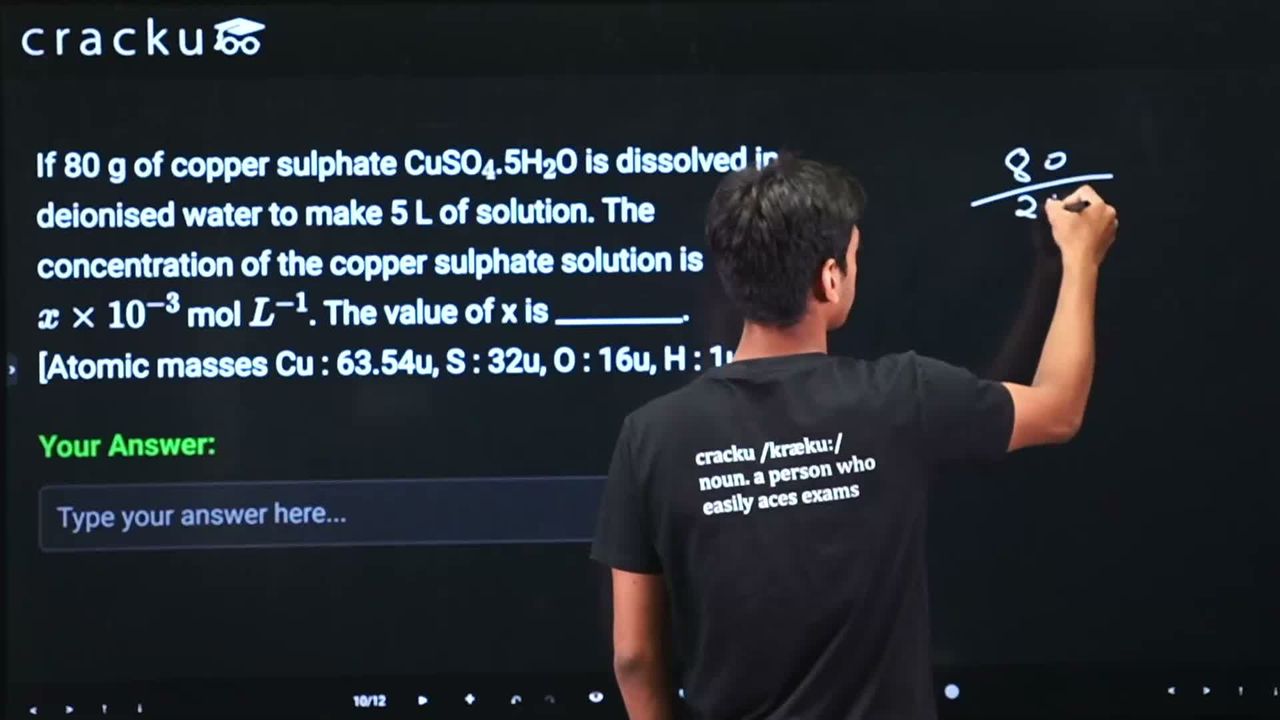
If 80 g of copper sulphate CuSO$$_4$$.5H$$_2$$O is dissolved in deionised water to make 5 L of solution. The concentration of the copper sulphate solution is $$x \times 10^{-3}$$ mol $$L^{-1}$$. The value of x is _________.
[Atomic masses Cu : 63.54u, S : 32u, O : 16u, H : 1u]
Correct Answer: 64
The question asks for the molar concentration (molarity) of a copper(II) sulphate pentahydrate solution. By definition, molarity is “moles of solute per litre of solution.” Hence, we must first calculate the number of moles present in the given 80 g of $$\text{CuSO}_4\cdot5\text{H}_2\text{O}$$, and then divide by the final volume, which is 5 L.
We have to determine the molar mass (molecular weight) of $$\text{CuSO}_4\cdot5\text{H}_2\text{O}$$. We add the individual atomic masses furnished in the data:
$$$ \begin{aligned} M_{\text{CuSO}_4\cdot5\text{H}_2\text{O}} &= M_{\text{Cu}} + M_{\text{S}} + 4\,M_{\text{O}} + 5\bigl(2\,M_{\text{H}} + M_{\text{O}}\bigr) \\[4pt] &= 63.54 + 32 + 4(16) + 5\bigl(2(1) + 16\bigr) \end{aligned} $$$
Now we carry out the arithmetic term by term.
First, the anhydrous part $$\text{CuSO}_4$$:
$$$ 63.54 + 32 + 4(16) = 63.54 + 32 + 64 = 159.54 $$$
Next, the water of crystallisation $$5\text{H}_2\text{O}$$:
Each water molecule has $$2(1) + 16 = 2 + 16 = 18$$ g mol$$^{-1}$$.
Therefore five water molecules contribute
$$ 5 \times 18 = 90 $$
Adding the two parts gives the full molar mass:
$$$ M_{\text{CuSO}_4\cdot5\text{H}_2\text{O}} = 159.54 + 90 = 249.54\ \text{g mol}^{-1} $$$
Now, applying the formula $$\text{moles} = \dfrac{\text{mass}}{\text{molar mass}}$$, we substitute the given mass 80 g:
$$ n = \frac{80\ \text{g}}{249.54\ \text{g mol}^{-1}} $$
We perform the division:
$$ n \approx 0.3206\ \text{mol} $$
The solution volume is 5 L, therefore the molarity $$M$$ is:
$$$ M = \frac{n}{V} = \frac{0.3206\ \text{mol}}{5\ \text{L}} = 0.06412\ \text{mol L}^{-1} $$$
The concentration is required in the form $$x \times 10^{-3}\ \text{mol L}^{-1}$$. We rewrite 0.06412 in that power-of-ten format:
$$ 0.06412 = 64.12 \times 10^{-3} $$
Rounding in the usual manner for JEE Main (to the nearest whole number for x), we take $$x = 64$$.
So, the answer is $$64$$.
Was this solution helpful?
Click on the Email ☝️ to Watch the Video Solution
Create a FREE account and get:
_1.webp)

Educational materials for JEE preparation

Ask our AI anything

AI can make mistakes. Please verify important information.
AI can make mistakes. Please verify important information.
