
Join Our JEE Preparation Group
Prep with like-minded aspirants; Get access to free daily tests and study material.
Sign in
Please select an account to continue using cracku.in
↓ →
Join Our JEE Preparation Group
Prep with like-minded aspirants; Get access to free daily tests and study material.
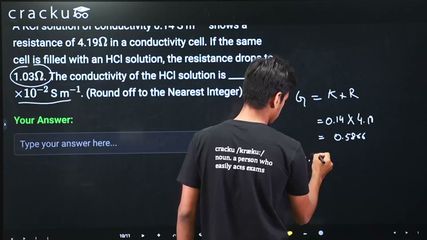
A KCl solution of conductivity 0.14 S m$$^{-1}$$ shows a resistance of 4.19$$\Omega$$ in a conductivity cell. If the same cell is filled with an HCl solution, the resistance drops to 1.03$$\Omega$$. The conductivity of the HCl solution is ________ $$\times 10^{-2}$$ S m$$^{-1}$$. (Round off to the Nearest Integer).
Correct Answer: 57
The cell constant $$G^*$$ of a conductivity cell is related to the conductivity $$\kappa$$ and the resistance $$R$$ by the formula $$\kappa = \frac{G^*}{R}$$, or equivalently $$G^* = \kappa \times R$$.
Using the KCl solution data to find the cell constant:
$$G^* = \kappa_{\text{KCl}} \times R_{\text{KCl}} = 0.14 \times 4.19 = 0.5866 \text{ m}^{-1}$$
Now using this cell constant with the HCl solution:
$$\kappa_{\text{HCl}} = \frac{G^*}{R_{\text{HCl}}} = \frac{0.5866}{1.03} = 0.5695 \text{ S m}^{-1}$$
Converting to the required format of $$\times 10^{-2} \text{ S m}^{-1}$$:
$$\kappa_{\text{HCl}} = 56.95 \times 10^{-2} \text{ S m}^{-1}$$
Rounding to the nearest integer, this gives $$57 \times 10^{-2} \text{ S m}^{-1}$$.
The answer is 57.
Was this solution helpful?
Click on the Email ☝️ to Watch the Video Solution
Create a FREE account and get:
_1.webp)

Educational materials for JEE preparation

Ask our AI anything

AI can make mistakes. Please verify important information.
AI can make mistakes. Please verify important information.


