
Join Our JEE Preparation Group
Prep with like-minded aspirants; Get access to free daily tests and study material.
Sign in
Please select an account to continue using cracku.in
↓ →
Join Our JEE Preparation Group
Prep with like-minded aspirants; Get access to free daily tests and study material.
The solubility product constants of Ag$$_2$$CrO$$_4$$ and AgBr are 32x and 4y respectively at 298 K. The value of $$\left(\frac{\text{molarity of Ag}_2\text{CrO}_4}{\text{molarity of AgBr}}\right)$$ can be expressed as :
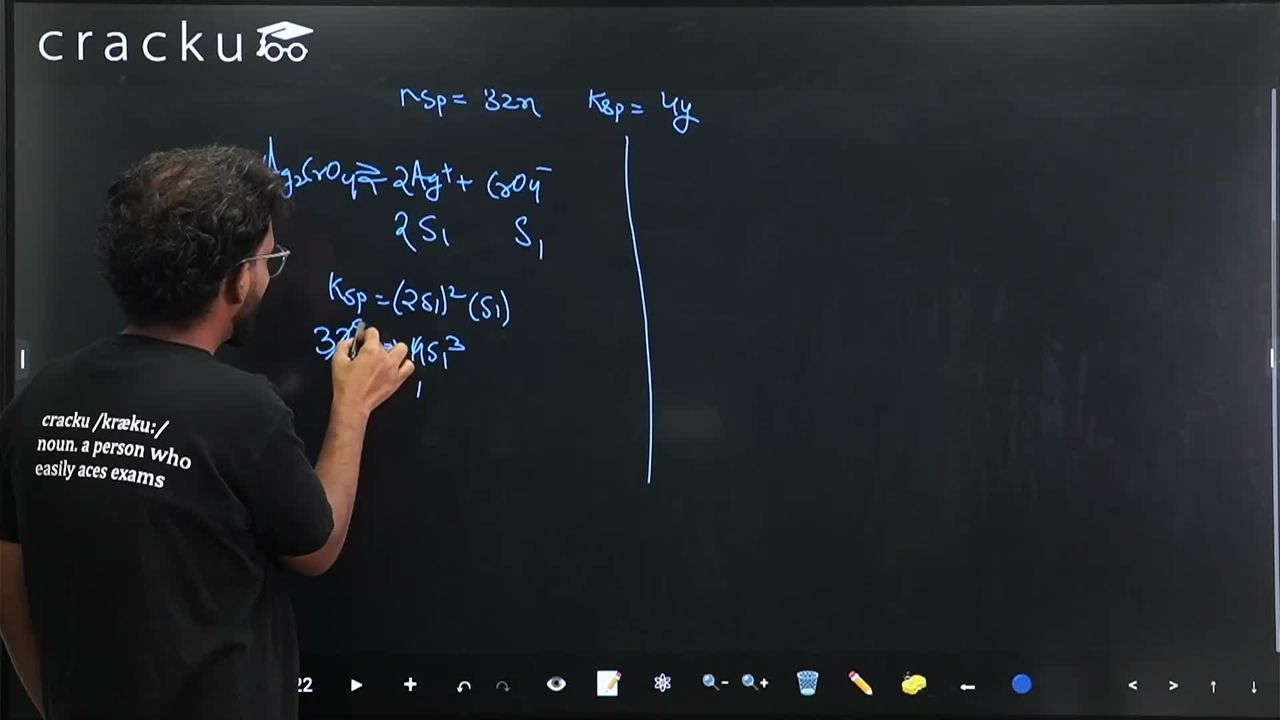
Let the molar solubility (molarity of the saturated solution) of $$Ag_2CrO_4$$ be $$S_1$$ M.
$$Ag_2CrO_4 \; (s) \;\rightleftharpoons\; 2\,Ag^+ (aq) + CrO_4^{2-} (aq)$$
At equilibrium: $$[Ag^+] = 2S_1$$ and $$[CrO_4^{2-}] = S_1$$.
For a salt $$A_mB_n$$ that dissolves as $$mA^{n+} + nB^{m-}$$, the solubility product expression is $$K_{sp} = [A^{n+}]^m [B^{m-}]^n$$.
Applying this rule:
$$K_{sp}(Ag_2CrO_4) = [Ag^+]^2[CrO_4^{2-}] = (2S_1)^2(S_1)=4S_1^{\,3} \quad -(1)$$
The question states $$K_{sp}(Ag_2CrO_4)=32x$$, so from $$(1)$$
$$4S_1^{\,3}=32x \;\;\Longrightarrow\;\; S_1^{\,3}=8x \;\;\Longrightarrow\;\; S_1=2x^{1/3} \quad -(2)$$
Let the molar solubility of $$AgBr$$ be $$S_2$$ M.
$$AgBr \; (s) \;\rightleftharpoons\; Ag^+ (aq) + Br^- (aq)$$
At equilibrium: $$[Ag^+]=S_2$$ and $$[Br^-]=S_2$$.
For a salt that dissociates 1:1, $$K_{sp}=S_2^{\,2} \quad -(3)$$
The question gives $$K_{sp}(AgBr)=4y$$, hence from $$(3)$$
$$S_2^{\,2}=4y \;\;\Longrightarrow\;\; S_2=2y^{1/2} \quad -(4)$$
The required ratio is
$$\frac{\text{molarity of } Ag_2CrO_4}{\text{molarity of } AgBr}=\frac{S_1}{S_2}=\frac{2x^{1/3}}{2y^{1/2}}=\frac{\sqrt[3]{x}}{\sqrt{y}}$$
Therefore, the correct choice is
Option D i.e $$\frac{\sqrt[3]{x}}{\sqrt{y}}$$
Click on the Email ☝️ to Watch the Video Solution
Create a FREE account and get:
_1.webp)

Educational materials for JEE preparation

Ask our AI anything

AI can make mistakes. Please verify important information.
AI can make mistakes. Please verify important information.


