
Join Our JEE Preparation Group
Prep with like-minded aspirants; Get access to free daily tests and study material.
Sign in
Please select an account to continue using cracku.in
↓ →
Join Our JEE Preparation Group
Prep with like-minded aspirants; Get access to free daily tests and study material.
The number of ordered pairs $$(r, k)$$ for which $$6 \cdot {}^{35}C_r = (k^2 - 3) \cdot {}^{36}C_{r+1}$$, where $$k$$ is an integer is
We begin with the given equation
$$6\;{}^{35}C_r \;=\;(k^2-3)\;{}^{36}C_{\,r+1}.$$
We wish to connect the two binomial coefficients so that they involve the same upper index. The basic identity for binomial coefficients is
$$^{\,n}C_m \;=\;\dfrac{n}{m}\;{}^{\,n-1}C_{\,m-1}.$$
Using this with $$n=36$$ and $$m=r+1$$ we have
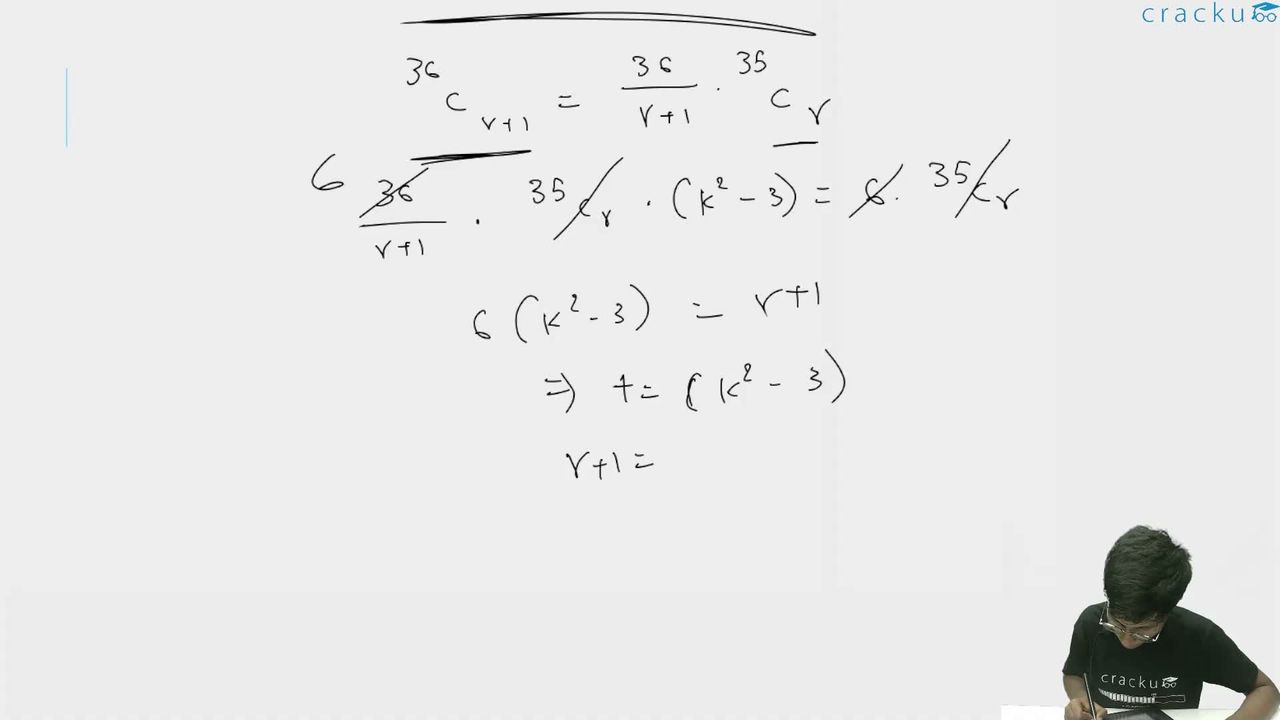
$$^{36}C_{\,r+1} \;=\;\dfrac{36}{r+1}\;{}^{35}C_r.$$
Substituting this into the original equation gives
$$6\;{}^{35}C_r \;=\;(k^2-3)\;\left(\dfrac{36}{r+1}\;{}^{35}C_r\right).$$
Because $$^{35}C_r$$ is non-zero for all integral $$r$$ with $$0\le r\le35,$$ we can cancel it from both sides:
$$6 \;=\;(k^2-3)\;\dfrac{36}{r+1}.$$
Multiplying both sides by $$\dfrac{r+1}{36}$$ yields
$$k^2-3 \;=\;\dfrac{6(r+1)}{36}.$$
Simplifying the fraction $$\dfrac{6}{36}= \dfrac{1}{6},$$ we get
$$k^2-3 \;=\;\dfrac{r+1}{6}.$$
So $$r+1$$ must be a multiple of 6. Write
$$r+1 = 6t,$$
where $$t$$ is an integer. Substituting this into our equation gives
$$k^2-3 = t,$$
or equivalently
$$k^2 = t+3.$$
Next we restrict the possible values of $$t$$. Because $$r$$ must satisfy $$0 \le r \le 35,$$ we have $$1 \le r+1 \le 36,$$ and therefore
$$1 \le 6t \le 36 \;\Longrightarrow\; 1 \le t \le 6.$$
Thus the only permissible values are
$$t = 1,2,3,4,5,6.$$
For each of these $$t$$ we compute $$k^2 = t+3$$:
$$\begin{aligned} t=1 &\;\Rightarrow\; k^2 = 4,\\ t=2 &\;\Rightarrow\; k^2 = 5,\\ t=3 &\;\Rightarrow\; k^2 = 6,\\ t=4 &\;\Rightarrow\; k^2 = 7,\\ t=5 &\;\Rightarrow\; k^2 = 8,\\ t=6 &\;\Rightarrow\; k^2 = 9. \end{aligned}$$
Among the numbers $$4,5,6,7,8,9,$$ the perfect squares are only $$4$$ and $$9.$$ Hence we keep
$$k^2 = 4 \;\text{or}\; k^2 = 9.$$
Handling each case:
• If $$k^2 = 4,$$ then $$k = \pm2.$$ This comes from $$t=1,$$ so $$r+1 = 6\cdot1 = 6 \Rightarrow r = 5.$$ Thus we obtain the two ordered pairs $$(5,2)$$ and $$(5,-2).$$
• If $$k^2 = 9,$$ then $$k = \pm3.$$ This comes from $$t=6,$$ so $$r+1 = 6\cdot6 = 36 \Rightarrow r = 35.$$ Thus we obtain the two ordered pairs $$(35,3)$$ and $$(35,-3).$$
No other $$t$$ values lead to integer $$k$$, so there are altogether
$$2 + 2 = 4$$
ordered pairs $$(r,k).$$
Hence, the correct answer is Option D.
Was this solution helpful?
Click on the Email ☝️ to Watch the Video Solution
Create a FREE account and get:
_1.webp)

Educational materials for JEE preparation

Ask our AI anything

AI can make mistakes. Please verify important information.
AI can make mistakes. Please verify important information.
