
Join Our JEE Preparation Group
Prep with like-minded aspirants; Get access to free daily tests and study material.
Sign in
Please select an account to continue using cracku.in
↓ →
Join Our JEE Preparation Group
Prep with like-minded aspirants; Get access to free daily tests and study material.
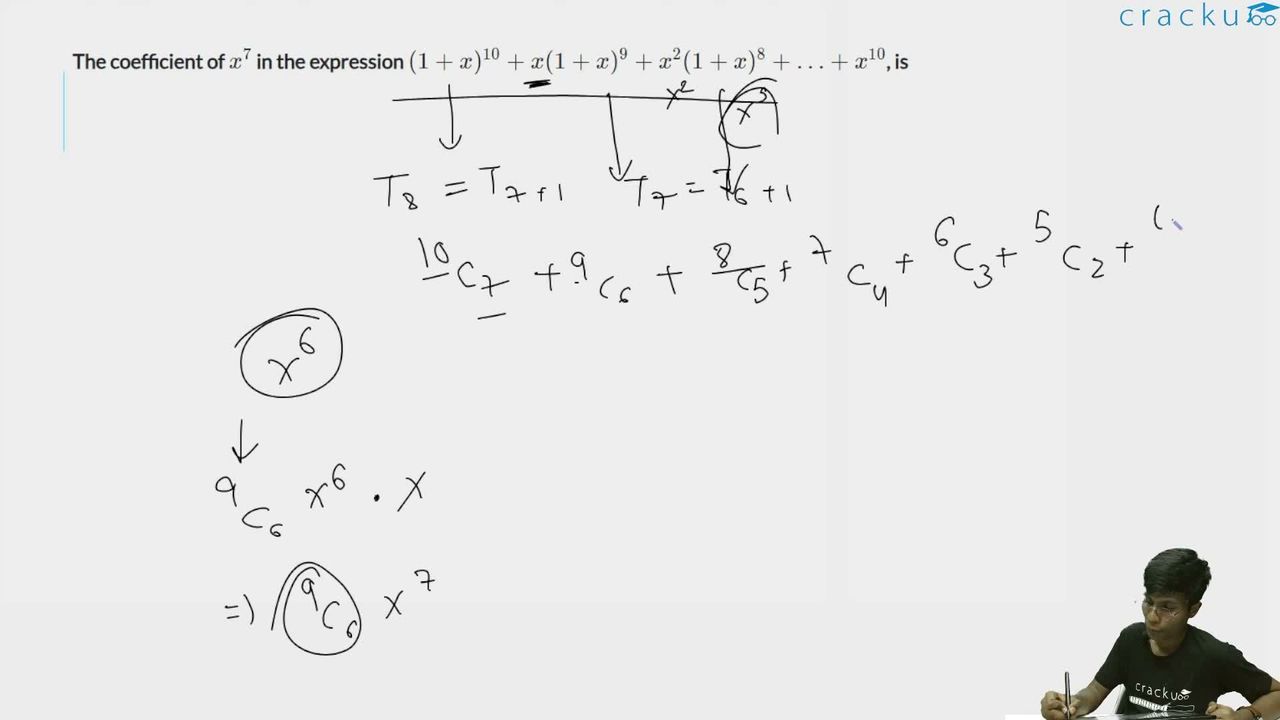
The coefficient of $$x^7$$ in the expression $$(1 + x)^{10} + x(1 + x)^9 + x^2(1 + x)^8 + \ldots + x^{10}$$, is
We are asked to find the coefficient of $$x^7$$ in the long sum
$$$S \;=\; (1 + x)^{10} \;+\; x(1 + x)^{9} \;+\; x^{2}(1 + x)^{8} \;+\; \cdots \;+\; x^{10}.$$$
For convenience we rewrite this expression in sigma notation, so that every term follows the same pattern. Observing the powers, we can write
$$$S \;=\; \sum_{k = 0}^{10} x^{\,k}\,(1 + x)^{\,10 - k}.$$$
Here the index $$k$$ tells us the shift contributed by the factor $$x^k,$$ while $$(1 + x)^{10-k}$$ is the binomial factor that is still to be expanded.
Our goal is to collect the total coefficient of $$x^7$$ in this entire sum. A term from the $$k^{\text{th}}$$ summand will have the general form
$$$x^{\,k}\,\bigl[\text{coefficient of }x^{\,j}\text{ in }(1 + x)^{10 - k}\bigr] \;=\; x^{\,k}\,\binom{\,10 - k\,}{\,j\,}x^{\,j} \;=\; \binom{\,10 - k\,}{\,j\,}x^{\,k + j}.$$$
To make the power of $$x$$ equal to 7, the indices must satisfy
$$k + j \;=\; 7.$$
Because $$j$$ must be a non-negative integer not exceeding $$10 - k,$$ only those $$k$$ from 0 up to 7 are possible; for each such $$k$$ we then have the unique choice $$j = 7 - k.$$ Substituting $$j = 7 - k$$ in the binomial coefficient gives the contribution from the $$k^{\text{th}}$$ term:
$$$\text{Contribution}(k) \;=\; \binom{\,10 - k\,}{\,7 - k\,}.$$$
We now list every admissible $$k$$ and compute the corresponding binomial coefficient one by one, showing every arithmetic step.
For $$k = 0$$: $$\binom{10}{7} = \frac{10!}{7!\,3!} = 120.$$
For $$k = 1$$: $$\binom{9}{6} = \frac{9!}{6!\,3!} = 84.$$
For $$k = 2$$: $$\binom{8}{5} = \frac{8!}{5!\,3!} = 56.$$
For $$k = 3$$: $$\binom{7}{4} = \frac{7!}{4!\,3!} = 35.$$
For $$k = 4$$: $$\binom{6}{3} = \frac{6!}{3!\,3!} = 20.$$
For $$k = 5$$: $$\binom{5}{2} = \frac{5!}{2!\,3!} = 10.$$
For $$k = 6$$: $$\binom{4}{1} = 4.$$
For $$k = 7$$: $$\binom{3}{0} = 1.$$
All remaining $$k$$ (namely 8, 9, 10) are not allowed because they would require $$j$$ to be negative, which is impossible in a binomial expansion. Now we add up all the contributions obtained:
$$$\begin{aligned} \text{Total coefficient} &= 120 + 84 + 56 + 35 + 20 + 10 + 4 + 1 \\ &= 204 + 56 + 35 + 20 + 10 + 4 + 1 \\ &= 260 + 35 + 20 + 10 + 4 + 1 \\ &= 295 + 20 + 10 + 4 + 1 \\ &= 315 + 10 + 4 + 1 \\ &= 325 + 4 + 1 \\ &= 329 + 1 \\ &= 330. \end{aligned}$$$
So, the coefficient of $$x^7$$ in the given sum is $$330$$.
Hence, the correct answer is Option B.
Was this solution helpful?
Click on the Email ☝️ to Watch the Video Solution
Create a FREE account and get:
_1.webp)

Educational materials for JEE preparation

Ask our AI anything

AI can make mistakes. Please verify important information.
AI can make mistakes. Please verify important information.
