
Join Our JEE Preparation Group
Prep with like-minded aspirants; Get access to free daily tests and study material.
Sign in
Please select an account to continue using cracku.in
↓ →
Join Our JEE Preparation Group
Prep with like-minded aspirants; Get access to free daily tests and study material.
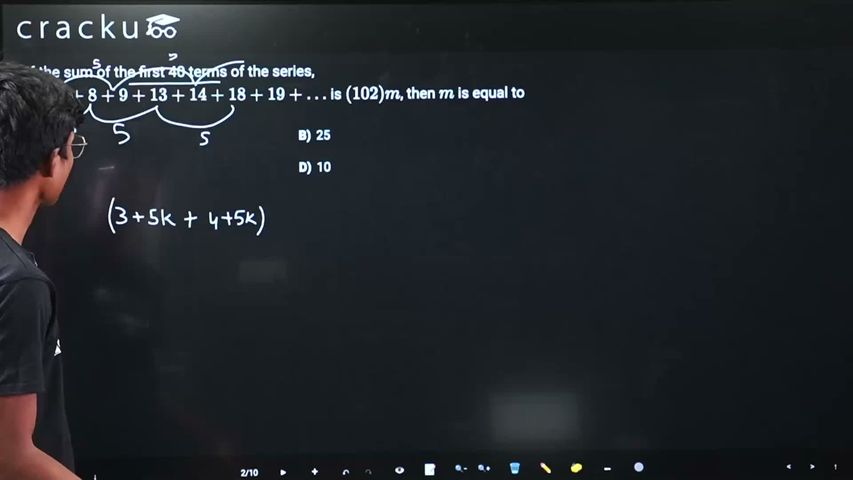
If the sum of the first 40 terms of the series, $$3 + 4 + 8 + 9 + 13 + 14 + 18 + 19 + \ldots$$ is $$(102)m$$, then $$m$$ is equal to
We begin by writing a few terms again to notice the regularity:
$$3,\;4,\;8,\;9,\;13,\;14,\;18,\;19,\;\ldots$$
Inside each small block of two successive terms the difference is $$1$$, while the first number of one block is obtained from the first number of the previous block by adding $$5$$. The same happens with the second numbers. Hence every block (or “pair”) can be described neatly.
Let us label the blocks by a non-negative integer $$k$$.
For $$k=0$$ the two terms are $$3$$ and $$4$$.
Adding $$5$$ once gives the next block $$8,9$$, so for $$k=1$$ the terms are $$3+5(1)=8$$ and $$4+5(1)=9$$.
Continuing like this, the block numbered $$k$$ contributes the two terms
$$3+5k \qquad\text{and}\qquad 4+5k.$$
Hence the entire series may be written as
$$\bigl(3+5\!\cdot\!0,\;4+5\!\cdot\!0\bigr),\; \bigl(3+5\!\cdot\!1,\;4+5\!\cdot\!1\bigr),\; \bigl(3+5\!\cdot\!2,\;4+5\!\cdot\!2\bigr),\;\ldots$$
In every block there are two terms, so the first $$40$$ terms form $$40/2=20$$ complete blocks. Thus we must sum the blocks for $$k=0,1,2,\ldots,19$$.
Within a single block the sum of the two terms is
$$\bigl(3+5k\bigr)+\bigl(4+5k\bigr)=7+10k.$$
Therefore the required sum of the first $$40$$ terms is
$$S_{40}=\sum_{k=0}^{19}\bigl(7+10k\bigr).$$
We separate the constant part and the part involving $$k$$:
$$S_{40}= \sum_{k=0}^{19}7 \;+\; \sum_{k=0}^{19}10k = 7\sum_{k=0}^{19}1 \;+\;10\sum_{k=0}^{19}k.$$
The first summation is simply $$7$$ added $$20$$ times, giving $$7\times20$$.
For the second summation we use the standard formula for the sum of the first $$n$$ natural numbers:
$$\sum_{k=0}^{n-1}k = \frac{n(n-1)}{2}.$$
Here $$n=20$$, so
$$\sum_{k=0}^{19}k = \frac{20(20-1)}{2}=\frac{20\cdot19}{2}=190.$$
Substituting these results back, we get
$$S_{40}=7\times20 \;+\;10\times190 = 140 \;+\;1900 = 2040.$$
The problem states that this sum equals $$(102)m$$. Hence
$$2040 = 102\,m.$$
Solving for $$m$$ we divide both sides by $$102$$:
$$m=\frac{2040}{102}=20.$$
Hence, the correct answer is Option A.
Was this solution helpful?
Click on the Email ☝️ to Watch the Video Solution
Create a FREE account and get:
_1.webp)

Educational materials for JEE preparation

Ask our AI anything

AI can make mistakes. Please verify important information.
AI can make mistakes. Please verify important information.
