
Join Our JEE Preparation Group
Prep with like-minded aspirants; Get access to free daily tests and study material.
Sign in
Please select an account to continue using cracku.in
↓ →
Join Our JEE Preparation Group
Prep with like-minded aspirants; Get access to free daily tests and study material.
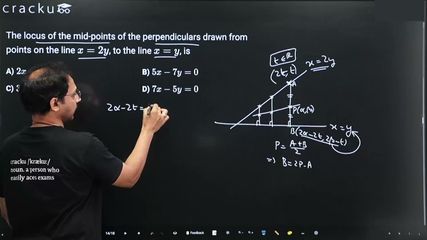
The locus of the mid-points of the perpendiculars drawn from points on the line $$x = 2y$$, to the line $$x = y$$, is
Let us begin by choosing an arbitrary point on the given line $$x = 2y$$. If we denote the ordinate of this point by the parameter $$k$$, then the abscissa must be twice the ordinate. So the point can be written as $$P\,(2k,\;k)$$.
From this point $$P$$ we drop a perpendicular to the line $$x = y$$. To find the foot of this perpendicular we recall the standard formula:
For a line written as $$ax + by + c = 0$$ and an external point $$(x_1,y_1)$$, the coordinates of the foot of the perpendicular $$(x',y')$$ are given by
$$x' \;=\; x_1 - \dfrac{a\,(ax_1 + by_1 + c)}{a^2 + b^2}, \qquad y' \;=\; y_1 - \dfrac{b\,(ax_1 + by_1 + c)}{a^2 + b^2}.$$
Writing $$x = y$$ as $$x - y = 0$$ we identify $$a = 1,\;b = -1,\;c = 0$$. For the point $$P(2k,k)$$ we now compute
$$ax_1 + by_1 + c \;=\; 1(2k) + (-1)(k) + 0 \;=\; k,$$ $$a^2 + b^2 \;=\; 1^2 + (-1)^2 \;=\; 2.$$
Substituting these values into the formula, the coordinates of the foot $$Q$$ are
$$x_Q \;=\; 2k \;-\; \dfrac{1\,(k)}{2} \;=\; 2k - \dfrac{k}{2} \;=\; \dfrac{3k}{2},$$ $$y_Q \;=\; k \;-\; \dfrac{(-1)\,(k)}{2} \;=\; k + \dfrac{k}{2} \;=\; \dfrac{3k}{2}.$$
Hence $$Q\Bigl(\dfrac{3k}{2},\;\dfrac{3k}{2}\Bigr)$$ lies on the line $$x = y$$, as expected.
We now seek the midpoint $$M$$ of the segment $$PQ$$. The midpoint formula is
$$M\bigl(x_M,\,y_M\bigr)\;=\;\left(\dfrac{x_P + x_Q}{2},\;\dfrac{y_P + y_Q}{2}\right).$$
Using $$P(2k,k)$$ and $$Q\bigl(\dfrac{3k}{2},\dfrac{3k}{2}\bigr)$$ we obtain
$$x_M \;=\; \dfrac{\,2k + \dfrac{3k}{2}\,}{2} \;=\; \dfrac{\dfrac{4k + 3k}{2}}{2} \;=\; \dfrac{\dfrac{7k}{2}}{2} \;=\; \dfrac{7k}{4},$$
$$y_M \;=\; \dfrac{\,k + \dfrac{3k}{2}\,}{2} \;=\; \dfrac{\dfrac{2k + 3k}{2}}{2} \;=\; \dfrac{\dfrac{5k}{2}}{2} \;=\; \dfrac{5k}{4}.$$
Thus the running midpoint has coordinates $$M\Bigl(\dfrac{7k}{4},\;\dfrac{5k}{4}\Bigr).$$
To find the locus we eliminate the parameter $$k$$. From the coordinates we have
$$k \;=\; \dfrac{4x_M}{7}, \qquad k \;=\; \dfrac{4y_M}{5}.$$
Equating these two expressions for $$k$$ gives
$$\dfrac{4x_M}{7} \;=\; \dfrac{4y_M}{5}\;\;\Longrightarrow\;\; \dfrac{x_M}{7} \;=\; \dfrac{y_M}{5}\;\;\Longrightarrow\;\; 5x_M - 7y_M = 0.$$
Since $$(x_M,y_M)$$ is a general point on the required locus, the locus is represented by the straight‐line equation
$$5x - 7y = 0.$$
Hence, the correct answer is Option B.
Was this solution helpful?
Click on the Email ☝️ to Watch the Video Solution
Create a FREE account and get:
_1.webp)

Educational materials for JEE preparation

Ask our AI anything

AI can make mistakes. Please verify important information.
AI can make mistakes. Please verify important information.
