
Join Our JEE Preparation Group
Prep with like-minded aspirants; Get access to free daily tests and study material.
Sign in
Please select an account to continue using cracku.in
↓ →
Join Our JEE Preparation Group
Prep with like-minded aspirants; Get access to free daily tests and study material.
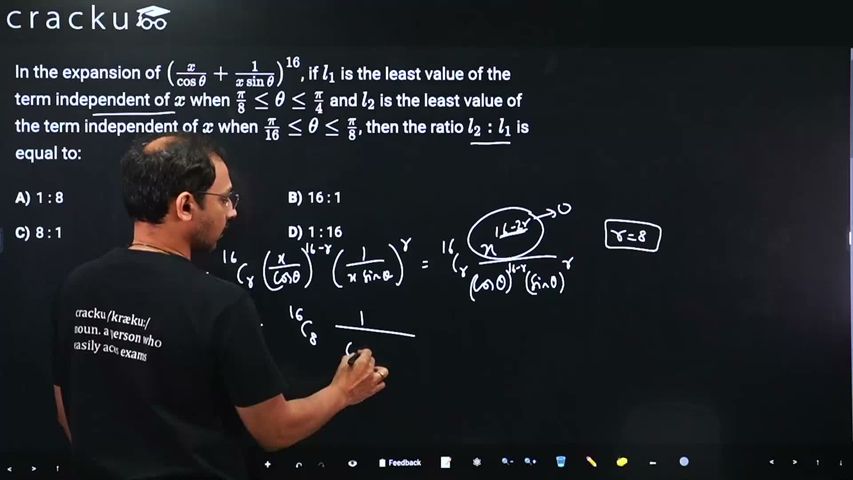
In the expansion of $$\left(\frac{x}{\cos\theta} + \frac{1}{x\sin\theta}\right)^{16}$$, if $$l_1$$ is the least value of the term independent of $$x$$ when $$\frac{\pi}{8} \le \theta \le \frac{\pi}{4}$$ and $$l_2$$ is the least value of the term independent of $$x$$ when $$\frac{\pi}{16} \le \theta \le \frac{\pi}{8}$$, then the ratio $$l_2 : l_1$$ is equal to:
We have the binomial
$$\left(\dfrac{x}{\cos\theta}+\dfrac{1}{x\sin\theta}\right)^{16}$$
and we want the term that is independent of $$x$$. For a binomial $$(a+b)^n$$ the general term is, by the binomial theorem,
$$T_r=\;{^{n}C_{r}}\;a^{\,n-r}\,b^{\,r},\qquad r=0,1,2,\ldots ,n.$$
Here $$n=16,\;a=\dfrac{x}{\cos\theta},\;b=\dfrac{1}{x\sin\theta}.$$ So the general term is
$$T_r={^{16}C_{r}}\left(\dfrac{x}{\cos\theta}\right)^{16-r} \left(\dfrac{1}{x\sin\theta}\right)^{r}.$$
Combining the powers of $$x$$:
$$T_r={^{16}C_{r}}\;x^{(16-r)}\,x^{-r}\;\cos^{-\,\!(16-r)}\!\theta\,\sin^{-\,\!r}\!\theta ={^{16}C_{r}}\;x^{\,16-2r}\;(\cos\theta)^{-(16-r)}(\sin\theta)^{-r}.$$
The term is independent of $$x$$ when the exponent of $$x$$ is zero, i.e.
$$16-2r=0\;\Longrightarrow\;r=8.$$
Hence there is a single $$x$$-free term, obtained by putting $$r=8$$:
$$T_{\text{indep}}={^{16}C_{8}} \;(\cos\theta)^{-(16-8)}(\sin\theta)^{-8} ={^{16}C_{8}}\;(\cos\theta)^{-8}(\sin\theta)^{-8} ={^{16}C_{8}}\;(\sin\theta\cos\theta)^{-8}.$$
Thus, for every allowed $$\theta,$$
$$\boxed{\,l(\theta)={^{16}C_{8}}\,[\sin\theta\cos\theta]^{-8}\,}.$$
To find the least value, we need the maximum of $$\sin\theta\cos\theta$$ in the given interval because the expression is the reciprocal of its eighth power. Using the identity
$$\sin\theta\cos\theta=\dfrac{1}{2}\sin2\theta,$$
we note that in the first quadrant $$\sin2\theta$$ (and hence $$\sin\theta\cos\theta$$) increases with $$\theta$$ until $$\theta=\dfrac{\pi}{4}.$$ Therefore:
First interval $$\dfrac{\pi}{8}\le\theta\le\dfrac{\pi}{4}:$$ The maximum occurs at the right end, $$\theta=\dfrac{\pi}{4}.$$ Then
$$\sin\dfrac{\pi}{4}=\cos\dfrac{\pi}{4}=\dfrac{\sqrt2}{2},\qquad \sin\dfrac{\pi}{4}\cos\dfrac{\pi}{4}=\dfrac12.$$
Hence
$$l_1={^{16}C_{8}}\left(\dfrac12\right)^{-8} ={^{16}C_{8}}\;2^{8} ={^{16}C_{8}}\times256.$$
Second interval $$\dfrac{\pi}{16}\le\theta\le\dfrac{\pi}{8}:$$ Again the maximum is at the right end, $$\theta=\dfrac{\pi}{8}.$$ Now
$$\sin\frac{\pi}{8}\cos\frac{\pi}{8} =\frac12\sin\frac{\pi}{4} =\frac12\cdot\frac{\sqrt2}{2} =\frac{\sqrt2}{4}.$$
Observe that $$\dfrac{\sqrt2}{4}=2^{-3/2},$$ so
$$(\sin\theta\cos\theta)^{8}=2^{-12}\quad\text{and}\quad (\sin\theta\cos\theta)^{-8}=2^{12}=4096.$$
Therefore
$$l_2={^{16}C_{8}}\times4096.$$
Finally, the required ratio is
$$\frac{l_2}{l_1} =\frac{{^{16}C_{8}}\times4096}{{^{16}C_{8}}\times256} =\frac{4096}{256} =16.$$
So $$l_2:l_1=16:1.$$
Hence, the correct answer is Option 2.
Was this solution helpful?
Click on the Email ☝️ to Watch the Video Solution
Create a FREE account and get:
_1.webp)

Educational materials for JEE preparation

Ask our AI anything

AI can make mistakes. Please verify important information.
AI can make mistakes. Please verify important information.
