
Join Our JEE Preparation Group
Prep with like-minded aspirants; Get access to free daily tests and study material.
Sign in
Please select an account to continue using cracku.in
↓ →
Join Our JEE Preparation Group
Prep with like-minded aspirants; Get access to free daily tests and study material.
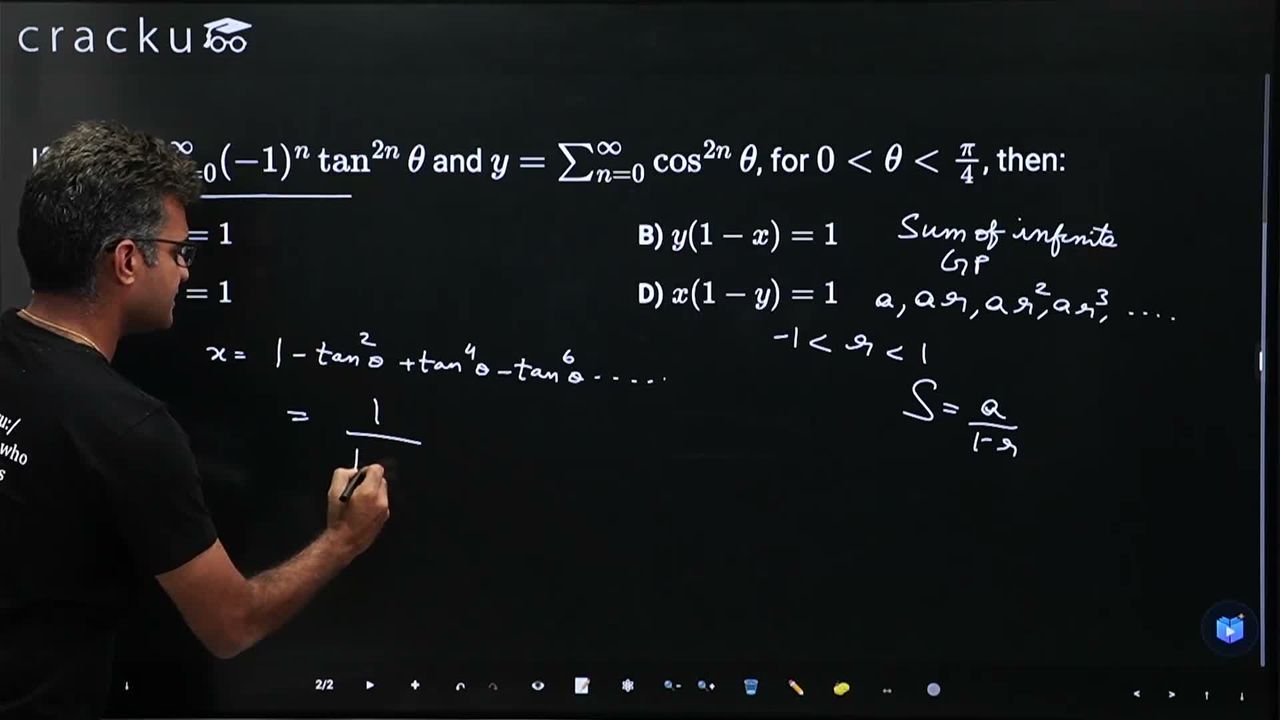
If $$x = \sum_{n=0}^{\infty} (-1)^n \tan^{2n}\theta$$ and $$y = \sum_{n=0}^{\infty} \cos^{2n}\theta$$, for $$0 < \theta < \frac{\pi}{4}$$, then:
We have been given two infinite series
$$x \;=\; \sum_{n=0}^{\infty}(-1)^n \tan^{2n}\theta \qquad\text{and}\qquad y \;=\; \sum_{n=0}^{\infty}\cos^{2n}\theta,$$ with the restriction $$0<\theta<\dfrac{\pi}{4}.$$
Because $$0<\theta<\dfrac{\pi}{4}$$ we know $$\tan\theta<1$$ and $$\cos\theta<1,$$ so $$|\,-\tan^{2}\theta\,|<1$$ and $$|\cos^{2}\theta|<1.$$ Therefore both series are convergent geometric series, and we may apply the standard infinite-geometric-series formula.
Formula used. For an infinite geometric series with first term $$a$$ and common ratio $$r$$ satisfying $$|r|<1,$$ the sum is
$$S \;=\;\dfrac{a}{1-r}\,.$$
Finding $$x$$. For the series that defines $$x$$, the first term is obtained by putting $$n=0$$:
$$a_x \;=\;(-1)^0\tan^{0}\theta \;=\;1.$$
The common ratio is the factor that multiplies one term to obtain the next. Setting $$n\mapsto n+1$$ we see
$$r_x \;=\;-\,\tan^{2}\theta.$$
Applying the formula,
$$x \;=\;\dfrac{a_x}{1-r_x} \;=\;\dfrac{1}{1-(-\tan^{2}\theta)} \;=\;\dfrac{1}{1+\tan^{2}\theta}.$$
We now invoke the well-known trigonometric identity $$1+\tan^{2}\theta=\sec^{2}\theta.$$ Substituting,
$$x \;=\;\dfrac{1}{\sec^{2}\theta} \;=\;\cos^{2}\theta.$$
Finding $$y$$. For the series that defines $$y$$, the first term is obtained by putting $$n=0$$:
$$a_y \;=\;\cos^{0}\theta \;=\;1.$$
The common ratio is
$$r_y \;=\;\cos^{2}\theta.$$
Again using the formula,
$$y \;=\;\dfrac{a_y}{1-r_y} \;=\;\dfrac{1}{1-\cos^{2}\theta}.$$
From the Pythagorean identity $$\sin^{2}\theta +\cos^{2}\theta =1$$ we have $$1-\cos^{2}\theta=\sin^{2}\theta.$$ Substituting,
$$y \;=\;\dfrac{1}{\sin^{2}\theta} \;=\;\csc^{2}\theta.$$
Evaluating the required combinations. The option that interests us most is $$y(1-x).$$ Let us compute it step by step:
$$y(1-x) \;=\;\csc^{2}\theta\bigl(1-\cos^{2}\theta\bigr).$$
But we already know $$1-\cos^{2}\theta=\sin^{2}\theta.$$ Substituting,
$$y(1-x) \;=\;\csc^{2}\theta\,\sin^{2}\theta \;=\;\dfrac{1}{\sin^{2}\theta}\,\sin^{2}\theta \;=\;1.$$
Thus we have obtained the identity
$$y(1-x)=1.$$
No other option yields the value $$1$$, so the relationship demanded by the question corresponds precisely to option B.
Hence, the correct answer is Option B.
Was this solution helpful?
Click on the Email ☝️ to Watch the Video Solution
Create a FREE account and get:
_1.webp)

Educational materials for JEE preparation

Ask our AI anything

AI can make mistakes. Please verify important information.
AI can make mistakes. Please verify important information.
