
Join Our JEE Preparation Group
Prep with like-minded aspirants; Get access to free daily tests and study material.
Sign in
Please select an account to continue using cracku.in
↓ →
Join Our JEE Preparation Group
Prep with like-minded aspirants; Get access to free daily tests and study material.
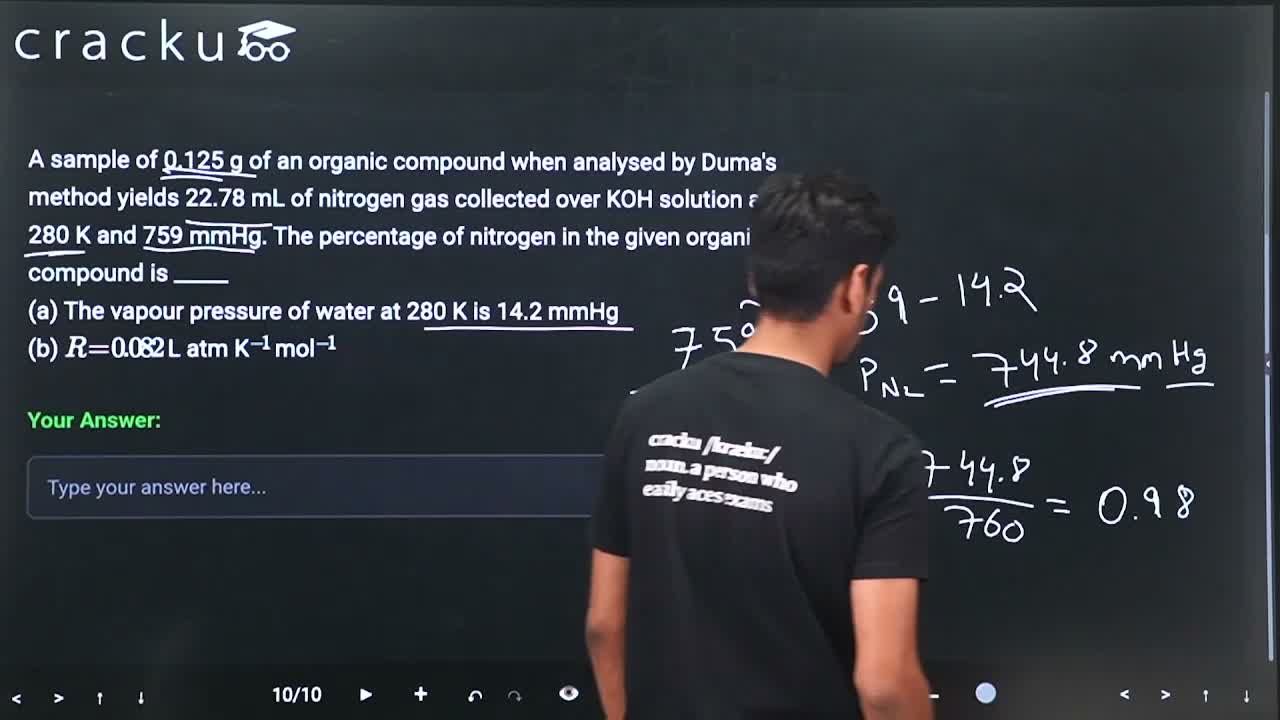
A sample of 0.125 g of an organic compound when analysed by Duma's method yields 22.78 mL of nitrogen gas collected over KOH solution at 280 K and 759 mmHg. The percentage of nitrogen in the given organic compound is _____
(a) The vapour pressure of water at 280 K is 14.2 mmHg
(b) $$R = 0.082$$ L atm K$$^{-1}$$ mol$$^{-1}$$
Correct Answer: 22
We are given a 0.125 g sample of an organic compound analyzed by Duma's method. The nitrogen gas collected over KOH solution has a volume of 22.78 mL at 280 K and 759 mmHg. The vapour pressure of water at 280 K is 14.2 mmHg. We need to find the percentage of nitrogen in the compound.
In Duma's method, the nitrogen gas is collected over KOH solution, so it is saturated with water vapour. We need to correct the pressure for water vapour to get the pressure of dry nitrogen gas.
The pressure of dry $$N_2$$ is:
$$P_{N_2} = P_{total} - P_{water} = 759 - 14.2 = 744.8 \text{ mmHg}$$
Converting to atm: $$P_{N_2} = \frac{744.8}{760} = 0.98 \text{ atm}$$
The volume of $$N_2$$ collected is $$V = 22.78 \text{ mL} = 0.02278 \text{ L}$$, and the temperature is $$T = 280 \text{ K}$$.
Using the ideal gas law $$PV = nRT$$, we find the moles of $$N_2$$:
$$n = \frac{PV}{RT} = \frac{0.98 \times 0.02278}{0.082 \times 280}$$
Calculating the numerator: $$0.98 \times 0.02278 = 0.022324$$
Calculating the denominator: $$0.082 \times 280 = 22.96$$
$$n = \frac{0.022324}{22.96} = 9.723 \times 10^{-4} \text{ mol}$$
Now, the mass of nitrogen is (since $$N_2$$ has molar mass 28 g/mol):
$$\text{Mass of } N_2 = 9.723 \times 10^{-4} \times 28 = 0.02722 \text{ g}$$
The percentage of nitrogen in the organic compound is:
$$\% N = \frac{\text{Mass of } N_2}{\text{Mass of sample}} \times 100 = \frac{0.02722}{0.125} \times 100 = 21.78\%$$
Rounding to the nearest integer, the percentage of nitrogen is approximately 22%.
Hence, the correct answer is 22.
Was this solution helpful?
Click on the Email ☝️ to Watch the Video Solution
Create a FREE account and get:
_1.webp)

Educational materials for JEE preparation

Ask our AI anything

AI can make mistakes. Please verify important information.
AI can make mistakes. Please verify important information.
