
Join Our JEE Preparation Group
Prep with like-minded aspirants; Get access to free daily tests and study material.
Sign in
Please select an account to continue using cracku.in
↓ →
Join Our JEE Preparation Group
Prep with like-minded aspirants; Get access to free daily tests and study material.
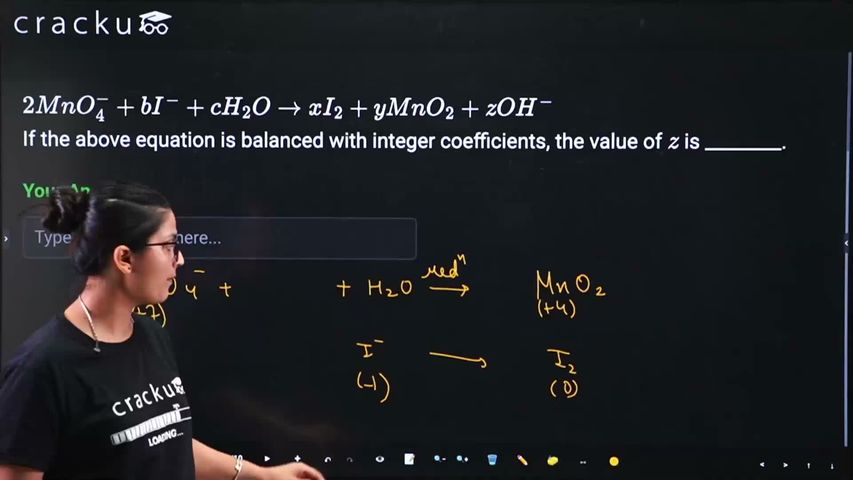
$$2MnO_4^- + bI^- + cH_2O \rightarrow xI_2 + yMnO_2 + zOH^-$$
If the above equation is balanced with integer coefficients, the value of $$z$$ is ________.
Correct Answer: 8
We need to balance the redox equation in basic medium: $$2MnO_4^- + bI^- + cH_2O \rightarrow xI_2 + yMnO_2 + zOH^-$$.
Mn in $$MnO_4^-$$ is +7 and in $$MnO_2$$ is +4, so manganese is reduced by gaining three electrons. Iodine in $$I^-$$ is -1 and in $$I_2$$ is 0, so iodine is oxidized by losing one electron.
In basic medium the half-reactions are written as follows. The reduction half-reaction is $$MnO_4^- + 2H_2O + 3e^- \rightarrow MnO_2 + 4OH^-$$ and the oxidation half-reaction is $$2I^- \rightarrow I_2 + 2e^-$$.
To equalize the electrons exchanged, multiply the reduction half-reaction by 2 and the oxidation half-reaction by 3, giving: $$2MnO_4^- + 4H_2O + 6e^- \rightarrow 2MnO_2 + 8OH^-$$ and $$6I^- \rightarrow 3I_2 + 6e^-$$.
Adding these half-reactions yields the balanced overall equation: $$2MnO_4^- + 6I^- + 4H_2O \rightarrow 3I_2 + 2MnO_2 + 8OH^-$$.
Verification confirms that manganese, iodine, oxygen, hydrogen, and charge are all balanced.
From the balanced equation: $$z = 8$$
Answer: 8
Was this solution helpful?
Click on the Email ☝️ to Watch the Video Solution
Create a FREE account and get:
_1.webp)

Educational materials for JEE preparation

Ask our AI anything

AI can make mistakes. Please verify important information.
AI can make mistakes. Please verify important information.
