
Join Our JEE Preparation Group
Prep with like-minded aspirants; Get access to free daily tests and study material.
Sign in
Please select an account to continue using cracku.in
↓ →
Join Our JEE Preparation Group
Prep with like-minded aspirants; Get access to free daily tests and study material.
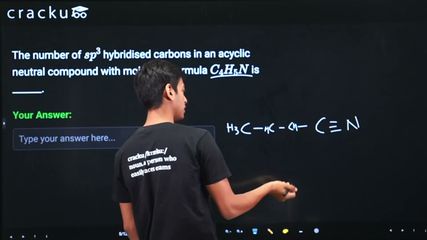
The number of $$sp^3$$ hybridised carbons in an acyclic neutral compound with molecular formula $$C_4H_5N$$ is ______.
Correct Answer: 1
We need to find the number of $$sp^3$$ hybridised carbons in an acyclic neutral compound with molecular formula $$C_4H_5N$$.
For $$C_4H_5N$$:
Degree of unsaturation = $$\dfrac{2(4) + 2 - 5 + 1}{2} = \dfrac{8 + 2 - 5 + 1}{2} = \dfrac{6}{2} = 3$$
With 3 degrees of unsaturation in an acyclic neutral compound with $$C_4H_5N$$, we need a structure with 3 degrees of unsaturation (from double bonds/triple bonds and nitrogen contribution).
A suitable structure is: $$CH_3-CH_2-C \equiv N$$ has only 3 carbons with nitrogen.
With 4 carbons: $$CH_3-CH_2-CH=CH-CN$$ would have too many hydrogens.
Let us consider: $$CH_2=CH-CH=CH-NH_2$$... checking H count: $$C_4H_7N$$ — too many H's.
With 3 degrees of unsaturation, a nitrile group ($$C \equiv N$$) accounts for 2, leaving 1 more degree of unsaturation:
$$CH_2=CH-CH_2-C \equiv N$$ (3-butenenitrile)
Checking: C = 4, H = 2+1+2 = 5, N = 1. Formula = $$C_4H_5N$$. This works!
In $$CH_2=CH-CH_2-C \equiv N$$:
- $$CH_2=$$ : $$sp^2$$ (double bond)
- $$=CH-$$ : $$sp^2$$ (double bond)
- $$-CH_2-$$ : $$sp^3$$ (single bonds only)
- $$-C \equiv N$$ : $$sp$$ (triple bond)
There is 1 $$sp^3$$ hybridised carbon.
Hence, the answer is 1.
Was this solution helpful?
Click on the Email ☝️ to Watch the Video Solution
Create a FREE account and get:
_1.webp)

Educational materials for JEE preparation

Ask our AI anything

AI can make mistakes. Please verify important information.
AI can make mistakes. Please verify important information.
