
Join Our JEE Preparation Group
Prep with like-minded aspirants; Get access to free daily tests and study material.
Sign in
Please select an account to continue using cracku.in
↓ →
Join Our JEE Preparation Group
Prep with like-minded aspirants; Get access to free daily tests and study material.
If the number of integral terms in the expansion of $$\left(3^{\frac{1}{2}} + 5^{\frac{1}{8}}\right)^n$$ is exactly 33, then the least value of $$n$$ is
We start with the binomial expansion
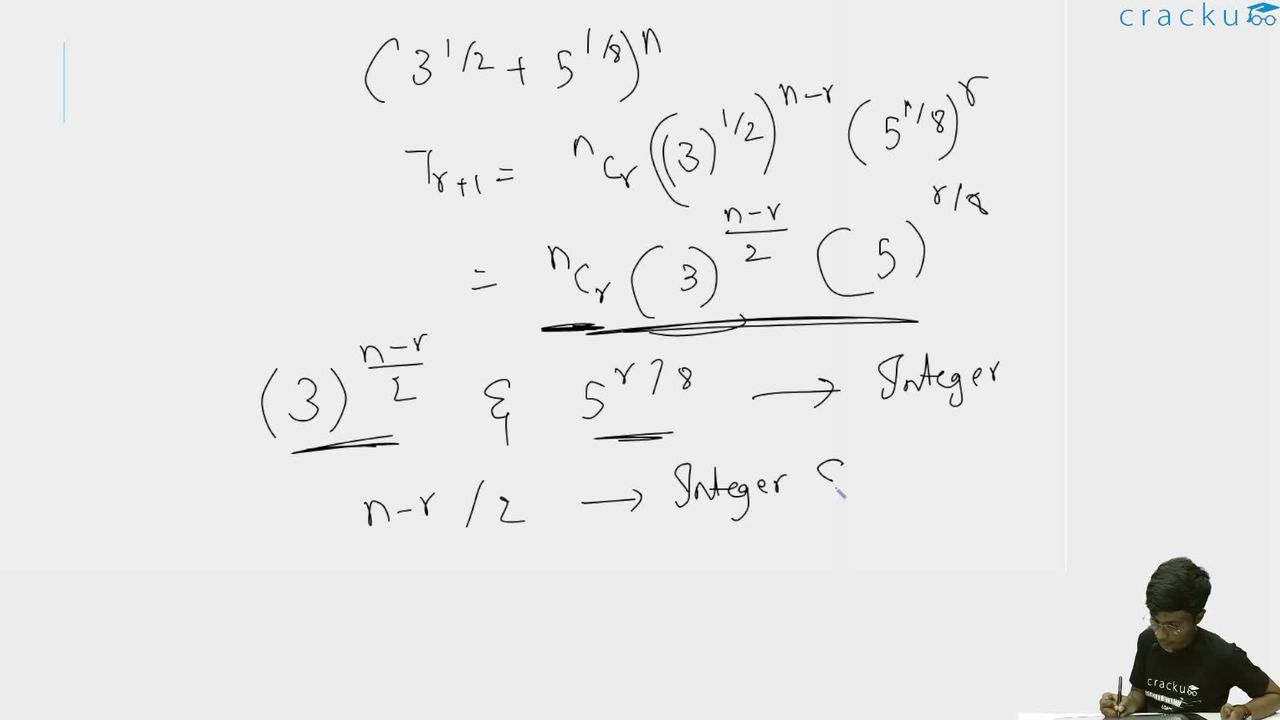
$$\left(3^{\tfrac12}+5^{\tfrac18}\right)^n=\sum_{k=0}^{n}\binom{n}{k}\left(3^{\tfrac12}\right)^{\,n-k}\left(5^{\tfrac18}\right)^{\,k}.$$
The general (k-th) term of this expansion is therefore
$$T_k=\binom{n}{k}\,3^{\tfrac{n-k}{2}}\;5^{\tfrac{k}{8}}.$$
For this term to be an integral (i.e., non-fractional) power of both 3 and 5, the exponents of 3 and 5 must be non-negative integers. So we impose two separate conditions:
1. The exponent of 3 is $$(n-k)/2,$$ which must be an integer.
2. The exponent of 5 is $$k/8,$$ which must also be an integer.
Now translate these statements into congruences:
• From $$\dfrac{k}{8}\in\mathbb Z$$ we get $$k\equiv 0\pmod{8}.$$ Hence we may write $$k=8m,$$ where $$m$$ is a non-negative integer.
• From $$\dfrac{n-k}{2}\in\mathbb Z$$ we get $$n-k\equiv 0\pmod{2}.$$ Substituting $$k=8m$$ gives $$n-8m\equiv 0\pmod{2}.$$ Because $$8m$$ is always even, this reduces to $$n\equiv 0\pmod{2},$$ so $$n$$ itself must be even.
Therefore every integer term corresponds to a non-negative integer $$m$$ satisfying $$k=8m\le n.$$ Equivalently, $$m$$ can take all integer values from $$0$$ up to
$$\left\lfloor\frac{n}{8}\right\rfloor.$$
Counting these values, we get exactly
$$\left\lfloor\frac{n}{8}\right\rfloor+1$$
integral terms in the whole expansion.
The statement of the problem tells us that the number of integral terms is $$33.$$ Hence
$$\left\lfloor\frac{n}{8}\right\rfloor+1=33.$$
Subtracting 1 from both sides gives
$$\left\lfloor\frac{n}{8}\right\rfloor=32.$$
This means that $$n/8$$ lies between $$32$$ and $$33$$, but is not equal to $$33$$. In inequality form,
$$32\le\frac{n}{8}\lt 33.$$
Multiplying through by $$8$$, we obtain
$$256\le n\lt264.$$
Because $$n$$ must be an integer, the possible values are $$256,257,258,259,260,261,262,263.$$ But we also discovered earlier that $$n$$ must be even, so the admissible set narrows down to $$256,258,260,262.$$
We are asked for the least value of $$n,$$ which is clearly $$n=256.$$
Hence, the correct answer is Option C.
Was this solution helpful?
Click on the Email ☝️ to Watch the Video Solution
Create a FREE account and get:
_1.webp)

Educational materials for JEE preparation

Ask our AI anything

AI can make mistakes. Please verify important information.
AI can make mistakes. Please verify important information.
