
Join Our JEE Preparation Group
Prep with like-minded aspirants; Get access to free daily tests and study material.
Sign in
Please select an account to continue using cracku.in
↓ →
Join Our JEE Preparation Group
Prep with like-minded aspirants; Get access to free daily tests and study material.
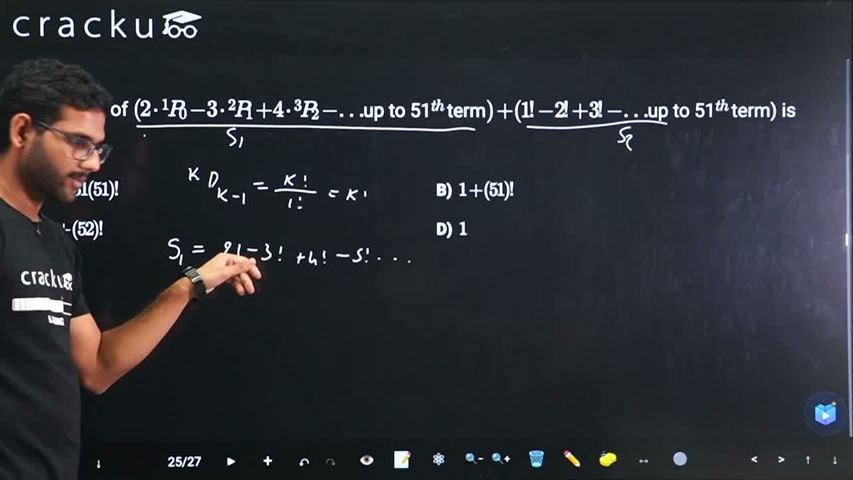
The value of $$(2 \cdot {}^1P_0 - 3 \cdot {}^2P_1 + 4 \cdot {}^3P_2 - \ldots$$ up to 51$$^{th}$$ term$$) + (1! - 2! + 3! - \ldots$$ up to 51$$^{th}$$ term) is equal to
We have to evaluate the following two alternating sums and then add them:
$$S_1 \;=\; 2\cdot {}^1P_0 \;-\; 3\cdot {}^2P_1 \;+\; 4\cdot {}^3P_2 \;-\;\ldots \text{ up to the 51}^{\text{st}}\text{ term},$$
$$S_2 \;=\; 1! \;-\; 2! \;+\; 3! \;-\;\ldots \text{ up to the 51}^{\text{st}}\text{ term}.$$
We first simplify each term of the permutation-based sum $$S_1$$.
Recall the permutation formula:
$$ {}^nP_r \;=\; \dfrac{n!}{(n-r)!}. $$
In the $$k^{\text{th}}$$ term of $$S_1$$ we observe the pattern
$$\text{coefficient} = k+1,\qquad {}^kP_{\,k-1} = \dfrac{k!}{(k-(k-1))!} = \dfrac{k!}{1!} = k!. $$
So the $$k^{\text{th}}$$ term of $$S_1$$ becomes
$$(-1)^{\,k-1}\,(k+1)\,k!,$$
because the sign alternates, starting with $$+$$ for $$k=1$$.
Now we note that $$(k+1)\,k! = (k+1)!$$. Hence
$$S_1 \;=\;\sum_{k=1}^{51} (-1)^{\,k-1}\,(k+1)!.$$
For convenience we shift the index by putting $$j = k+1$$. When $$k$$ runs from $$1$$ to $$51$$, $$j$$ runs from $$2$$ to $$52$$. Thus
$$S_1 \;=\;\sum_{j=2}^{52} (-1)^{\,j-2}\,j!.$$
Next we write the factorial sum $$S_2$$ in sigma notation:
$$S_2 \;=\;\sum_{j=1}^{51} (-1)^{\,j-1}\,j!.$$
The total expression we need is
$$V \;=\; S_1 + S_2 \;=\;\sum_{j=1}^{51} (-1)^{\,j-1}\,j! \;+\;\sum_{j=2}^{52} (-1)^{\,j-2}\,j!.$$
We now combine the two sums term by term.
1. The term with $$j=1$$
Occurs only in the first sum: $$(-1)^{\,1-1}\,1! \;=\; 1\times 1! = 1.$$
2. The terms with $$2 \le j \le 51$$
For every such $$j$$ we have two contributions:
From $$S_2$$: $$(-1)^{\,j-1}\,j!,$$
From $$S_1$$: $$(-1)^{\,j-2}\,j!.$$ Adding them gives $$j!\Bigl[\,(-1)^{\,j-1} + (-1)^{\,j-2}\Bigr] \;=\; j! \,(-1)^{\,j-2}\bigl[\,-1 + 1\bigr] = 0.$$ Thus every factorial from $$2!$$ up to $$51!$$ cancels out completely.
3. The term with $$j=52$$
Appears only in the second sum (shifted $$S_1$$) and equals
$$(-1)^{\,52-2}\,52! \;=\; (-1)^{50}\,52! \;=\; (+1)\,52! = 52!.$$
Collecting the non-zero contributions, we obtain
$$V \;=\; 1 + 52!.$$
Hence, the correct answer is Option C.
Was this solution helpful?
Click on the Email ☝️ to Watch the Video Solution
Create a FREE account and get:
_1.webp)

Educational materials for JEE preparation

Ask our AI anything

AI can make mistakes. Please verify important information.
AI can make mistakes. Please verify important information.
