
Join Our JEE Preparation Group
Prep with like-minded aspirants; Get access to free daily tests and study material.
Sign in
Please select an account to continue using cracku.in
↓ →
Join Our JEE Preparation Group
Prep with like-minded aspirants; Get access to free daily tests and study material.
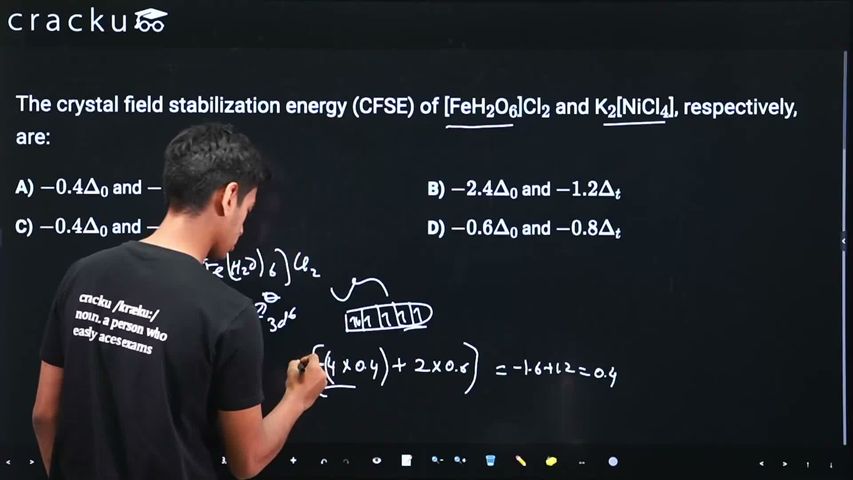
The crystal field stabilization energy (CFSE) of [FeH$$_2$$O$$_6$$]Cl$$_2$$ and K$$_2$$[NiCl$$_4$$], respectively, are:
First, we look at the octahedral complex $$[{\rm Fe(H_2O)_6}]Cl_2$$.
Because there are two chloride counter-ions, the charge on the complex ion is $$+2$$, so the metal ion is $$\text{Fe}^{2+}$$.
Electronic configuration of the neutral atom $$\text{Fe}$$ is $$[{\rm Ar}]\,3d^{6}4s^{2}$$. Removing two electrons to form $$\text{Fe}^{2+}$$ gives
$$\text{Fe}^{2+} : [{\rm Ar}]\,3d^{6}$$.
Water $$(H_2O)$$ is a weak-field ligand, so the complex is high-spin and the splitting involved is octahedral, denoted by $$\Delta_0$$.
In an octahedral field the lower set is $$t_{2g}$$ (stabilised by $$-0.4\Delta_0$$ per electron) and the upper set is $$e_g$$ (destabilised by $$+0.6\Delta_0$$ per electron).
For a high-spin $$d^6$$ ion the electrons are filled as
$$t_{2g}^{4}\;e_g^{2}$$ (four electrons in $$t_{2g}$$ and two in $$e_g$$).
Now we calculate the crystal field stabilisation energy (CFSE) using the formula just stated:
$$ {\rm CFSE}=({\rm electrons~in}~t_{2g})(-0.4\Delta_0)+({\rm electrons~in}~e_g)(+0.6\Delta_0) $$
Substituting the numbers, we obtain
$$ {\rm CFSE}=4(-0.4\Delta_0)+2(+0.6\Delta_0) =-1.6\Delta_0+1.2\Delta_0 =-0.4\Delta_0. $$
So for $$[{\rm Fe(H_2O)_6}]^{2+}$$ the CFSE is $$-0.4\Delta_0.$$ Now we turn to the tetrahedral complex $$K_2[{\rm NiCl_4}].$$
Two potassium ions give an overall charge of $$-2$$ on the complex ion, hence the metal ion is $$\text{Ni}^{2+}$$.
The ground-state configuration of neutral nickel is $$[{\rm Ar}]\,3d^{8}4s^{2}$$, so for $$\text{Ni}^{2+}$$ we have
$$\text{Ni}^{2+} : [{\rm Ar}]\,3d^{8}.$$
Chloride $$(Cl^-)$$ is also a weak-field ligand. With four ligands we obtain a tetrahedral geometry; the splitting symbol is $$\Delta_t$$.
In a tetrahedral field the lower set is $$e$$ (stabilised by $$-0.6\Delta_t$$ per electron) and the upper set is $$t_{2}$$ (destabilised by $$+0.4\Delta_t$$ per electron).
For a high-spin $$d^8$$ ion the electrons are arranged as
$$e^{4}\;t_{2}^{4}$$ (four electrons in the lower $$e$$ set and four in the higher $$t_{2}$$ set).
Applying the tetrahedral CFSE expression,
$$ {\rm CFSE}=({\rm electrons~in}~e)(-0.6\Delta_t)+({\rm electrons~in}~t_{2})(+0.4\Delta_t), $$
we substitute the numbers:
$$ {\rm CFSE}=4(-0.6\Delta_t)+4(+0.4\Delta_t) =-2.4\Delta_t+1.6\Delta_t =-0.8\Delta_t. $$
Thus, for $$[{\rm NiCl_4}]^{2-}$$ the CFSE is $$-0.8\Delta_t.$$ Collecting the two results:
$$[{\rm Fe(H_2O)_6}]Cl_2:\; -0.4\Delta_0,\qquad K_2[{\rm NiCl_4}]:\; -0.8\Delta_t.$$
Comparing with the listed options, only Option C matches these values.
Hence, the correct answer is Option C.
Was this solution helpful?
Click on the Email ☝️ to Watch the Video Solution
Create a FREE account and get:
_1.webp)

Educational materials for JEE preparation

Ask our AI anything

AI can make mistakes. Please verify important information.
AI can make mistakes. Please verify important information.
