
Join Our JEE Preparation Group
Prep with like-minded aspirants; Get access to free daily tests and study material.
Sign in
Please select an account to continue using cracku.in
↓ →
Join Our JEE Preparation Group
Prep with like-minded aspirants; Get access to free daily tests and study material.
The strength of $$50$$ volume solution of hydrogen peroxide is ______ g/L (Nearest integer).
Given: Molar mass of H$$_2$$O$$_2$$ is 34 g mol$$^{-1}$$. Molar volume of gas at STP = 22.7 L.
Correct Answer: 150
1. Understand the Chemical Equation
The decomposition of hydrogen peroxide ($$\text{H}_2\text{O}_2$$) is represented by the balanced chemical equation:
$$2\text{H}_2\text{O}_2\text{ (aq)} \rightarrow 2\text{H}_2\text{O}\text{ (l)} + \text{O}_2\text{ (g)}$$
From the stoichiometry of the reaction:
2. Define "Volume Strength"
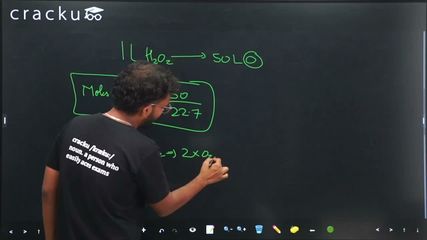
A "50 volume" solution means that $$1\text{ L}$$ of this $$\text{H}_2\text{O}_2$$ solution will liberate $$50\text{ L}$$ of $$\text{O}_2$$ gas at STP.
3. Calculate Moles of $$\text{O}_2$$ Produced
Given that the molar volume of a gas at STP is $$22.7\text{ L}$$:
$$\text{Moles of }\text{O}_2 = \frac{\text{Volume of }\text{O}_2\text{ at STP}}{\text{Molar Volume}} = \frac{50\text{ L}}{22.7\text{ L/mol}}$$
4. Calculate Moles and Mass of $$\text{H}_2\text{O}_2$$
Since 1 mole of $$\text{O}_2$$ comes from 2 moles of $$\text{H}_2\text{O}_2$$:
$$\text{Moles of }\text{H}_2\text{O}_2 = 2 \times \text{Moles of }\text{O}_2 = 2 \times \frac{50}{22.7} = \frac{100}{22.7}\text{ moles}$$
Now, we can find the mass of $$\text{H}_2\text{O}_2$$ present in that $$1\text{ L}$$ solution using its molar mass ($$34\text{ g/mol}$$):
$$\text{Mass of }\text{H}_2\text{O}_2 = \text{Moles} \times \text{Molar Mass} = \frac{100}{22.7} \times 34 = \frac{3400}{22.7}\text{ g}$$
$$\text{Mass of }\text{H}_2\text{O}_2 \approx 149.78\text{ g}$$
The strength of the solution is the mass of solute per liter of solution ($$\text{g/L}$$). Since this mass is contained in $$1\text{ L}$$:
$$\text{Strength} \approx 150\text{ g/L}$$
Was this solution helpful?
Click on the Email ☝️ to Watch the Video Solution
Create a FREE account and get:
_1.webp)

Educational materials for JEE preparation

Ask our AI anything

AI can make mistakes. Please verify important information.
AI can make mistakes. Please verify important information.
