
Join Our JEE Preparation Group
Prep with like-minded aspirants; Get access to free daily tests and study material.
Sign in
Please select an account to continue using cracku.in
↓ →
Join Our JEE Preparation Group
Prep with like-minded aspirants; Get access to free daily tests and study material.
The enthalpy change for the conversion of $$\dfrac{1}{2}$$Cl$$_2$$(g) to Cl$$^-$$(aq) is (-) ______ kJmol$$^{-1}$$ (Nearest integer)
Given: $$\Delta_{dis}H^0_{Cl_2(g)} = 240$$ kJmol$$^{-1}$$
$$\Delta_{eg}H^o_{Cl(g)} = -350$$ kJmol$$^{-1}$$
$$\Delta_{hyd}H^o_{Cl^-(g)} = -380$$ kJmol$$^{-1}$$
Correct Answer: 610
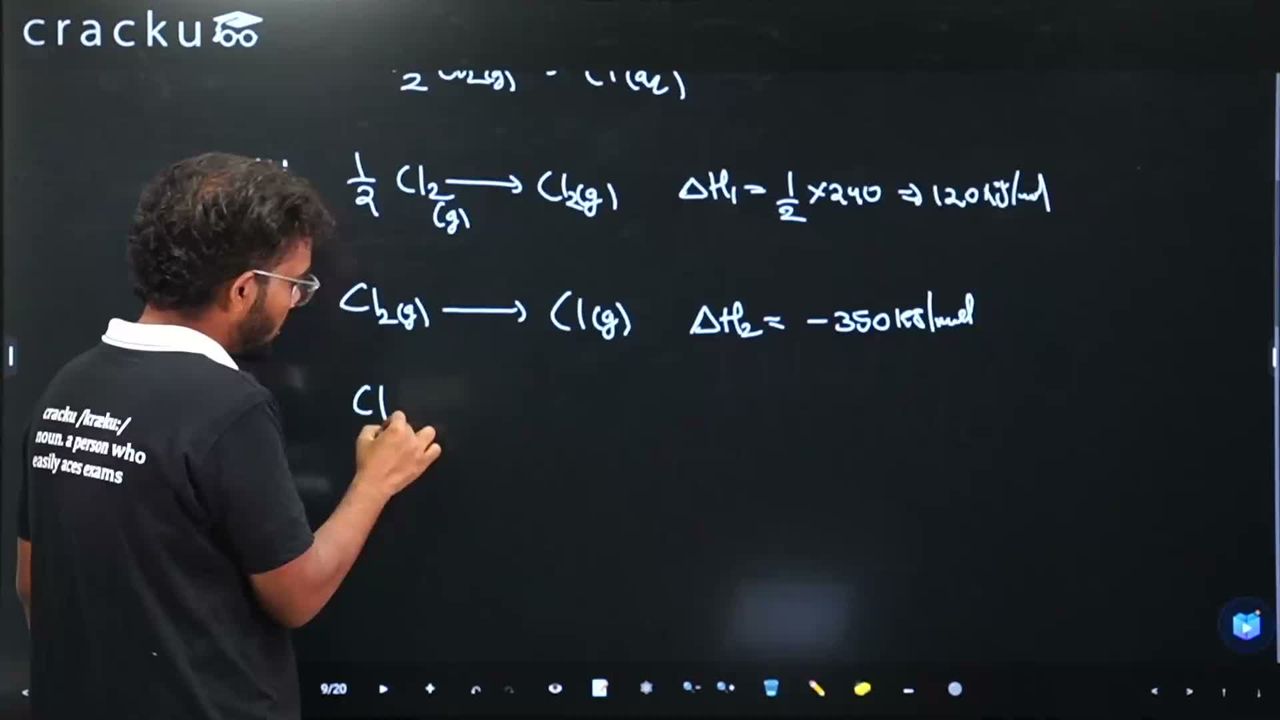
The conversion $$\frac{1}{2}Cl_2(g) \rightarrow Cl^-(aq)$$ can be broken into three steps:
First, dissociation of $$\frac{1}{2}Cl_2(g)$$ to $$Cl(g)$$:.
$$ \Delta H_1 = \frac{1}{2} \times \Delta_{dis}H^0 = \frac{1}{2} \times 240 = 120 \text{ kJ/mol} $$
Next, electron gain by $$Cl(g)$$ to form $$Cl^-(g)$$:.
$$ \Delta H_2 = \Delta_{eg}H^0 = -350 \text{ kJ/mol} $$
Now, hydration of $$Cl^-(g)$$ to form $$Cl^-(aq)$$:.
$$ \Delta H_3 = \Delta_{hyd}H^0 = -380 \text{ kJ/mol} $$
Total enthalpy change (by Hess's law):
$$ \Delta H = \Delta H_1 + \Delta H_2 + \Delta H_3 = 120 + (-350) + (-380) = -610 \text{ kJ/mol} $$
The enthalpy change is $$(-) 610$$ kJ/mol.
Was this solution helpful?
Click on the Email ☝️ to Watch the Video Solution
Create a FREE account and get:
_1.webp)

Educational materials for JEE preparation

Ask our AI anything

AI can make mistakes. Please verify important information.
AI can make mistakes. Please verify important information.
