
Join Our JEE Preparation Group
Prep with like-minded aspirants; Get access to free daily tests and study material.
Sign in
Please select an account to continue using cracku.in
↓ →
Join Our JEE Preparation Group
Prep with like-minded aspirants; Get access to free daily tests and study material.
For reaction: $$SO_2(g) + \dfrac{1}{2}O_2(g) \rightleftharpoons SO_3(g)$$ $$K_P = 2 \times 10^{12}$$ at 27°C and 1 atm pressure. The $$K_c$$ for the same reaction is ______ $$\times 10^{13}$$. (Nearest integer)
(Given $$R = 0.082$$ L atm K$$^{-1}$$ mol$$^{-1}$$)
Correct Answer: 1
For the reaction: $$SO_2(g) + \frac{1}{2}O_2(g) \rightleftharpoons SO_3(g)$$
The change in moles of gas: $$\Delta n = 1 - 1 - \frac{1}{2} = -\frac{1}{2}$$
The relation between $$K_p$$ and $$K_c$$:
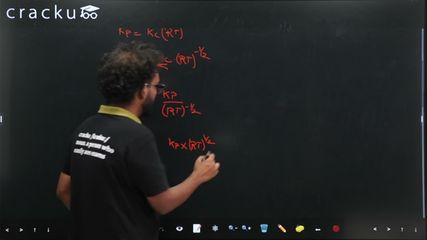
$$ K_p = K_c(RT)^{\Delta n} $$
$$ K_c = \frac{K_p}{(RT)^{\Delta n}} = K_p \times (RT)^{1/2} $$
At $$T = 27°C = 300$$ K:
$$ RT = 0.082 \times 300 = 24.6 $$
$$ K_c = 2 \times 10^{12} \times \sqrt{24.6} = 2 \times 10^{12} \times 4.96 \approx 9.92 \times 10^{12} \approx 1 \times 10^{13} $$
Therefore, $$K_c \approx 1 \times 10^{13}$$, and the value of $$x = 1$$.
Was this solution helpful?
Click on the Email ☝️ to Watch the Video Solution
Create a FREE account and get:
_1.webp)

Educational materials for JEE preparation

Ask our AI anything

AI can make mistakes. Please verify important information.
AI can make mistakes. Please verify important information.
