
Join Our JEE Preparation Group
Prep with like-minded aspirants; Get access to free daily tests and study material.
Sign in
Please select an account to continue using cracku.in
↓ →
Join Our JEE Preparation Group
Prep with like-minded aspirants; Get access to free daily tests and study material.
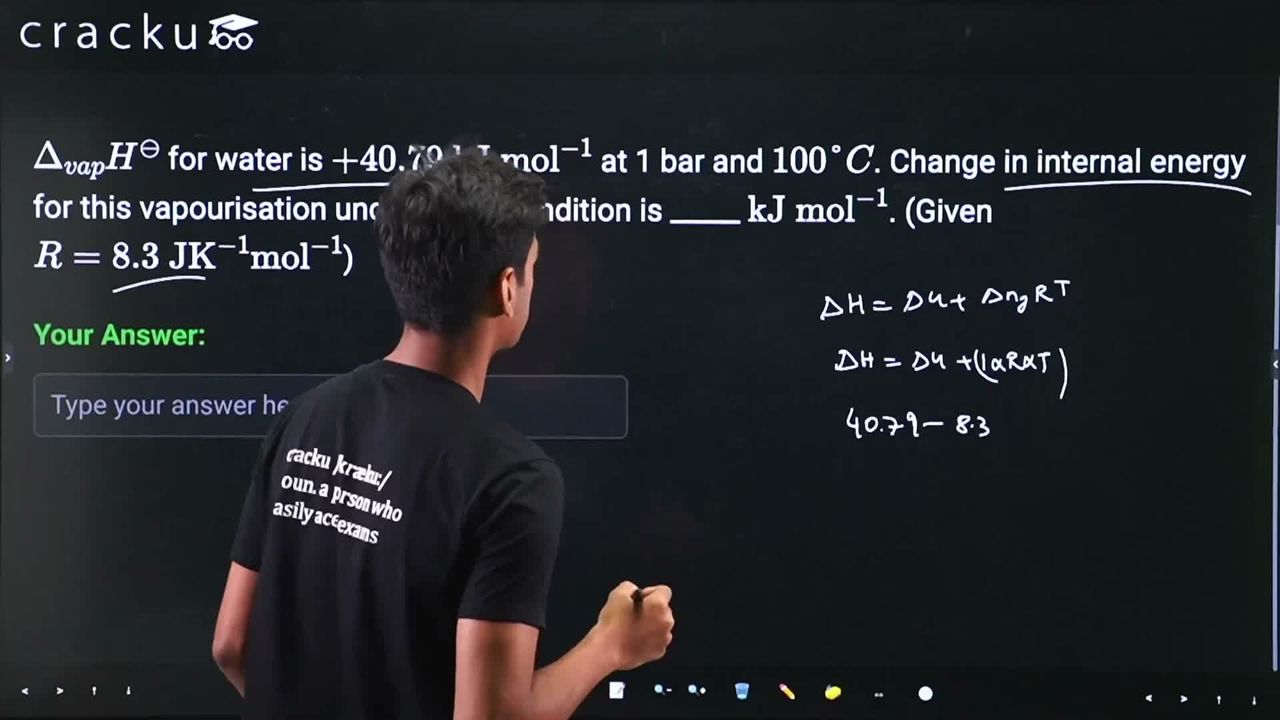
$$\Delta_{vap}H^{\ominus}$$ for water is $$+40.79 \text{ kJ mol}^{-1}$$ at 1 bar and $$100°C$$. Change in internal energy for this vapourisation under same condition is _____ $$\text{kJ mol}^{-1}$$. (Given $$R = 8.3 \text{ JK}^{-1}\text{mol}^{-1}$$)
Correct Answer: 38
We need to find the change in internal energy for the vaporisation of water at 100°C and 1 bar.
The relationship between enthalpy change and internal energy change is given by $$\Delta H = \Delta U + \Delta n_g RT$$, where $$\Delta n_g$$ is the change in number of moles of gas.
For the reaction $$H_2O(l) \rightarrow H_2O(g)$$, one mole of water vaporises from the liquid so that $$\Delta n_g = 1 - 0 = 1$$, since the liquid has negligible molar volume compared to the gas.
The standard enthalpy of vaporisation at 100°C is $$\Delta_{vap}H^{\ominus} = +40.79 \text{ kJ mol}^{-1}$$, the temperature is $$T = 100°C = 373 \text{ K}$$, and the gas constant is $$R = 8.3 \text{ J K}^{-1}\text{mol}^{-1}$$.
Substituting into the expression for internal energy change gives:
$$\Delta U = \Delta H - \Delta n_g RT$$
$$\Delta U = 40.79 - 1 \times 8.3 \times 10^{-3} \times 373$$
$$\Delta U = 40.79 - 3.0959$$
Therefore,
$$\Delta U = 40.79 - 3.10 = 37.69 \text{ kJ mol}^{-1}$$
Rounding to the nearest integer yields $$\Delta U \approx 38 \text{ kJ mol}^{-1}$$.
The answer is $$\boxed{38}$$.
Was this solution helpful?
Click on the Email ☝️ to Watch the Video Solution
Create a FREE account and get:
_1.webp)

Educational materials for JEE preparation

Ask our AI anything

AI can make mistakes. Please verify important information.
AI can make mistakes. Please verify important information.
