
Join Our JEE Preparation Group
Prep with like-minded aspirants; Get access to free daily tests and study material.
Sign in
Please select an account to continue using cracku.in
↓ →
Join Our JEE Preparation Group
Prep with like-minded aspirants; Get access to free daily tests and study material.
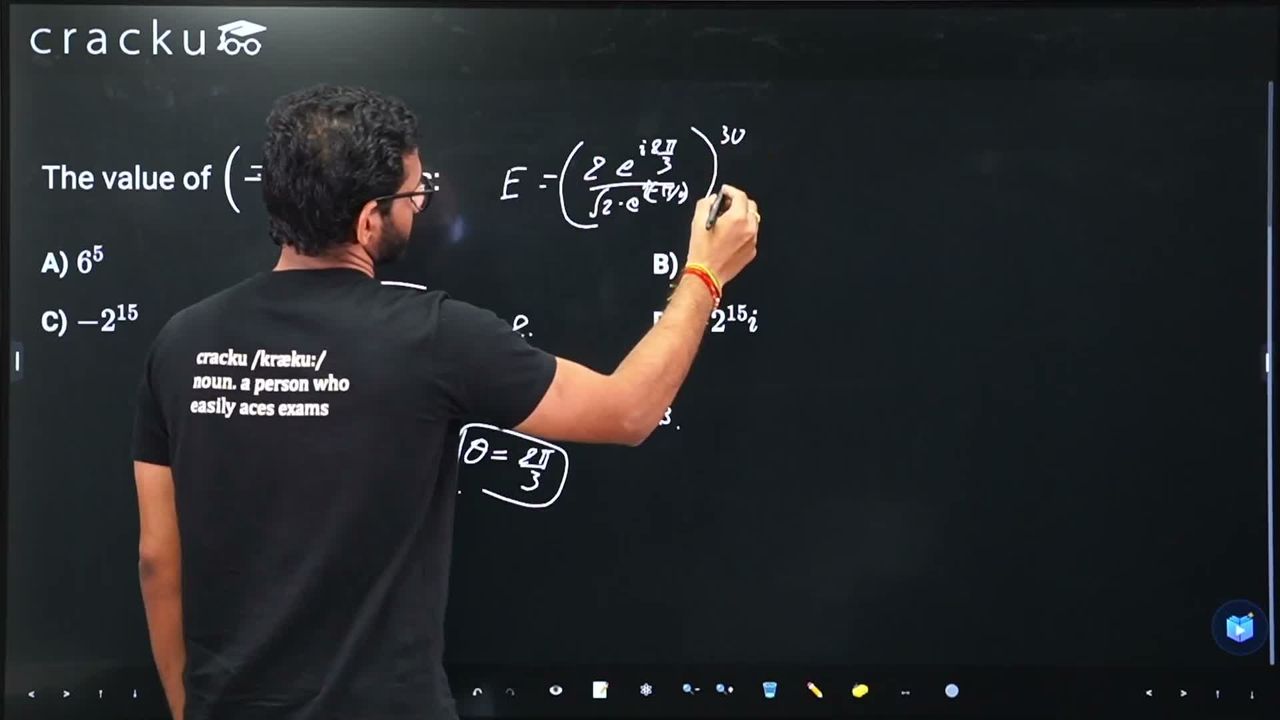
We have to evaluate the expression $$\left(\dfrac{-1+i\sqrt{3}}{1-i}\right)^{30}.$$ The most systematic way is to convert both the numerator and the denominator into polar (trigonometric) form, simplify the quotient, and finally apply De Moivre’s theorem for the 30-th power.
For any complex number $$z=a+ib$$ the modulus and the argument are given by the relations
$$r=\sqrt{a^{2}+b^{2}}, \qquad \theta=\tan^{-1}\!\left(\dfrac{b}{a}\right),$$
so that $$z=r\bigl(\cos\theta+i\sin\theta\bigr).$$
First we treat the numerator $$-1+i\sqrt{3}\,.$$
The modulus is $$\sqrt{(-1)^{2}+(\sqrt{3})^{2}}=\sqrt{1+3}=2.$$
Because the real part is negative and the imaginary part is positive, the point lies in the second quadrant. There $$\tan\theta=\dfrac{\sqrt{3}}{-1}=-\sqrt{3}\;,$$ hence $$\theta=120^{\circ}= \dfrac{2\pi}{3}.$$
Thus
$$-1+i\sqrt{3}=2\bigl(\cos\tfrac{2\pi}{3}+i\sin\tfrac{2\pi}{3}\bigr).$$
Next we examine the denominator $$1-i.$$
The modulus is $$\sqrt{1^{2}+(-1)^{2}}=\sqrt{2}.$$
Here the real part is positive and the imaginary part is negative, placing the point in the fourth quadrant. We have $$\tan\phi=\dfrac{-1}{1}=-1,$$ so $$\phi=-45^{\circ}= -\dfrac{\pi}{4}.$$ Therefore
$$1-i=\sqrt{2}\bigl(\cos(-\tfrac{\pi}{4})+i\sin(-\tfrac{\pi}{4})\bigr).$$
Now we divide the two complex numbers. Using the fact that
$$\dfrac{r_{1}(\cos\theta_{1}+i\sin\theta_{1})}{r_{2}(\cos\theta_{2}+i\sin\theta_{2})} =\dfrac{r_{1}}{r_{2}}\bigl(\cos(\theta_{1}-\theta_{2})+i\sin(\theta_{1}-\theta_{2})\bigr),$$
we find
$$\dfrac{-1+i\sqrt{3}}{1-i} =\dfrac{2}{\sqrt{2}}\Bigl(\cos\!\Bigl(\tfrac{2\pi}{3}-(-\tfrac{\pi}{4})\Bigr) +i\sin\!\Bigl(\tfrac{2\pi}{3}-(-\tfrac{\pi}{4})\Bigr)\Bigr).$$
The radial part is $$\dfrac{2}{\sqrt{2}}=\sqrt{2}.$$
The angular part is
$$\tfrac{2\pi}{3}-(-\tfrac{\pi}{4})=\tfrac{2\pi}{3}+\tfrac{\pi}{4} =\dfrac{8\pi}{12}+\dfrac{3\pi}{12} =\dfrac{11\pi}{12}.$$
Hence the quotient is
$$\sqrt{2}\bigl(\cos\tfrac{11\pi}{12}+i\sin\tfrac{11\pi}{12}\bigr).$$
We must now raise this to the 30-th power. By De Moivre’s theorem,
$$(r(\cos\theta+i\sin\theta))^{n}=r^{n}\bigl(\cos n\theta+i\sin n\theta\bigr).$$
Taking $$r=\sqrt{2}$$, $$\theta=\dfrac{11\pi}{12}$$ and $$n=30$$, we obtain
$$\Bigl(\sqrt{2}(\cos\tfrac{11\pi}{12}+i\sin\tfrac{11\pi}{12})\Bigr)^{30} =(\sqrt{2})^{30}\Bigl(\cos(30\cdot\tfrac{11\pi}{12})+i\sin(30\cdot\tfrac{11\pi}{12})\Bigr).$$
First compute the modulus:
$$(\sqrt{2})^{30}=(2^{1/2})^{30}=2^{15}.$$
Next compute the angle:
$$30\cdot\dfrac{11\pi}{12}=\dfrac{330\pi}{12}=\dfrac{55\pi}{2}.$$
Because a full revolution is $$2\pi,$$ we subtract as many $$2\pi$$ as possible:
$$\dfrac{55\pi}{2}-13\cdot 2\pi =\dfrac{55\pi}{2}-\dfrac{52\pi}{2} =\dfrac{3\pi}{2}.$$
Therefore the required power equals
$$2^{15}\bigl(\cos\tfrac{3\pi}{2}+i\sin\tfrac{3\pi}{2}\bigr).$$
We know the exact trigonometric values
$$\cos\tfrac{3\pi}{2}=0,\qquad \sin\tfrac{3\pi}{2}=-1.$$
Substituting, we get
$$2^{15}(0-i)= -\,2^{15}i.$$
Hence, the correct answer is Option D.
Was this solution helpful?
Click on the Email ☝️ to Watch the Video Solution
Create a FREE account and get:
_1.webp)

Educational materials for JEE preparation

Ask our AI anything

AI can make mistakes. Please verify important information.
AI can make mistakes. Please verify important information.
