
Join Our JEE Preparation Group
Prep with like-minded aspirants; Get access to free daily tests and study material.
Sign in
Please select an account to continue using cracku.in
↓ →
Join Our JEE Preparation Group
Prep with like-minded aspirants; Get access to free daily tests and study material.
There are 3 sections in a question paper and each section contains 5 questions. A candidate has to answer a total of 5 questions, choosing at least one question from each section. Then the number of ways, in which the candidate can choose the questions, is:
Let the three sections be labelled Section I, Section II and Section III. If we denote by $$x_1,\,x_2,\,x_3$$ the number of questions chosen from Section I, Section II and Section III respectively, then
$$x_1+x_2+x_3 = 5,$$
because a total of five questions have to be answered, and
$$x_1 \ge 1,\; x_2 \ge 1,\; x_3 \ge 1,$$
because the candidate must attempt at least one question from each section. We now list all integer triples $$\,(x_1,x_2,x_3)\,$$ that satisfy these two conditions.
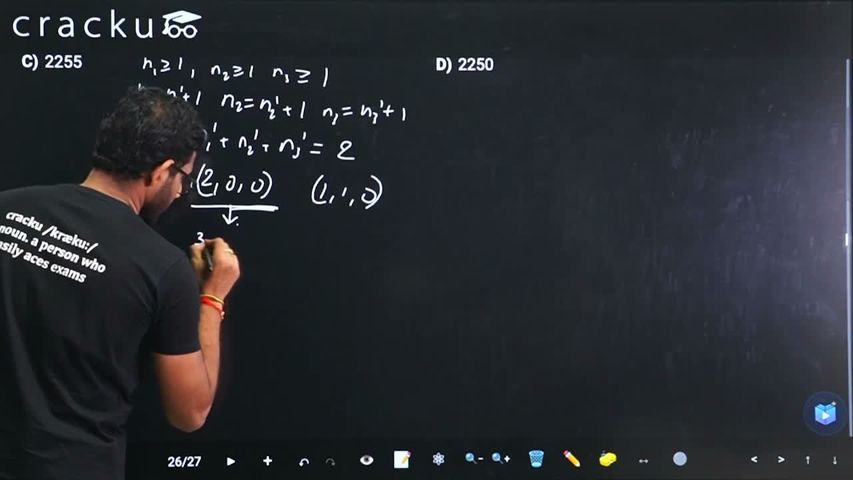
First we rewrite the condition $$x_1+x_2+x_3 = 5$$ under the restriction $$x_i \ge 1$$. If we set $$y_i = x_i-1$$ for $$i=1,2,3$$, then $$y_i \ge 0$$ and
$$y_1 + y_2 + y_3 = 5 - 3 = 2.$$
Hence we need the non-negative solutions of $$y_1 + y_2 + y_3 = 2$$. Using the stars-and-bars formula, the total number of such solutions is
$$\binom{2+3-1}{3-1} = \binom{4}{2} = 6,$$
and they are explicitly
$$$(2,0,0),\, (0,2,0),\, (0,0,2),\, (1,1,0)$$$, $$(1,0,1),\, (0,1,1).$$
Translating back by adding 1 to every component, the admissible triples $$\,(x_1,x_2,x_3)\,$$ are
$$$(3,1,1),\, (1,3,1),\, (1,1,3),\, (2,2,1)$$$, $$(2,1,2),\, (1,2,2).$$
So there are exactly two distinct types of distributions:
Type A. One section contributes 3 questions and each of the other two contributes 1 question → patterns $$\;(3,1,1)\,$$, $$\,(1,3,1)\,$$, $$\,(1,1,3).$$
Type B. Two sections contribute 2 questions each and the remaining one contributes 1 question → patterns $$\;(2,2,1)\,$$, $$\,(2,1,2)\,$$, $$\,(1,2,2).$$
We now count the actual choices of questions for every pattern.
Type A: pattern (3,1,1). From the section where 3 questions are to be chosen, the number of ways is $$\binom{5}{3}.$$ From each section where 1 question is to be chosen, the number of ways is $$\binom{5}{1}.$$ Hence, for this pattern, the number of ways is
$$$\binom{5}{3}\,\binom{5}{1}\,\binom{5}{1} = 10 \times 5 \times 5 = 250.$$$
The same count applies to each of the 3 permutations of (3,1,1), so the total for Type A is
$$3 \times 250 = 750.$$
Type B: pattern (2,2,1). Here the number of ways is
$$$\binom{5}{2}\,\binom{5}{2}\,\binom{5}{1} = 10 \times 10 \times 5 = 500.$$$
Again there are 3 permutations of (2,2,1), so the total for Type B is
$$3 \times 500 = 1500.$$
Adding the two types together, the grand total number of permissible question selections is
$$750 + 1500 = 2250.$$
Hence, the correct answer is Option D.
Was this solution helpful?
Click on the Email ☝️ to Watch the Video Solution
Create a FREE account and get:
_1.webp)

Educational materials for JEE preparation

Ask our AI anything

AI can make mistakes. Please verify important information.
AI can make mistakes. Please verify important information.
