
Join Our JEE Preparation Group
Prep with like-minded aspirants; Get access to free daily tests and study material.
Sign in
Please select an account to continue using cracku.in
↓ →
Join Our JEE Preparation Group
Prep with like-minded aspirants; Get access to free daily tests and study material.
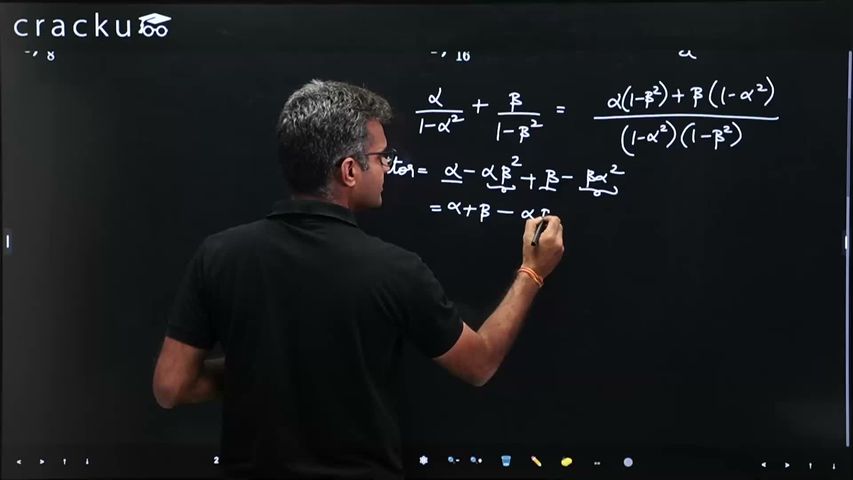
If $$\alpha$$ and $$\beta$$ are the roots of the equation, $$7x^2 - 3x - 2 = 0$$, then the value of $$\frac{\alpha}{1-\alpha^2} + \frac{\beta}{1-\beta^2}$$ is equal to:
We start with the quadratic equation $$7x^2-3x-2=0$$ whose roots are denoted by $$\alpha$$ and $$\beta$$. For any quadratic equation $$ax^2+bx+c=0$$ the standard Vieta’s relations tell us
$$\alpha+\beta=-\dfrac{b}{a}, \qquad \alpha\beta=\dfrac{c}{a}.$$
Here we have $$a=7,\; b=-3,\; c=-2,$$ so
$$\alpha+\beta=-\dfrac{-3}{7}=\dfrac{3}{7}, \qquad \alpha\beta=\dfrac{-2}{7}.$$
We are asked to find the value of
$$S=\dfrac{\alpha}{1-\alpha^2}+\dfrac{\beta}{1-\beta^2}.$$
To simplify each denominator, we use the fact that every root satisfies the original quadratic. Because $$7\alpha^2-3\alpha-2=0,$$ we can solve for $$\alpha^2$$:
$$7\alpha^2=3\alpha+2\;\; \Longrightarrow\;\; \alpha^2=\dfrac{3\alpha+2}{7}.$$
Subtracting this from 1 gives
$$1-\alpha^2=1-\dfrac{3\alpha+2}{7}=\dfrac{7-(3\alpha+2)}{7}=\dfrac{5-3\alpha}{7}.$$
Hence
$$\dfrac{\alpha}{1-\alpha^2}=\dfrac{\alpha}{\dfrac{5-3\alpha}{7}} =\dfrac{7\alpha}{5-3\alpha}.$$
Exactly the same reasoning for $$\beta$$ gives
$$\dfrac{\beta}{1-\beta^2}=\dfrac{7\beta}{5-3\beta}.$$
Therefore
$$S=\dfrac{7\alpha}{5-3\alpha}+\dfrac{7\beta}{5-3\beta} =7\left(\dfrac{\alpha}{5-3\alpha}+\dfrac{\beta}{5-3\beta}\right).$$
We now combine the two fractions inside the parentheses by taking a common denominator:
$$\dfrac{\alpha}{5-3\alpha}+\dfrac{\beta}{5-3\beta} =\dfrac{\alpha(5-3\beta)+\beta(5-3\alpha)} {(5-3\alpha)(5-3\beta)}.$$
Expanding the numerator carefully, we obtain
$$\alpha(5-3\beta)+\beta(5-3\alpha) =5\alpha-3\alpha\beta+5\beta-3\alpha\beta =5(\alpha+\beta)-6\alpha\beta.$$
The denominator multiplies out to
$$(5-3\alpha)(5-3\beta)=25-15(\alpha+\beta)+9\alpha\beta.$$
We now substitute the known values $$\alpha+\beta=\dfrac{3}{7}$$ and $$\alpha\beta=-\dfrac{2}{7}$$ into both numerator and denominator.
Numerator:
$$5(\alpha+\beta)-6\alpha\beta =5\left(\dfrac{3}{7}\right)-6\left(-\dfrac{2}{7}\right) =\dfrac{15}{7}+\dfrac{12}{7} =\dfrac{27}{7}.$$
Denominator:
$$25-15(\alpha+\beta)+9\alpha\beta =25-15\left(\dfrac{3}{7}\right)+9\left(-\dfrac{2}{7}\right) =25-\dfrac{45}{7}-\dfrac{18}{7} =25-\dfrac{63}{7} =25-9 =16.$$
So the inner fraction becomes
$$\dfrac{\dfrac{27}{7}}{16} =\dfrac{27}{7\times16}.$$
Finally we multiply by the outer factor of 7:
$$S=7\left(\dfrac{27}{7\times16}\right)=\dfrac{27}{16}.$$
Hence, the correct answer is Option D.
Was this solution helpful?
Click on the Email ☝️ to Watch the Video Solution
Create a FREE account and get:
_1.webp)

Educational materials for JEE preparation

Ask our AI anything

AI can make mistakes. Please verify important information.
AI can make mistakes. Please verify important information.
