
Join Our JEE Preparation Group
Prep with like-minded aspirants; Get access to free daily tests and study material.
Sign in
Please select an account to continue using cracku.in
↓ →
Join Our JEE Preparation Group
Prep with like-minded aspirants; Get access to free daily tests and study material.
The region represented by $$\{z = x + iy \in \mathbb{C} : |z| - \text{Re}(z) \leq 1\}$$ is also given by the inequality:
We have the given set of complex numbers written as $$\{\,z = x + iy \in \mathbb{C} : |z| - \text{Re}(z) \le 1\,\}$$.
For any complex number $$z = x + iy$$ we know two standard facts:
1. The modulus (or absolute value) is $$|z| = \sqrt{x^2 + y^2}.$$
2. The real part is $$\text{Re}(z) = x.$$
Substituting these into the given inequality, we get
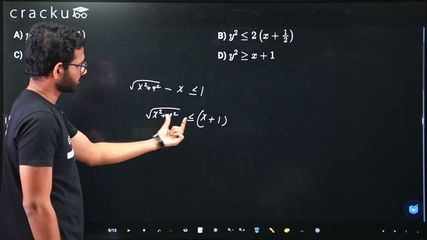
$$|z| - \text{Re}(z) \le 1 \;\;\Longrightarrow\;\; \sqrt{x^2 + y^2} - x \le 1.$$
Now we isolate the square root term by adding $$x$$ to both sides:
$$\sqrt{x^2 + y^2} \le x + 1.$$
Before squaring, we recall that squaring preserves the order of an inequality only when both sides are non-negative.
Observe that $$\sqrt{x^2 + y^2} \ge 0$$ automatically.
The right-hand side $$x + 1$$ may in principle be negative, but whenever $$x + 1 < 0$$ the right-hand side is negative while the left-hand side is non-negative, making the inequality impossible. Hence the valid region already forces $$x + 1 \ge 0,$$ so both sides are indeed non-negative and we may safely square.
Squaring both sides gives
$$x^2 + y^2 \le (x + 1)^2.$$
Expanding the binomial on the right and writing out every algebraic step:
$$x^2 + y^2 \le x^2 + 2x + 1.$$
Next we subtract $$x^2$$ from both sides:
$$y^2 \le 2x + 1.$$
Finally we rewrite the right-hand side so that the constant $$1$$ is expressed as $$2 \times \frac12$$, which allows us to factor a common $$2$$:
$$y^2 \le 2\left(x + \frac12\right).$$
This inequality exactly matches Option B.
Hence, the correct answer is Option B.
Was this solution helpful?
Click on the Email ☝️ to Watch the Video Solution
Create a FREE account and get:
_1.webp)

Educational materials for JEE preparation

Ask our AI anything

AI can make mistakes. Please verify important information.
AI can make mistakes. Please verify important information.
