
Join Our JEE Preparation Group
Prep with like-minded aspirants; Get access to free daily tests and study material.
Sign in
Please select an account to continue using cracku.in
↓ →
Join Our JEE Preparation Group
Prep with like-minded aspirants; Get access to free daily tests and study material.
If $$\alpha$$ and $$\beta$$ be two roots of the equation $$x^2 - 64x + 256 = 0$$. Then the value of $$\left(\frac{\alpha^3}{\beta^5}\right)^{1/8} + \left(\frac{\beta^3}{\alpha^5}\right)^{1/8}$$ is:
First, simplify the expression completely in terms of $$\alpha + \beta$$ and $$\alpha\beta$$, and only then substitute their values.
Given:
$$\left(\frac{\alpha^3}{\beta^5}\right)^{1/8} + \left(\frac{\beta^3}{\alpha^5}\right)^{1/8}$$
Step 1: Simplify the first term
To introduce $$\alpha\beta$$, multiply the numerator and denominator inside the fraction by $$\alpha^5$$:
$$\frac{\alpha^3}{\beta^5} = \frac{\alpha^3 \cdot \alpha^5}{\beta^5 \cdot \alpha^5} = \frac{\alpha^8}{(\alpha\beta)^5}$$
Therefore:
$$\left(\frac{\alpha^3}{\beta^5}\right)^{1/8} = \left(\frac{\alpha^8}{(\alpha\beta)^5}\right)^{1/8} = \frac{\alpha}{(\alpha\beta)^{5/8}}$$
Similarly:
$$\left(\frac{\beta^3}{\alpha^5}\right)^{1/8} = \frac{\beta}{(\alpha\beta)^{5/8}}$$
Step 2: Add the terms
The whole expression becomes:
$$\frac{\alpha}{(\alpha\beta)^{5/8}} + \frac{\beta}{(\alpha\beta)^{5/8}}$$
Combining over the common denominator:
$$= \frac{\alpha+\beta}{(\alpha\beta)^{5/8}}$$
So the simplified form in terms of sum and product is:
$$\boxed{\frac{\alpha+\beta}{(\alpha\beta)^{5/8}}}$$
Step 3: Use the quadratic equation
The roots $$\alpha, \beta$$ of the equation:
$$x^2 - 64x + 256 = 0$$
give, by Vieta's formulas:
$$\boxed{\alpha+\beta = 64}$$
and
$$\boxed{\alpha\beta = 256}$$
Substitute these values into the simplified expression:
$$\frac{\alpha+\beta}{(\alpha\beta)^{5/8}} = \frac{64}{256^{5/8}}$$
Since $256 = 2^8$:
$$256^{5/8} = (2^8)^{5/8} = 2^5 = 32$$
Hence:
$$\frac{64}{32} = \boxed{2}$$
Final Answer
$$\boxed{2}$$
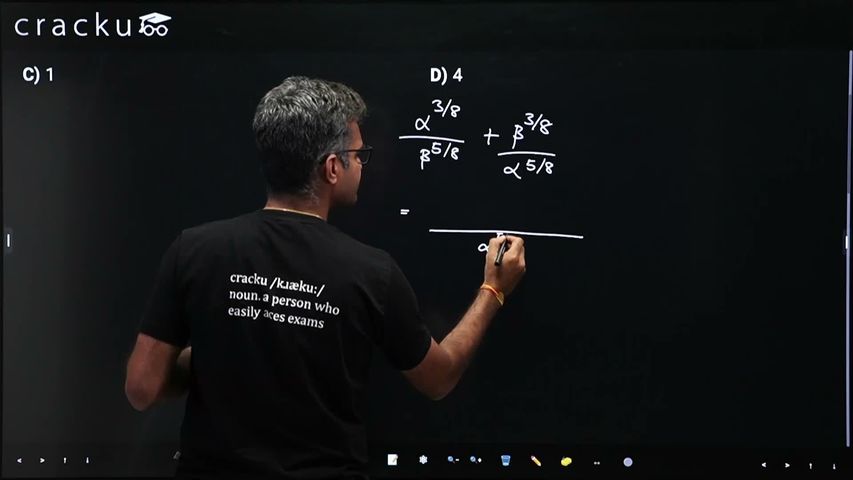
Click on the Email ☝️ to Watch the Video Solution
Create a FREE account and get:
_1.webp)

Educational materials for JEE preparation

Ask our AI anything

AI can make mistakes. Please verify important information.
AI can make mistakes. Please verify important information.


