
Join Our JEE Preparation Group
Prep with like-minded aspirants; Get access to free daily tests and study material.
Sign in
Please select an account to continue using cracku.in
↓ →
Join Our JEE Preparation Group
Prep with like-minded aspirants; Get access to free daily tests and study material.
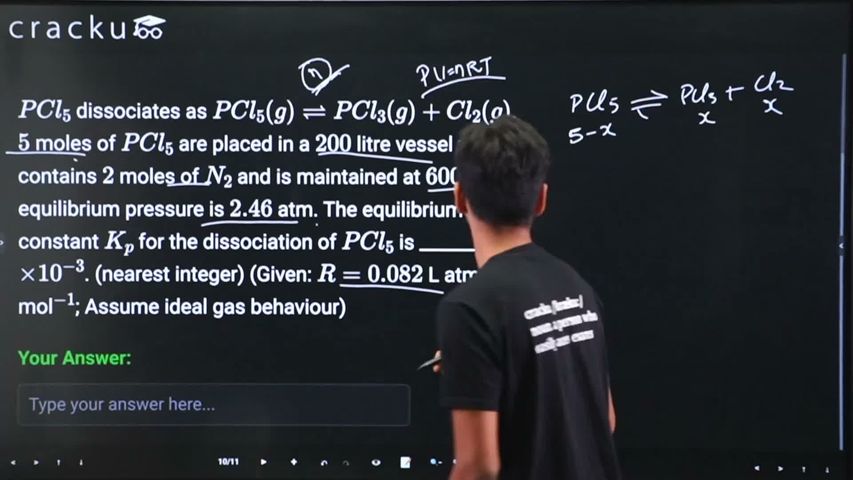
$$PCl_5$$ dissociates as $$PCl_5(g) \rightleftharpoons PCl_3(g) + Cl_2(g)$$. $$5$$ moles of $$PCl_5$$ are placed in a $$200$$ litre vessel which contains $$2$$ moles of $$N_2$$ and is maintained at $$600$$ K. The equilibrium pressure is $$2.46$$ atm. The equilibrium constant $$K_p$$ for the dissociation of $$PCl_5$$ is ______ $$\times 10^{-3}$$. (nearest integer) (Given: $$R = 0.082$$ L atm K$$^{-1}$$ mol$$^{-1}$$; Assume ideal gas behaviour)
Correct Answer: 1107
5 moles of $$PCl_5$$ and 2 moles of $$N_2$$ in a 200 L vessel at 600 K and an equilibrium pressure of 2.46 atm are considered for the dissociation reaction $$PCl_5(g) \rightleftharpoons PCl_3(g) + Cl_2(g)$$. Let $$x$$ moles of $$PCl_5$$ dissociate at equilibrium, giving $$PCl_5 = 5 - x$$ moles, $$PCl_3 = x$$ moles, $$Cl_2 = x$$ moles, while $$N_2$$ remains unchanged at 2 moles (inert gas). The total moles at equilibrium are $$(5 - x) + x + x + 2 = 7 + x$$.
Using the ideal gas law $$P_{total} = \frac{n_{total} \cdot R \cdot T}{V}$$, we write $$2.46 = \frac{(7 + x) \times 0.082 \times 600}{200}$$ which simplifies to $$2.46 = \frac{(7 + x) \times 49.2}{200}$$ and then to $$2.46 = (7 + x) \times 0.246$$, so $$7 + x = \frac{2.46}{0.246} = 10$$ and hence $$x = 3$$.
With a total of 10 moles at equilibrium, the partial pressures using mole fractions and total pressure are $$p_{PCl_5} = \frac{5 - 3}{10} \times 2.46 = \frac{2}{10} \times 2.46 = 0.492 \text{ atm}$$, $$p_{PCl_3} = \frac{3}{10} \times 2.46 = 0.738 \text{ atm}$$, and $$p_{Cl_2} = \frac{3}{10} \times 2.46 = 0.738 \text{ atm}$$.
Finally, $$K_p = \frac{p_{PCl_3} \times p_{Cl_2}}{p_{PCl_5}} = \frac{0.738 \times 0.738}{0.492} = \frac{0.544644}{0.492} = 1.107 \text{ atm}$$ and $$K_p = 1107 \times 10^{-3}$$. The answer is 1107.
Was this solution helpful?
Click on the Email ☝️ to Watch the Video Solution
Create a FREE account and get:
_1.webp)

Educational materials for JEE preparation

Ask our AI anything

AI can make mistakes. Please verify important information.
AI can make mistakes. Please verify important information.
