
Join Our JEE Preparation Group
Prep with like-minded aspirants; Get access to free daily tests and study material.
Sign in
Please select an account to continue using cracku.in
↓ →
Join Our JEE Preparation Group
Prep with like-minded aspirants; Get access to free daily tests and study material.
Let $$S$$, be the set of all real roots of the equation, $$3^x(3^x - 1) + 2 = |3^x - 1| + |3^x - 2|$$, then S
We begin by observing that the given equation involves the expression $$3^x$$ inside absolute value signs. To simplify the subsequent algebra, let us set $$y = 3^x$$. Because an exponential is always positive, we automatically have $$y > 0$$.
With this substitution, the original equation
$$3^x(3^x - 1) + 2 = |3^x - 1| + |3^x - 2|$$
becomes
$$y(y - 1) + 2 \;=\; |y - 1| + |y - 2|.$$
Now the entire problem is to solve this equation for positive real $$y$$ and then back-substitute to obtain $$x$$. Because of the absolute values, we split the analysis into intervals decided by the critical points $$1$$ and $$2$$.
Case I: $$0 < y < 1$$ (both $$y-1$$ and $$y-2$$ are negative)
For this range
$$|y - 1| = 1 - y,\qquad |y - 2| = 2 - y.$$
Substituting into the equation gives
$$y(y - 1) + 2 \;=\; (1 - y) + (2 - y).$$
The right side simplifies to $$3 - 2y$$, while the left side expands to $$y^2 - y + 2$$. Hence
$$y^2 - y + 2 = 3 - 2y.$$ $$y^2 - y + 2 - 3 + 2y = 0.$$ $$y^2 + y - 1 = 0.$$
This is a quadratic in standard form. Using the quadratic formula $$y = \dfrac{-b \pm \sqrt{b^2 - 4ac}}{2a}$$ with $$a = 1,\; b = 1,\; c = -1$$, we obtain
$$y = \frac{-1 \pm \sqrt{1 + 4}}{2} = \frac{-1 \pm \sqrt{5}}{2}.$$
Only the plus sign yields a positive value:
$$y = \frac{\sqrt5 - 1}{2}\approx 0.618.$$
Because $$0 < 0.618 < 1$$, this root indeed lies inside the assumed interval, so it is valid.
Case II: $$1 \le y < 2$$ (now $$y-1 \ge 0$$ but $$y-2<0$$)
Here
$$|y - 1| = y - 1,\qquad |y - 2| = 2 - y.$$
Substituting gives
$$y(y - 1) + 2 = (y - 1) + (2 - y) = 1.$$ $$y^2 - y + 2 = 1.$$ $$y^2 - y + 1 = 0.$$
The discriminant is $$(-1)^2 - 4(1)(1) = 1 - 4 = -3 < 0,$$ so there is no real root in this interval.
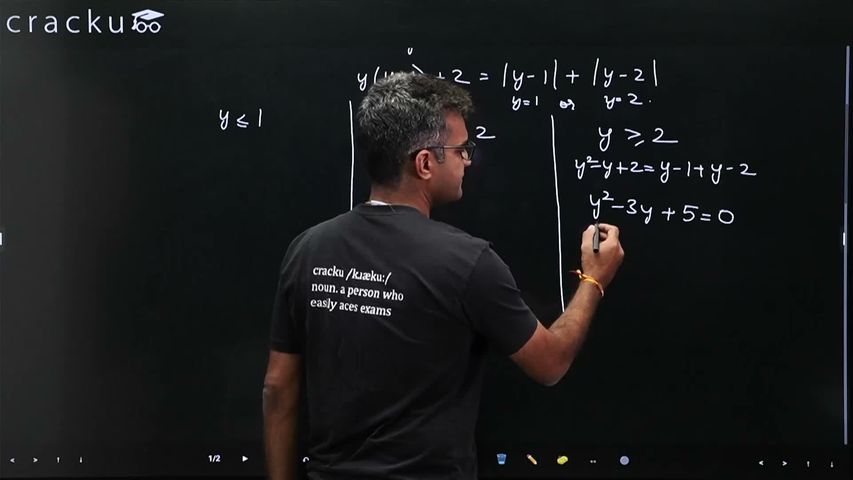
Case III: $$y \ge 2$$ (both $$y-1$$ and $$y-2$$ are non-negative)
Now
$$|y - 1| = y - 1,\qquad |y - 2| = y - 2.$$
Substituting yields
$$y(y - 1) + 2 = (y - 1) + (y - 2) = 2y - 3.$$ $$y^2 - y + 2 = 2y - 3.$$ $$y^2 - 3y + 5 = 0.$$
The discriminant is $$(-3)^2 - 4(1)(5) = 9 - 20 = -11 < 0,$$ again giving no real root.
Combining all three cases, the only positive $$y$$ that satisfies the equation is
$$y = \frac{\sqrt5 - 1}{2}.$$
Now revert to the original variable $$x$$ using $$y = 3^x$$:
$$3^x = \frac{\sqrt5 - 1}{2}.$$
Taking logarithm base 3 on both sides (or using natural logs divided by $$\ln 3$$) gives the single real solution
$$x = \log_3\!\Bigl(\tfrac{\sqrt5 - 1}{2}\Bigr).$$
Therefore the solution set $$S$$ contains exactly one real number; it is a singleton.
Hence, the correct answer is Option B.
Was this solution helpful?
Click on the Email ☝️ to Watch the Video Solution
Create a FREE account and get:
_1.webp)

Educational materials for JEE preparation

Ask our AI anything

AI can make mistakes. Please verify important information.
AI can make mistakes. Please verify important information.


